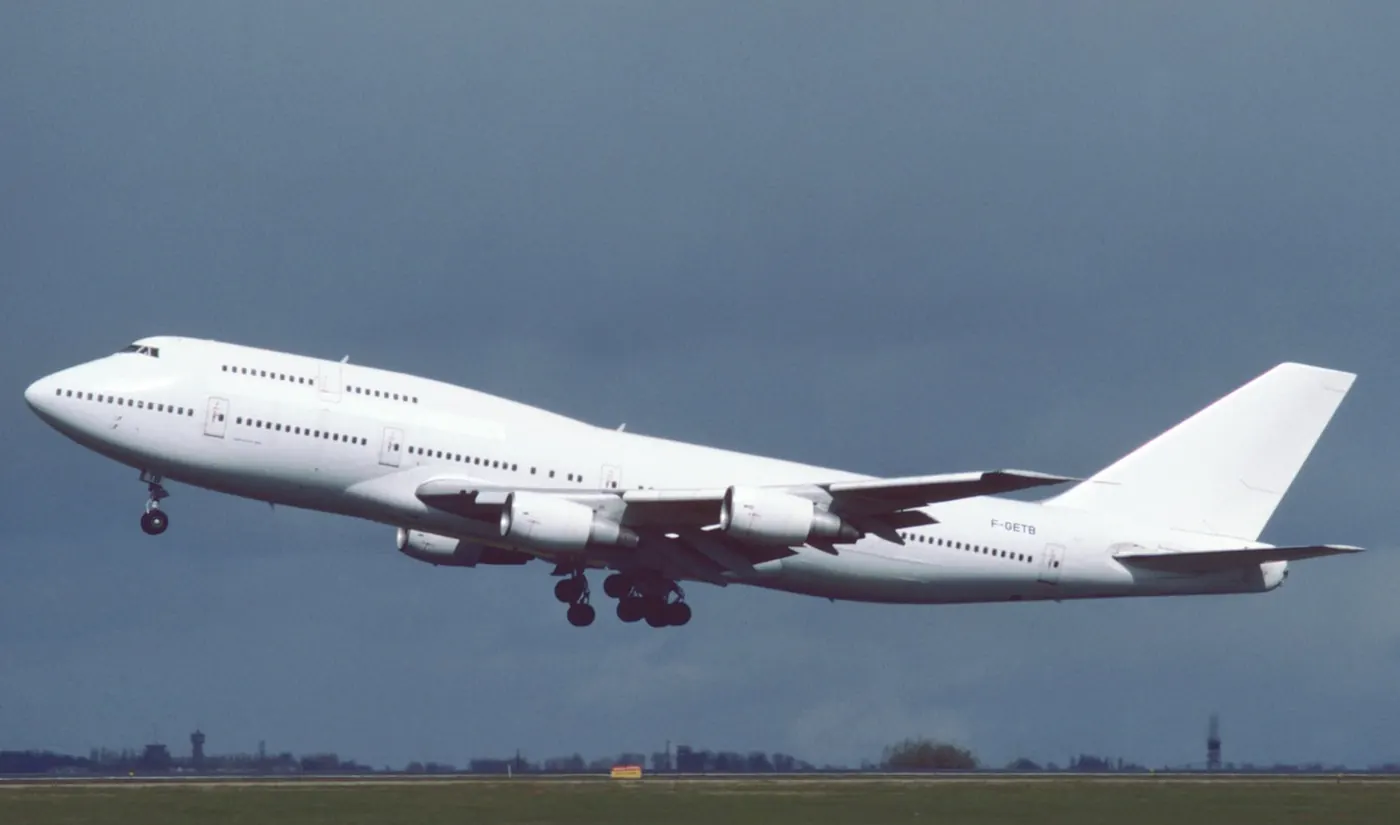
Lift can be analysed through two complementary physical frameworks:
Lift can be analysed through two complementary physical frameworks:
- The Newtonian (Momentum Change) Perspective: Focuses on the global cause and effect. Lift is the equal and opposite reaction force (Newton's Third Law) to the wing deflecting a mass of air downward.
- The Bernoulli (Pressure Differential) Perspective: Focuses on the local mechanism of the force. Lift is the integrated net force on the wing's surface resulting from a difference in air pressure between the upper and lower surfaces.
Terminology
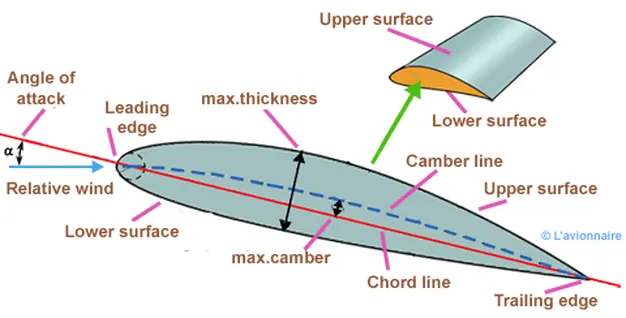
The Newtonian Perspective: Momentum and Downwash
|
The wing, due to its shape and angle of attack, interacts with the oncoming air. It doesn't simply "cut through" or "push" air aside; it continuously deflects the airflow downward. This is the action.
This deflection means the air behind the wing (the downwash) is moving downward with a significant vertical velocity component that it did not have before. In deflecting this mass of air downward every second, the wing imparts a downward rate of change of momentum to the air. By Newton's Third Law, for every action, there is an equal and opposite reaction. The reaction to this downward force on the air is an upward force on the wing: Lift. |
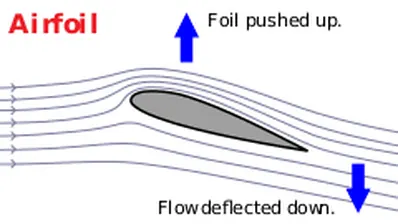 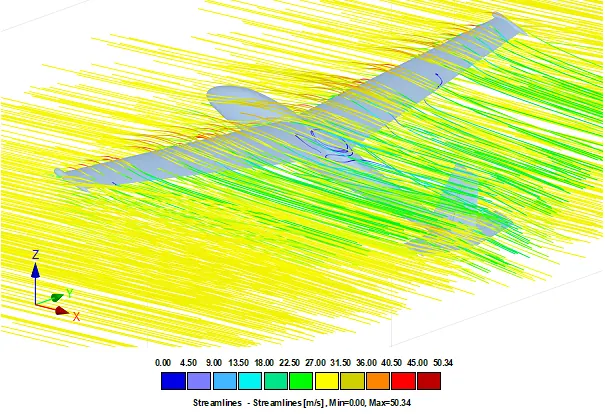 The air flow after the trailing edge has a significant downwash.
|
The Bernoulli Perspective: Pressure and Speed
If the wing is deflecting air down (Newton), how does it accomplish this? The answer is through a net pressure force. This is where Bernoulli's Principle provides insight. For a steady, incompressible, inviscid (frictionless) flow, the total mechanical energy in a fluid stream remains constant. Bernoulli's Principle is a statement of this conservation of energy:
An increase in the speed of a fluid occurs simultaneously with a decrease in its pressure or potential energy, and vice versa.
This is expressed mathematically by the Bernoulli Equation:

|
|
If height changes are negligible, then the Bernoulli equation can be simplified as:
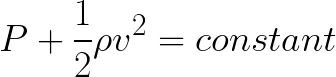
This equation tells us that static pressure (P) and dynamic pressure (½ρv²) are trade-offs, whose sum must remain unchanged.
The High static pressure at the bottom of the wing pushes towards the Low static pressure region at the top across the surface of the wing, thus creating lift.
- If the speed of the flow increases (dynamic pressure increases), the static pressure must decrease.
- If the speed of the flow decreases (dynamic pressure decreases), then the static pressure must increase.
The High static pressure at the bottom of the wing pushes towards the Low static pressure region at the top across the surface of the wing, thus creating lift.
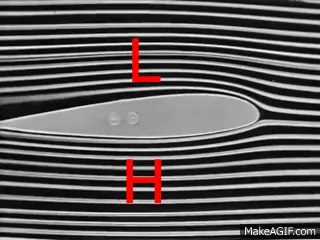 The High static pressure at the bottom pushes the wing surfaces up, known as lift.
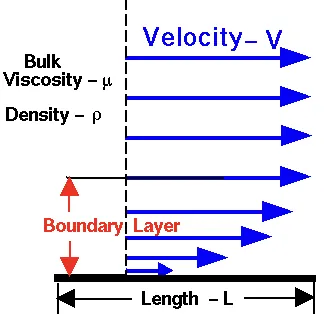 Air is slightly viscous. Thereby creating a boundary layer that has a lower air speed near the surface of the wing.
|
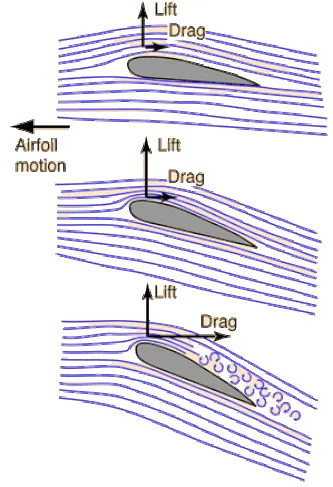 Increasing the angle of attack can increase the generate of lift up until a point. Turbulent flow dominates as angle of attack increases, it drastically increase drag and can lead to stall.
|
Addressing a Common Misconception
A common but incorrect explanation is the "Longer Path" or "Equal Transit Time" theory:
- Air molecules splitting at the leading edge are forced to meet at the trailing edge.
- Since the air over the curved top must travel a longer distance, so it must move faster.
- This higher speed results in lower pressure (via Bernoulli), creating lift.
Beyond the Basics: The Deeper Physics
So, if not the "longer path," what causes the air to accelerate over the top of the wing? The answer lies in the wing's geometry and its interaction with the air. Take a look at the following two physics concepts.
The Coandă Effect:
It is the phenomena in which a jet flow attaches itself to a nearby surface and remains attached even when the surface curves away from the initial jet direction.
It is the phenomena in which a jet flow attaches itself to a nearby surface and remains attached even when the surface curves away from the initial jet direction.
The Navier-Stokes Equations:
All these phenomena—pressure gradients, viscosity, momentum change, and circulation—are unified in the Navier-Stokes equations. These are the fundamental equations governing fluid motion. Solving them provides a complete description of lift, but they are complex and require sophisticated computer simulations (Computational Fluid Dynamics) to solve. Bernoulli's equation is a simplified, special-case solution to these equations for inviscid flow.
All these phenomena—pressure gradients, viscosity, momentum change, and circulation—are unified in the Navier-Stokes equations. These are the fundamental equations governing fluid motion. Solving them provides a complete description of lift, but they are complex and require sophisticated computer simulations (Computational Fluid Dynamics) to solve. Bernoulli's equation is a simplified, special-case solution to these equations for inviscid flow.
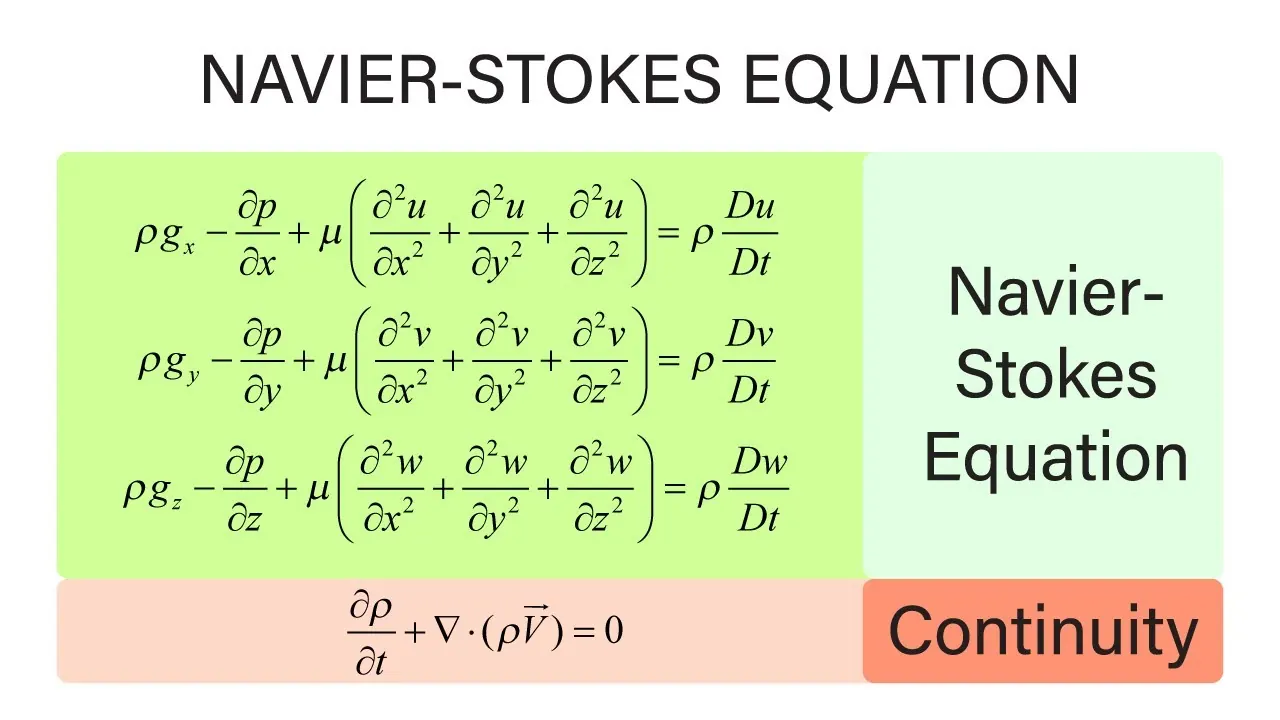 The Navier-Stokes Equations in its full glory.
|
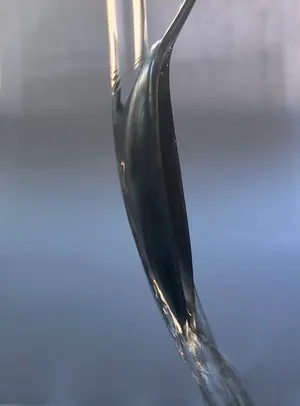 Fluid following the surface of the spoon is an example of Coanda Effect.
|
Conclusion: An Integrated Model
The curved top surface of the wing guides the air downward. Air follows the curve of the upper surface (air was sucked toward the surface), creating a low pressure zone. This lower pressure region causes the air molecules to accelerate over the top surface.
- The wing’s shape and angle create a pressure difference (low on top, high on bottom).
- This pressure difference causes the air to speed up on top and slow down on the bottom.
- This pressure difference is also what deflects the overall airflow downward, creating a downward wind behind the wing (downwash).