Introduction
From the ground to orbit, conditions change from dense, weather-filled air to an almost empty vacuum where flight relies more on speed and inertia than on wings. Temperature, pressure, and density do not just fall smoothly with height; they rise and fall in steps that reflect how the atmosphere is heated from below and by incoming solar radiation.
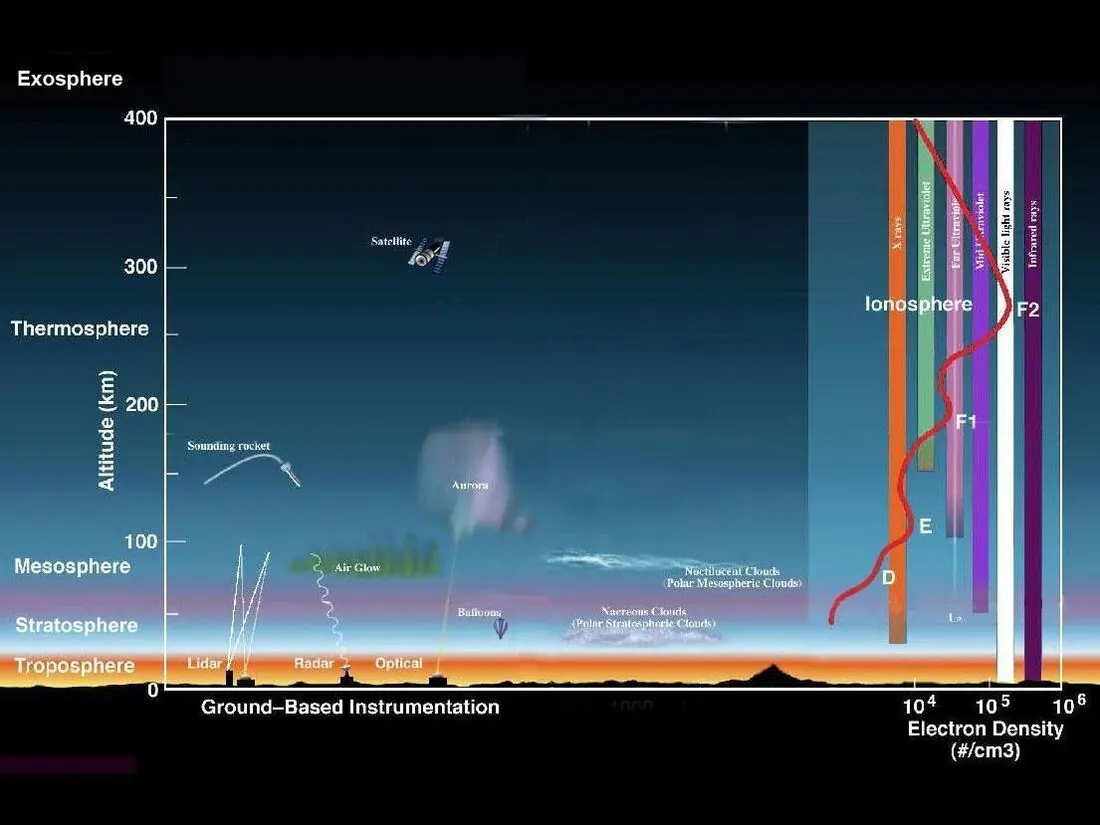
Part 1: Lower atmosphere and weather
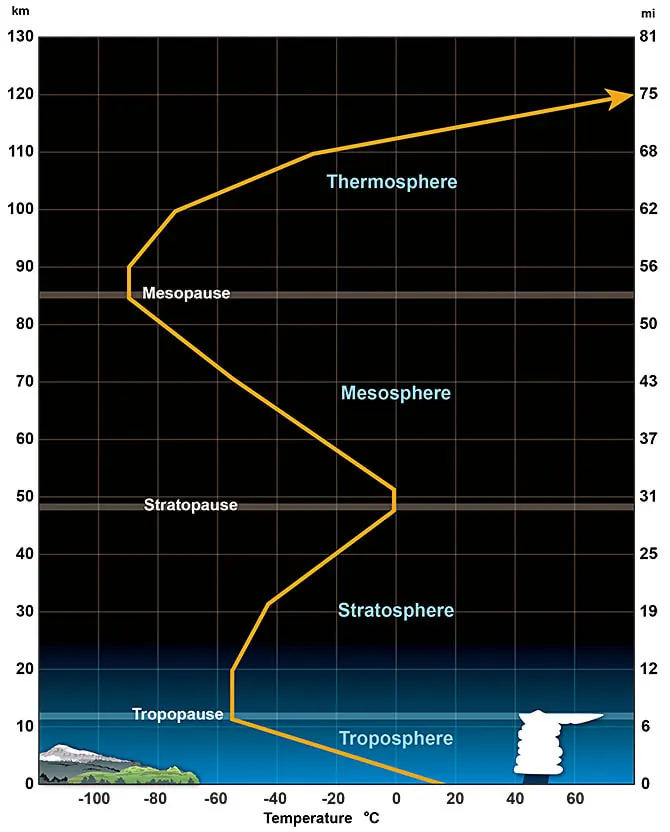
TroposphereThe troposphere extends from the surface up to about 8–15 km and contains most of the air, water vapour, clouds, and almost all weather. Sunlight passes largely unabsorbed through the air, warms the ground, and the surface then re‑emits infrared radiation, which is absorbed by greenhouse gases such as water vapour, carbon dioxide, and methane, so the air is mainly heated from below.
As a result, temperature generally decreases with height in this layer, and rising warm air drives convection, cloud formation, and storms; commercial jets cruise near the top of the troposphere to stay above most clouds, in thinner air with less drag but still enough density for lift. StratosphereAbove the troposphere lies the stratosphere, reaching to around 50 km and containing the ozone layer. Ozone (O₃) absorbs ultraviolet radiation from the Sun and converts it into heat, so temperature increases with height here, creating a thermally stable “lid” over the troposphere because cold air below has no buoyant drive to rise into warmer air above.
This stability explains why weather systems remain confined below the tropopause and why volcanic ash that reaches the stratosphere can spread globally and persist, rather than quickly raining out like tropospheric clouds. |
 |
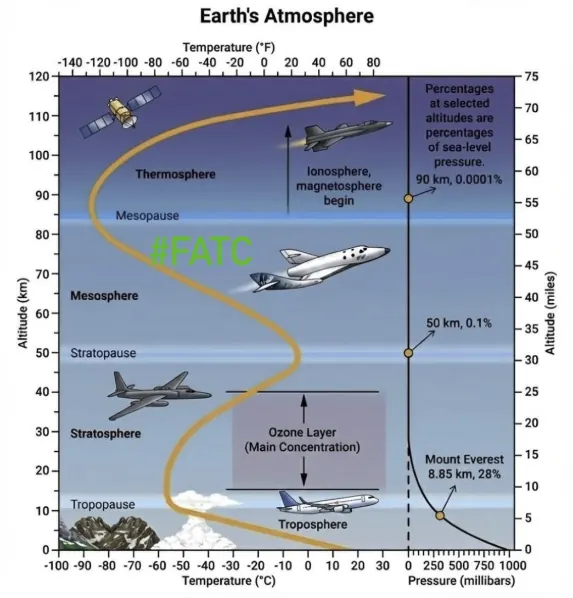
High-altitude and supersonic flightAs aircraft climb into the upper troposphere and lower stratosphere, air density and pressure drop, reducing both lift and engine thrust.
To remain aloft at still higher altitudes, a plane must fly faster to drive enough air over its wings, which is why very high‑flying craft like the U‑2 or the retired Concorde operated at high subsonic or supersonic speeds near the top of the troposphere and bottom of the stratosphere. At supersonic and hypersonic speeds, strong shock waves form around the vehicle, increasing drag and causing aerodynamic heating of the nose, leading edges, and skin, so designers adopt special shapes, materials, and cooling paths to manage both low density (for lift and control) and thermal regulation. |
 |
Part 2: Upper atmosphere and weather
MesosphereThe mesosphere, roughly 50–85 km above Earth, is a colder region where temperature again decreases with altitude and the air is very thin but still dense enough to matter. As Earth moves through space, small particles entering at high speeds collide with this thin air, heating it and producing the glowing trails seen as meteor showers, so the mesosphere can be associated with “shooting stars.”
Thermosphere
In the thermosphere, sparse gas molecules absorb high‑energy ultraviolet and X‑ray radiation, raising their kinetic energies so that calculated temperatures can reach thousands of degrees, even though the gas is so thin that it would not feel hot because very few particles collide with an object.
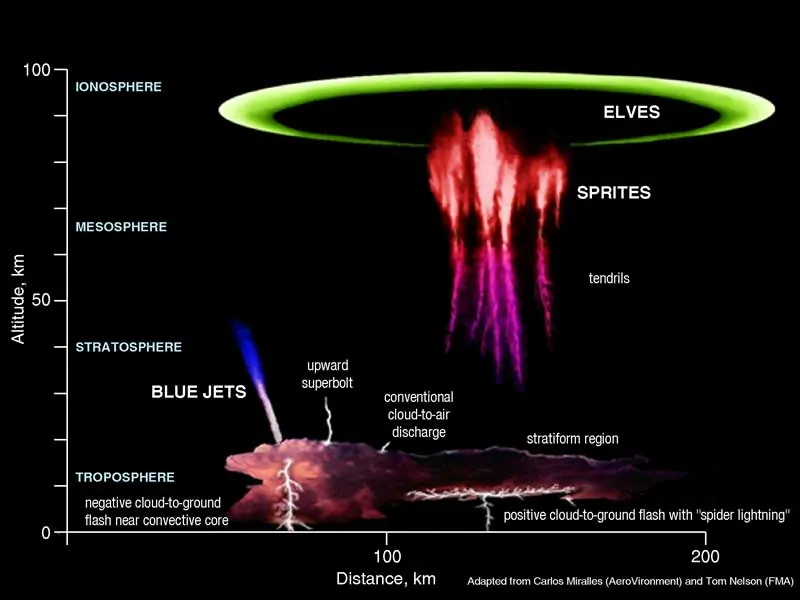
This is also where auroras occur: charged particles from the solar wind strike oxygen and nitrogen, excite their electrons, and produce shimmering curtains of visible light as the electrons return to lower energy states. Transient luminous eventsHigh above in the thin air of the upper atmosphere, brief flashes called transient luminous events create a kind of “upward lightning”. Red sprites appear 50–90 km above storm tops as branching, jellyfish-shaped glows triggered by strong lightning strokes below, while blue jets shoot narrow cones of blue light upward from the cloud tops to about 40–50 km. Even higher, at around 100 km, elves form enormous, expanding red rings in the lower ionosphere that last less than a thousandth of a second, marking where an electromagnetic pulse from a lightning strike has disturbed the upper atmosphere. Together, these events show that thunderstorms can briefly connect the weather layer to near-space, and they give satellites and astronauts a direct way to watch electrical activity reaching into the edge of the thermosphere.
 |
 |
The Kármán line and near-space
|
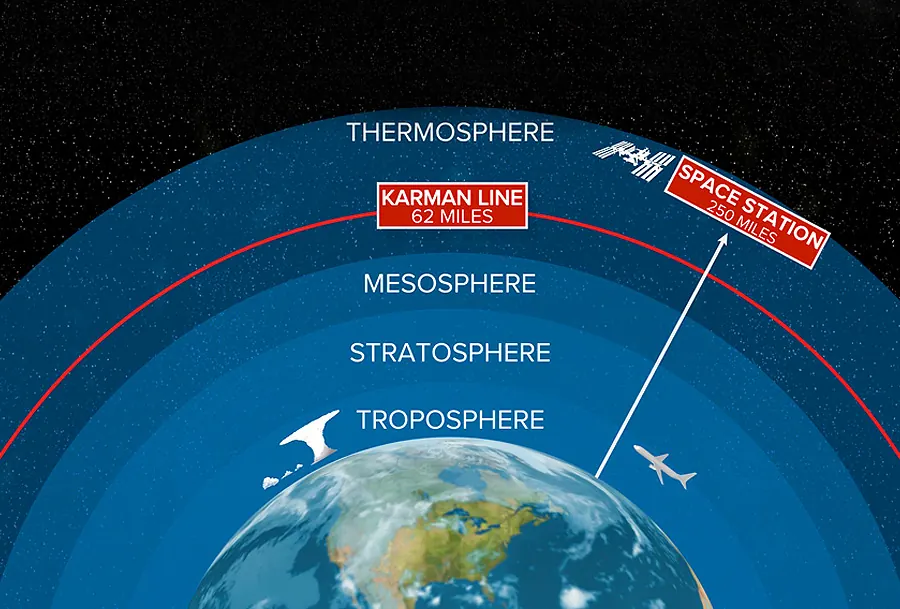
The Kármán line, at about 100 km altitude, is often used as a conventional boundary between the atmosphere and outer space. Around this height, the air is too thin for conventional wings to produce enough lift at ordinary aircraft speeds, so sustained flight would require speeds close to orbital velocity, and the sky becomes dark even at noon because the air no longer scatters enough blue light.
Vehicles crossing this line on suborbital flights are still moving through a layer of Earth’s atmosphere, not an empty vacuum. |
 |
Exosphere
Higher still, in the exosphere, the density of atmospheric particles gradually blends into the density of interplanetary space, making it hard to draw a sharp physical boundary between “atmosphere” and “space.”
From flight to orbit
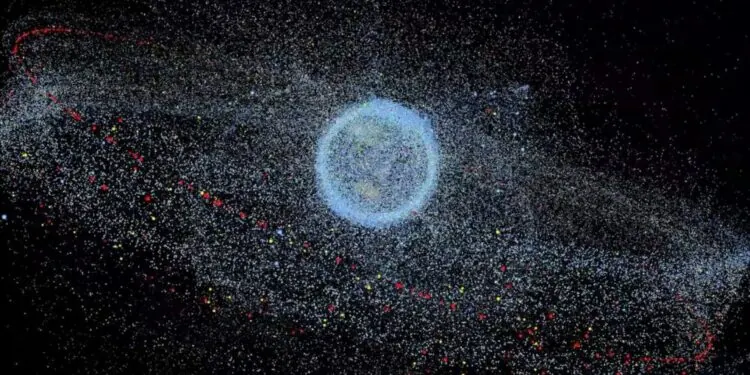
In low Earth orbit, satellites move fast enough sideways that, as gravity pulls them inward, Earth’s surface curves away beneath them, so they continually fall around the planet rather than back to the ground. For a circular orbit a few hundred kilometres above Earth, orbital speed is around 7.8 km/s, far above atmospheric aircraft speeds, and the environment is close to vacuum, though still dense enough in the upper thermosphere that large structures like the International Space Station experience drag and need periodic “reboosts” to maintain altitude. This progression—from heated, turbulent troposphere to stratified middle layers to thin, high‑energy upper layers—connects the vertical structure of the atmosphere with both high‑altitude flight and the basic ideas of orbital mechanics and near‑Earth space.
Activity: The "Atmospheric Ascent" AI Remix

To use AI to produce a track that correctly describes the changing conditions (temperature, pressure, and phenomena) from the Troposphere to the Exosphere.
1. The Mission
|
You are a Pilot or an Astronaut. Your song must act as a "Flight Manual" for someone ascending through the layers of the atmosphere. To pass the mission, your lyrics must accurately describe the "steps" of the atmosphere.
|
 |
2. Your "Atmospheric Fact Bricks"
Choose three layers to focus on for your song. You must include the specific facts for each:
- Brick A (Troposphere): Heated from below by IR; temperature drops as you go up; weather and convection happen here.
- Brick B (Stratosphere): The Ozone layer absorbs UV; temperature actually increases with height; it’s a stable "lid" with no weather.
- Brick C (Mesosphere): The coldest layer; thin air but enough to burn up meteors (shooting stars).
- Brick D (Thermosphere): High-energy X-rays and UV make it "hot" but sparse; home to the Auroras and the International Space Station (ISS).
- Brick E (The Kármán Line): At 100 km; the boundary where wings fail and you need orbital velocity to stay up.
3. Step-by-Step Instructions
 Click on image to proceed
|
Step A: Drafting the "Flight Log" (Lyrics) Use an AI chatbot (Gemini) to draft your lyrics. Use this prompt:
"I am an astronaut flying from Earth to space. Write lyrics for a [Insert Genre] song. Include these layers: [Insert your 3 chosen Bricks]. Describe how the temperature changes in each and one special event that happens there (like Auroras or Meteors)." Step B: The "Physics Audit" Check your lyrics! AI often gets the temperature "zigzag" wrong.
|
|
Step C: Production on Music GPT
 Click on image to proceed
|
 |