Introduction
Telescopes are engineered systems that collect light and form images more effectively than the human eye. In astronomy, the choice of optical design and mount directly affects how much detail can be seen (resolution), how wide a field can be observed (field of view), and how easily objects can be tracked as Earth rotates. This chapter surveys common optical layouts, identifies the main mechanical and optical parts of a telescope, and explains how different mount types control motion and stability.
Optical Telescope Types
Refracting telescopes use lenses (as the primary light‑collecting element).
|
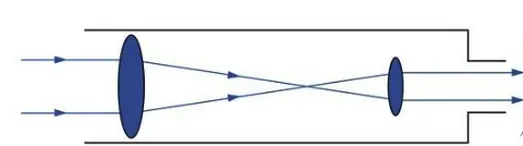
A Keplerian refractor uses a convex objective and a convex eyepiece, forming a real focus inside the tube and giving an inverted image. Small achromatic refractors (about 70–120 mm) are mechanically simple, give high‑contrast views of the Moon and planets, but show some chromatic aberration at fast focal ratios and become heavy and expensive at larger apertures.
 |
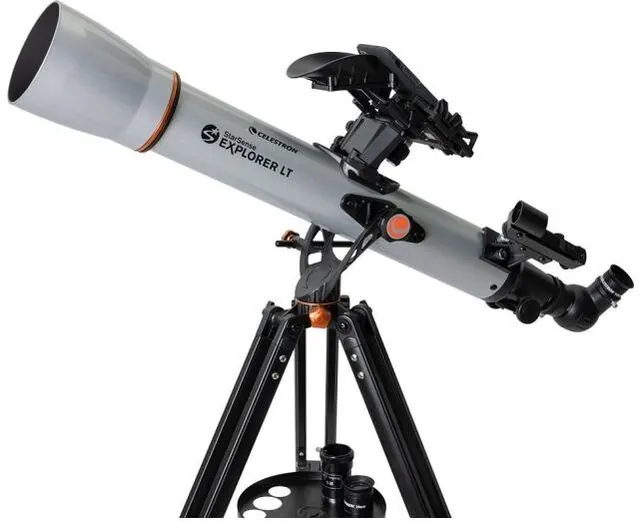 Typical complete beginner instruments cost roughly US$150–600 depending on aperture and mount.
|
|
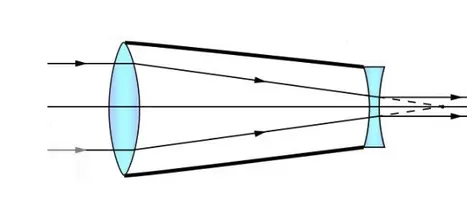
A Galilean refractor combines a convex objective with a concave eyepiece, so the light does not form a real focus and the image is upright but has a narrow field and more edge aberrations. This design appears mainly in low‑power spotting scopes and opera glasses rather than serious astronomical telescopes.
 |
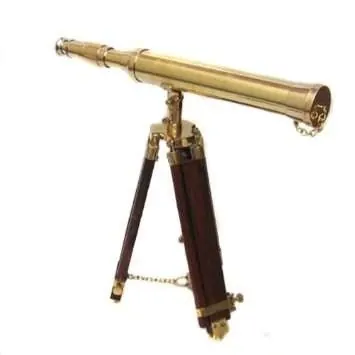 Small Galilean instruments are relatively inexpensive (around US$20–100), but astronomy‑grade versions are uncommon.
|
Reflecting telescopes use mirrors (as the primary light‑collecting element).
|
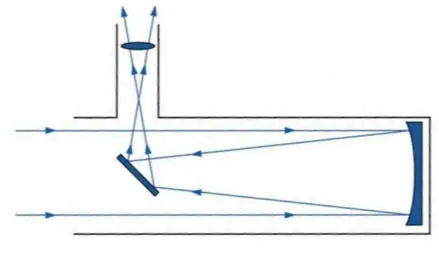
A Newtonian reflector uses a concave primary mirror and a flat secondary at 45° to send the focused beam out the side of the tube. Mirrors avoid chromatic aberration and can be made larger at lower cost, so 130–250 mm Newtonians offer strong light‑gathering power for faint nebulae and galaxies, although fast designs show coma off‑axis and central obstruction slightly reduces contrast.
 |
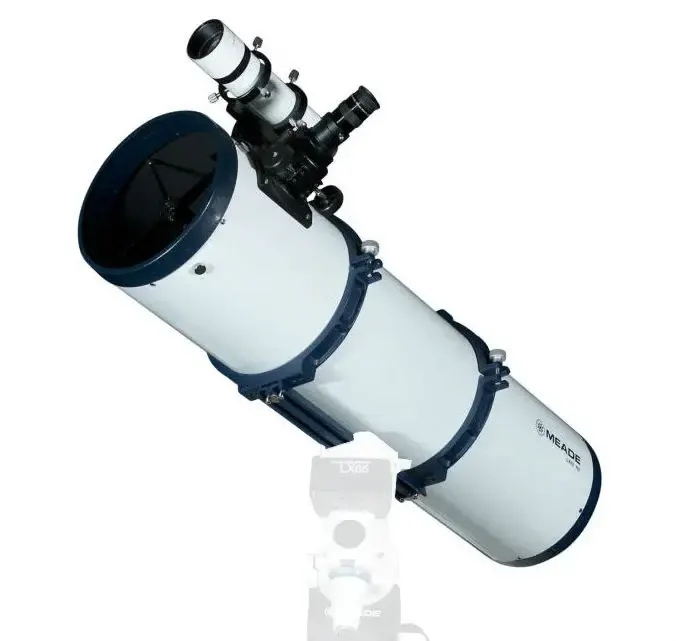 Typical complete systems on Dobsonian or simple equatorial mounts lie roughly in the US$250–800 range.
|
|
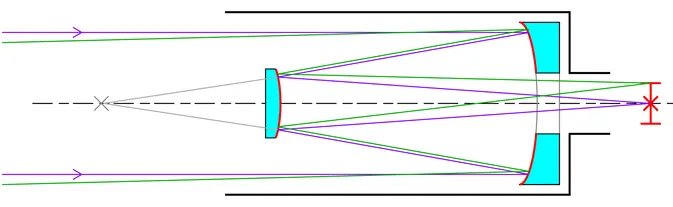
In a Cassegrain Reflector, a concave primary and convex secondary mirror fold the light path back through a hole in the primary, giving a long effective focal length in a short tube. This layout favours higher magnification and narrower fields, useful for planetary and small‑field imaging, but pure Cassegrain designs are less common at school level than their catadioptric relatives.
 |
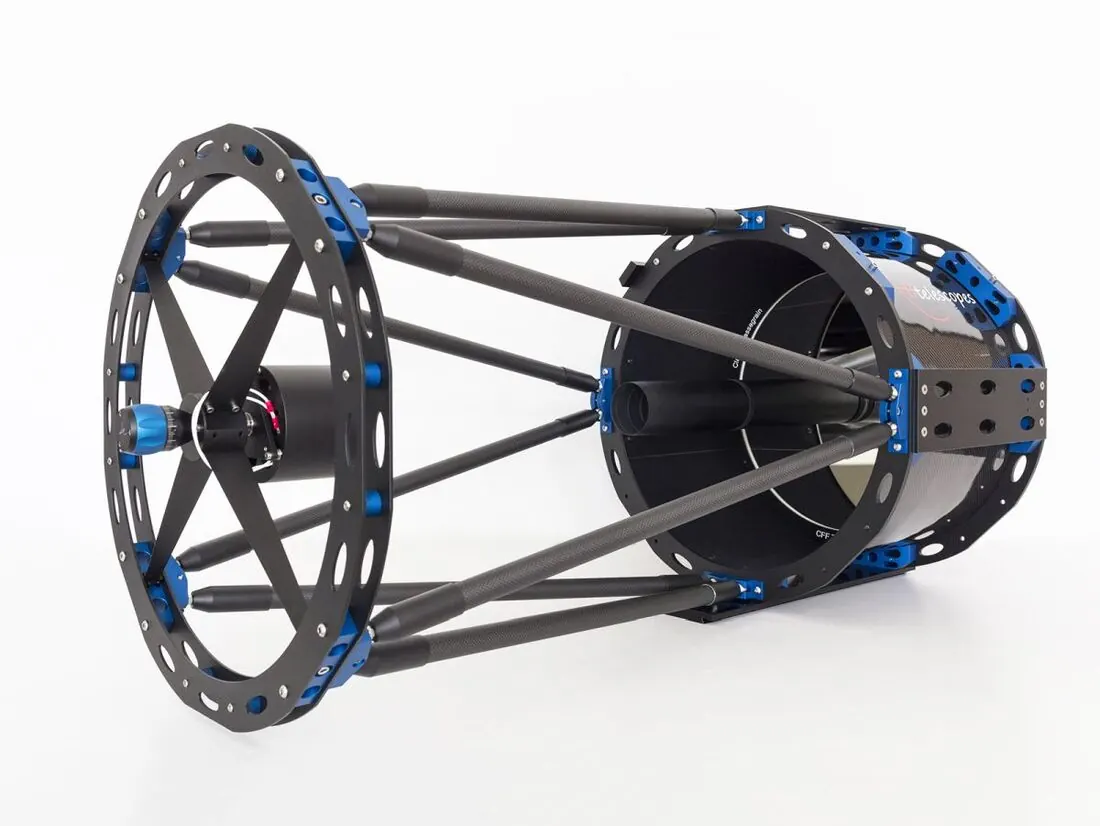 Amateur‑grade Cassegrains (150–250 mm with mount) typically cost around US$800–3000 depending on size and tracking capability.
|
Compound telescopes, or catadioptrics, combine refractive (lenses) and reflective (mirrors) elements.
|
Catadioptric (Schmidt‑Cassegrain) and related designs place a thin corrector lens at the front of the tube, with a spherical primary mirror and a secondary mirror similar to the Cassegrain layout. The corrector controls aberrations from the mirrors, and the folded optical path keeps the instrument compact while maintaining a relatively long focal length, making these designs popular for portable visual observing and basic imaging.
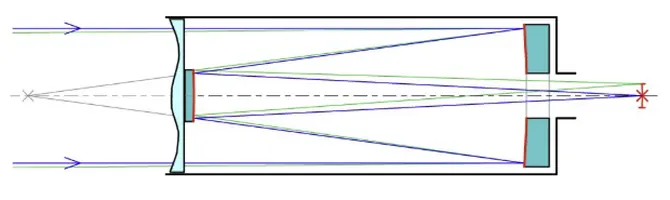 |
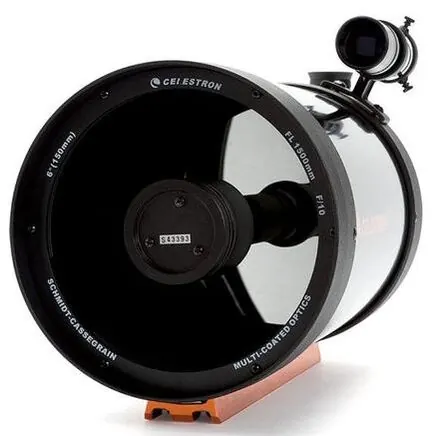 Common 150–250 mm SCT packages on fork or equatorial mounts usually fall in the US$1000–3000 range.
|
Comparison
- Image quality and contrast:
- Small Keplerian refractors provide high‑contrast, low‑maintenance views of bright targets but become expensive at larger apertures.
- Newtonian reflectors and Schmidt‑Cassegrains offer larger apertures at moderate cost, giving better performance on faint objects at the expense of central obstruction and, in fast Newtonians, some edge aberrations.
- Field of view:
- Newtonians and short‑focus refractors usually give wider fields at a given eyepiece;
- Classical Cassegrains and SCTs, with longer focal lengths, give narrower fields but higher image scale.
- Cost per aperture:
- For a given diameter, Newtonian reflectors are typically the least expensive,
- Schmidt‑Cassegrains are intermediate, and
- High‑quality refractors are the most expensive because of the difficulty of producing large lenses.
- For a given diameter, Newtonian reflectors are typically the least expensive,
Main Parts of a Telescope
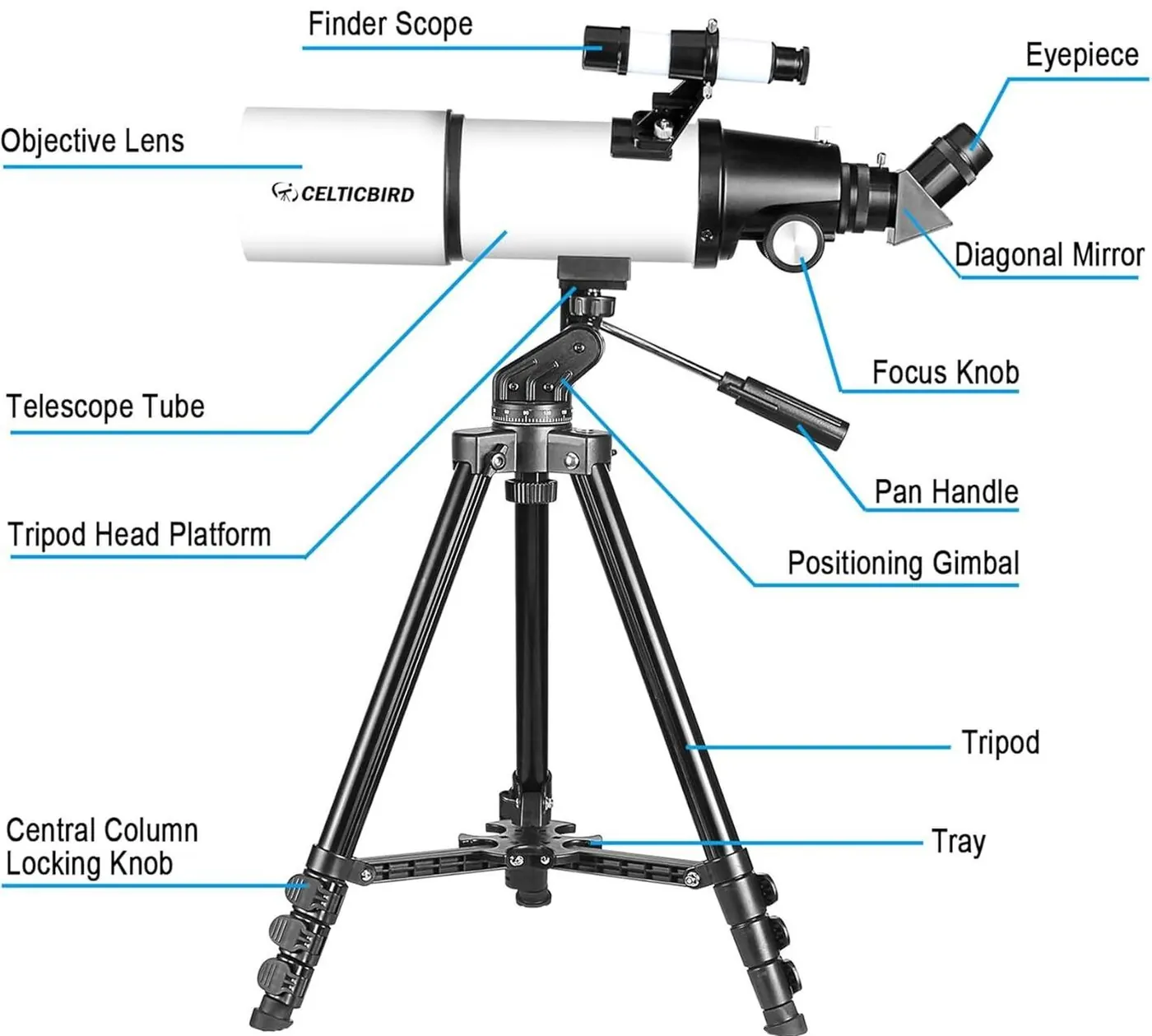
The optical tube assembly (OTA) holds the main light‑gathering element—either an objective lens in a refractor or a primary mirror in a reflector or catadioptric. The tube provides mechanical support and often includes internal baffles or matte coatings to reduce stray light and improve image contrast. At or near the focal plane, a focuser allows precise adjustment of the eyepiece or camera position.
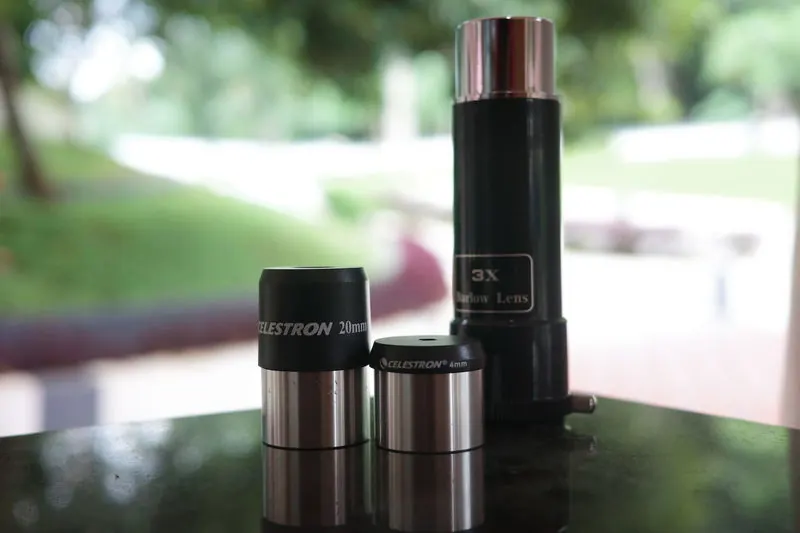 Eyepieces and Barlow lens
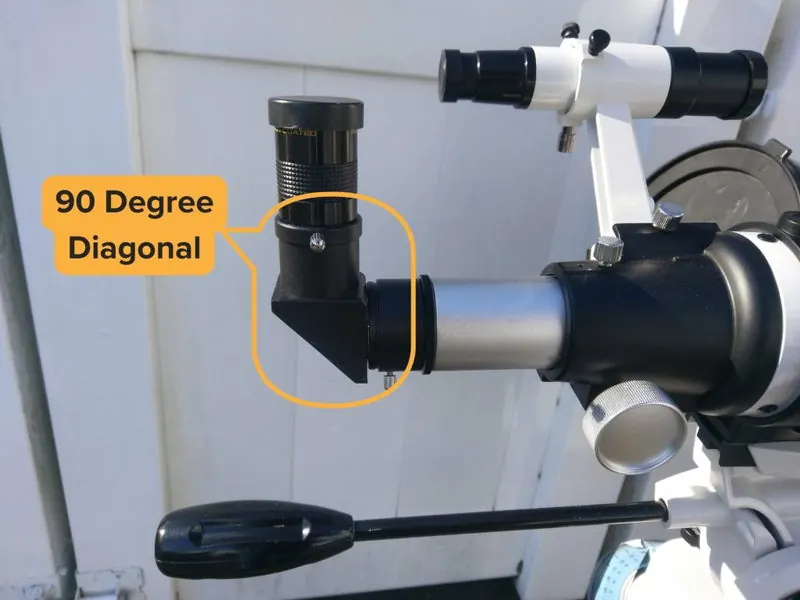 Diagonal
|
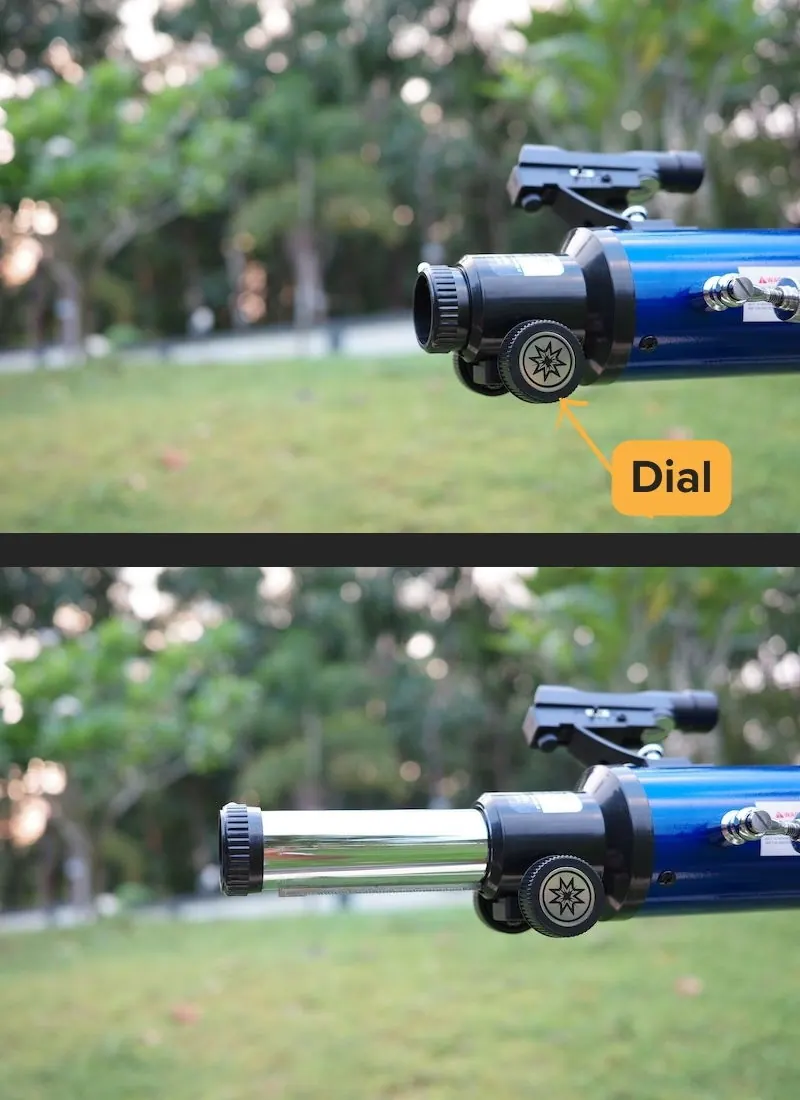 Focuser
|
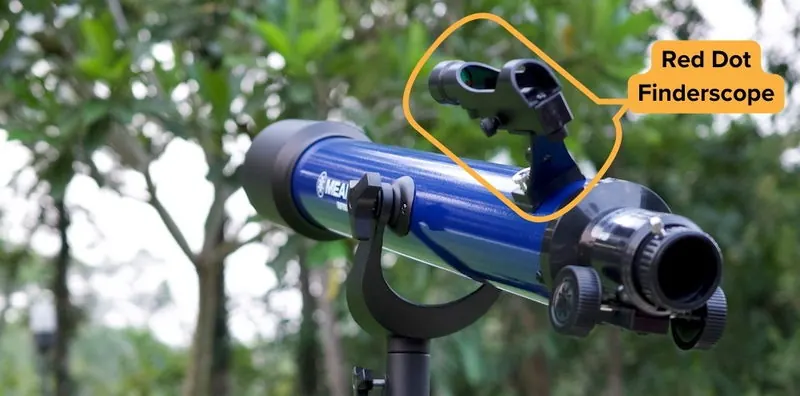 Finderscopes
|
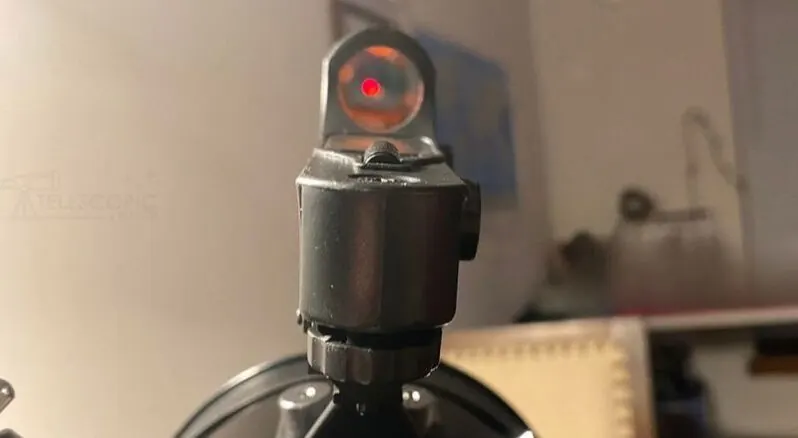 Finderscope alignment is needed
|
Eyepieces contain their own lens groups and determine the magnification and apparent field of view for a given telescope; they are usually interchangeable via standard barrel sizes (for example 1.25‑inch or 2‑inch). Accessory components may include a diagonal mirror or prism, which redirects the light path to a more comfortable viewing angle, and a finderscope or red‑dot finder mounted on the tube to help locate objects before centring them in the main eyepiece. Larger reflectors and catadioptrics often incorporate collimation screws on the primary and/or secondary mirror cells so that users can adjust mirror tilt and maintain alignment of the optical axis.
Telescope Mounts and Motion
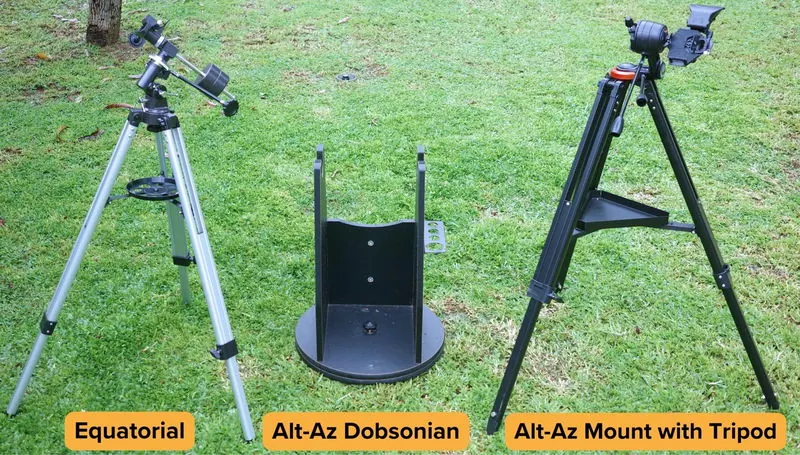
A telescope mount supports the OTA and controls its orientation.
Altazimuth (alt‑az) mounts move the telescope in altitude (up‑down) and azimuth (left‑right), matching the horizon‑based coordinate system and making manual pointing straightforward. Basic fork or yoke‑style alt‑az mounts are common on small refractors and catadioptrics.
Dobsonian mounts apply the same two‑axis principle to large Newtonian reflectors using a low rotating base and side bearings for smooth motion.
Equatorial mounts are arranged so that one axis, the right ascension (RA) or polar axis, is aligned parallel to Earth’s rotation axis, and the other axis adjusts declination. Once the polar axis is aligned with the celestial pole, a motor drive on this single axis can track stars as Earth rotates, keeping a target centred over long periods. Equatorial mounts balance the telescope with counterweights on the opposite side of the RA axis, while fork equatorial mounts support the OTA between two arms but follow the same tracking principle. For visual observing an alt‑az mount is often simpler to use, whereas for long‑exposure astrophotography an equatorial mount provides more suitable tracking along the sky’s apparent rotation.
Altazimuth (alt‑az) mounts move the telescope in altitude (up‑down) and azimuth (left‑right), matching the horizon‑based coordinate system and making manual pointing straightforward. Basic fork or yoke‑style alt‑az mounts are common on small refractors and catadioptrics.
Dobsonian mounts apply the same two‑axis principle to large Newtonian reflectors using a low rotating base and side bearings for smooth motion.
Equatorial mounts are arranged so that one axis, the right ascension (RA) or polar axis, is aligned parallel to Earth’s rotation axis, and the other axis adjusts declination. Once the polar axis is aligned with the celestial pole, a motor drive on this single axis can track stars as Earth rotates, keeping a target centred over long periods. Equatorial mounts balance the telescope with counterweights on the opposite side of the RA axis, while fork equatorial mounts support the OTA between two arms but follow the same tracking principle. For visual observing an alt‑az mount is often simpler to use, whereas for long‑exposure astrophotography an equatorial mount provides more suitable tracking along the sky’s apparent rotation.
Activity - A Deep Dive into Aperture and Optic
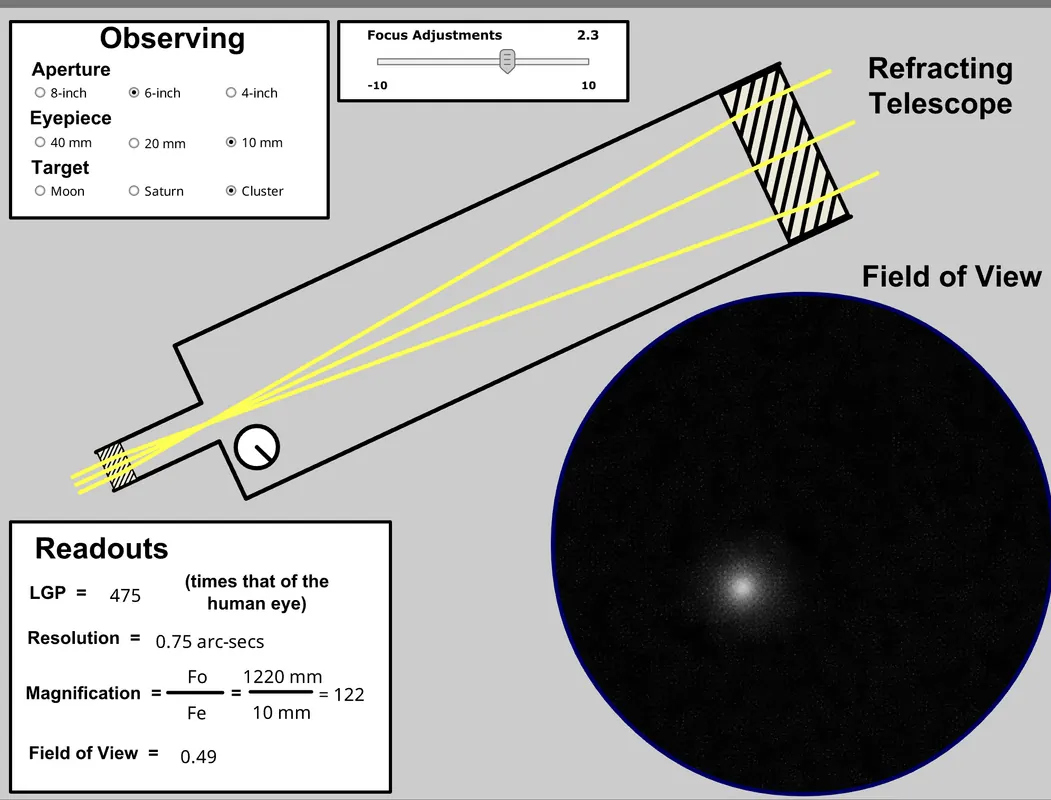
In your notes, you learned that telescopes are "light buckets." This simulator lets you change the size of that bucket (Aperture) and the zoom level (Eyepiece).
We will be testing how different setups affect:
We will be testing how different setups affect:
- Light Gathering Power: How bright the image is.
- Resolution: How much detail we can see (e.g., craters on the Moon).
- Field of View (FOV): How much of the sky fits in the eyepiece.
|
Task 1: The "Light Bucket" Test (Aperture)
Task 2: The Magnification Formula
|
 Click to try |
|
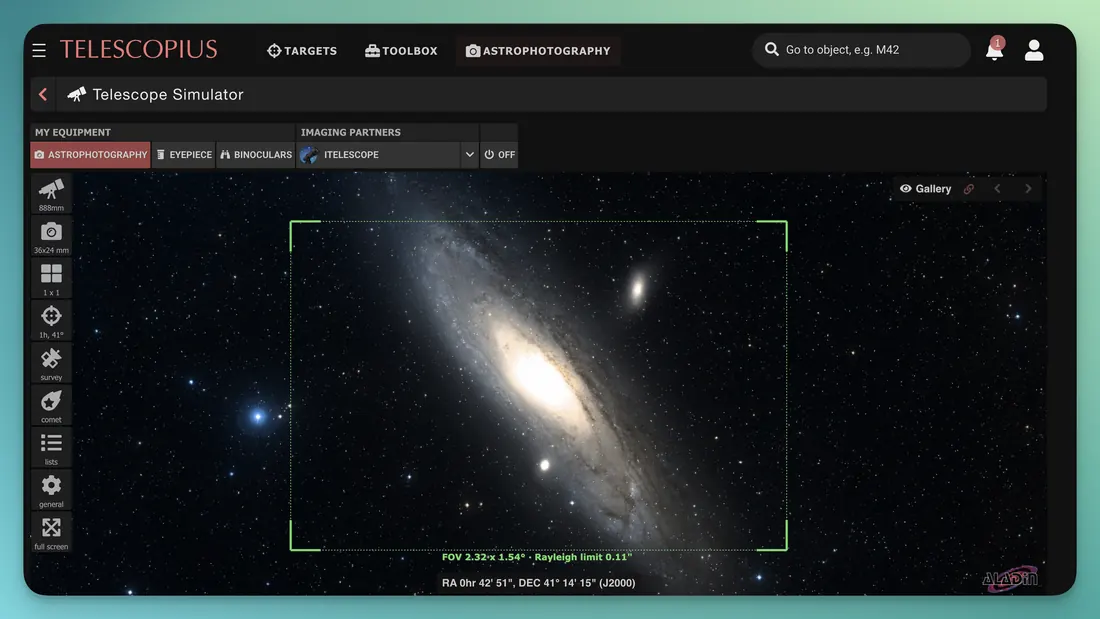
Telescopius is a professional-grade planning tool. While the previous simulator was great for understanding "how light works," this one is perfect for "Virtual Astrophotography." It shows you exactly what a camera sensor sees through a specific telescope.
🔭 Intro: The Astrophotographer’s ViewIn your notes, you learned that Reflectors (like Newtonians) and SCTs (Catadioptrics) are often used for deep-sky objects. Telescopius simulates the Field of View (FOV).
Task 3: The "Fitting" Challenge (Aperture vs. Target)
|
 Click to try |