How does Rocket Fly?
Every launch, from the smallest model rocket to the most powerful spacecraft, obeys a set of fundamental rules written not by engineers, but by nature itself. These rules were defined by Sir Isaac Newton over three centuries ago. For rocketry, Newton's Three Laws of Motion are more than just physics equations; they are the essential principles that explain how propulsion works, how rockets move, and how we can steer them through the vacuum of space. Without them, spaceflight would be impossible.
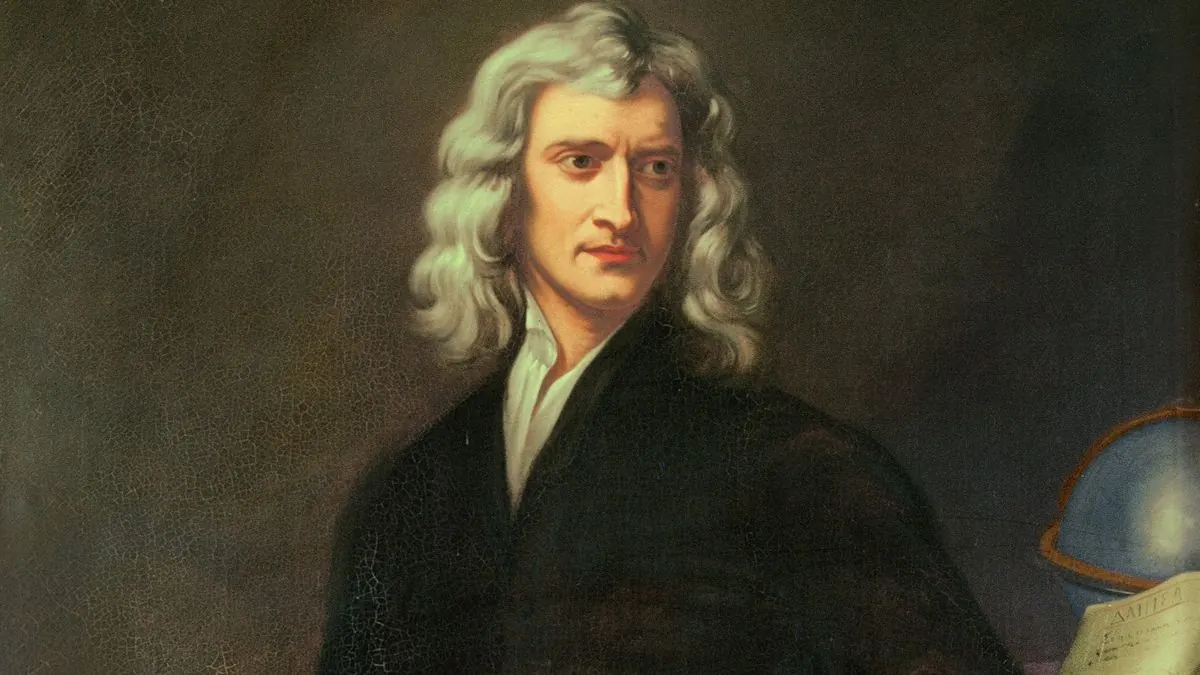
Newton's First Law - The Law of Inertia
“An object at rest stays at rest, and an object in motion stays in motion with the same speed and in the same direction unless acted upon by an unbalanced force.”
Inertia is an object's resistance to changing its motion.
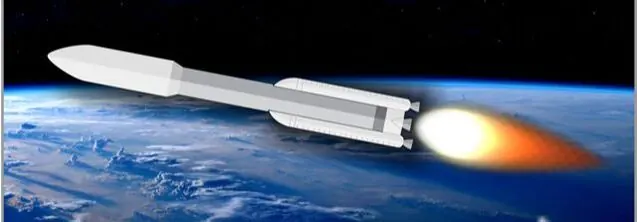
- Getting Off the Launch Pad: A massive rocket on the pad is an "object at rest." It has immense inertia and wants to stay right where it is. To overcome this inertia, you need a massive unbalanced force—that force is thrust.
- Stopping in Space: Conversely, a spacecraft coasting in orbit is an "object in motion." There's no air friction in space to slow it down, so it will keep moving at a constant velocity forever unless a force (like a thruster firing) acts to slow it down or change its direction.
Newton's Second Law - The Law of Force and Acceleration
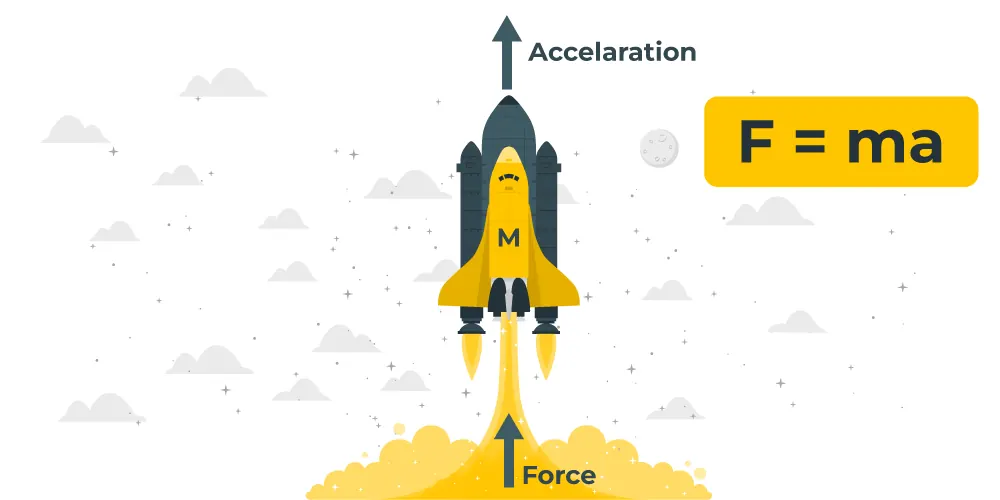
“The acceleration of an object is directly proportional to the net force acting on it and inversely proportional to its mass. (F = ma)”
This law tells us how much an object will accelerate when we apply a force. More force means more acceleration. More mass means less acceleration for the same amount of force.
The Formula: F = m * a
Force equals mass times acceleration
Liftoff: To achieve liftoff, the thrust (F) from the engines must be greater than the weight of the rocket (the force of gravity pulling it down). This creates a net force upward, resulting in upward acceleration (a).
The “Wow” Factor of Staging: A rocket’s mass (m) isn't constant—it decreases dramatically as propellant is burned.
According to F = m * a, if thrust (F) remains constant while mass (m) decreases, the acceleration (a) must increase. This is why astronauts feel pressed into their seats more and more strongly as the rocket ascends—the acceleration is increasing!
The Formula: F = m * a
Force equals mass times acceleration
Liftoff: To achieve liftoff, the thrust (F) from the engines must be greater than the weight of the rocket (the force of gravity pulling it down). This creates a net force upward, resulting in upward acceleration (a).
The “Wow” Factor of Staging: A rocket’s mass (m) isn't constant—it decreases dramatically as propellant is burned.
According to F = m * a, if thrust (F) remains constant while mass (m) decreases, the acceleration (a) must increase. This is why astronauts feel pressed into their seats more and more strongly as the rocket ascends—the acceleration is increasing!
Newton's Third Law - The Law of Action-Reaction
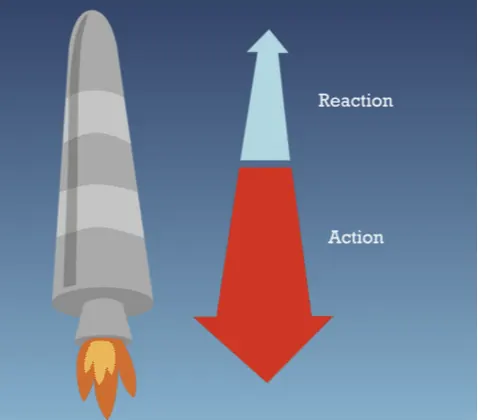
“For every action, there is an equal and opposite reaction.”
Forces always come in pairs. If Object A exerts a force on Object B, then Object B simultaneously exerts an equal and opposite force on Object A.
The action is the rocket engine forcing high-speed hot gases (exhaust) out of the back of the rocket. The reaction is the exhaust gas pushing back on the rocket with an equal force in the opposite direction. This reaction force is what we call THRUST.
Key Insight: A rocket does not "push off" the air or the ground. It works by throwing mass backward to create a forward push. This is why rockets work perfectly in the vacuum of space where there is nothing to push against!
The action is the rocket engine forcing high-speed hot gases (exhaust) out of the back of the rocket. The reaction is the exhaust gas pushing back on the rocket with an equal force in the opposite direction. This reaction force is what we call THRUST.
Key Insight: A rocket does not "push off" the air or the ground. It works by throwing mass backward to create a forward push. This is why rockets work perfectly in the vacuum of space where there is nothing to push against!
Summary
- Newton's 1st Law (Inertia): Explains why a powerful force is needed to start and stop a rocket's motion.
- Newton's 2nd Law (F=ma): Governs the relationship between thrust, the rocket's changing mass, and its increasing acceleration.
- Newton's 3rd Law (Action-Reaction): Explains the very principle of rocket propulsion itself. Thrust is the reaction force to expelling exhaust.
Key Terms:
- Inertia: The tendency of an object to resist changes in its motion.
- Force: A push or a pull.
- Thrust: The propulsive force that pushes a rocket forward.
- Mass: The amount of matter in an object (not to be confused with weight).
- Acceleration: The rate at which velocity changes.
- Action-Reaction Pair: The pair of equal and opposite forces described in Newton's Third Law.