Introduce
The fundamental principle of rocketry—propulsion by reaction—has been understood for centuries, with its earliest practical use traced to ancient China. However, the transition from simple solid-fuel fireworks to the sophisticated vehicles that enable modern space exploration is a story of 20th and 21st-century engineering. Pioneering theorists like Konstantin Tsiolkovsky laid the mathematical groundwork, while engineers like Robert Goddard turned theory into practice, launching the world's first liquid-propellant rocket in 1926. This breakthrough unlocked the potential for controllable, high-performance propulsion, culminating in the powerful and complex machines we rely on today. A launch vehicle is an integrated system where every component must work together, a failure of one component may lead to a cascading catastrophic event. Before analyzing the different types of rocket engines, let us understand the major components of a rocket and how the propulsion system fits into this broader architecture.
Major Rocket Components
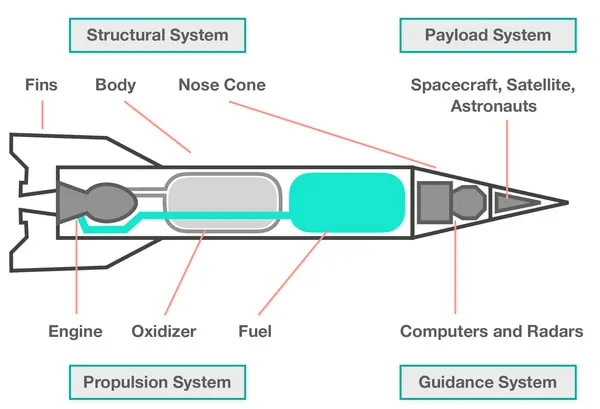
A rocket can be divided into four primary subsystems, namely:
|
Structural System
|
Payload System
|
|
Propulsion System
This system generates thrust by expelling mass at high velocity.
|
Guidance System
|
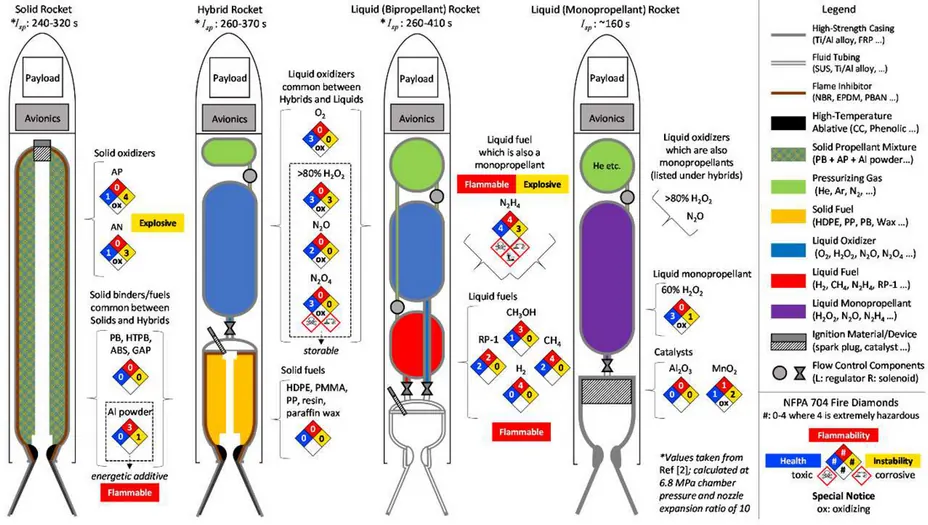
Comparison of Rocket Propulsion System
There are primarily 4 kinds of propulsion systems, each with their own performance, cost, and complexity.
Solid-Propellant Rocket Motors (SRMs)
Solid motors contain a pre-mixed solid propellant cast inside their combustion chamber. They are simple, reliable, and provide high thrust, making them ideal for booster stages. However, once ignited, they cannot be throttled or shut down, burning until all propellant is exhausted. Ideal for boosters (e.g., SLS, Vega), military missiles, and simple rockets.
Hybrid Rocket Engines
Hybrid engines combine a solid fuel with a liquid or gaseous oxidizer. This design offers a safer alternative, as the propellants are stable when separate. They can be throttled and stopped by regulating the oxidizer flow, providing a middle ground in performance and complexity between solids and liquids. (e.g., Virgin Galactic's SpaceShipTwo)
Liquid Bipropellant Rocket Engines
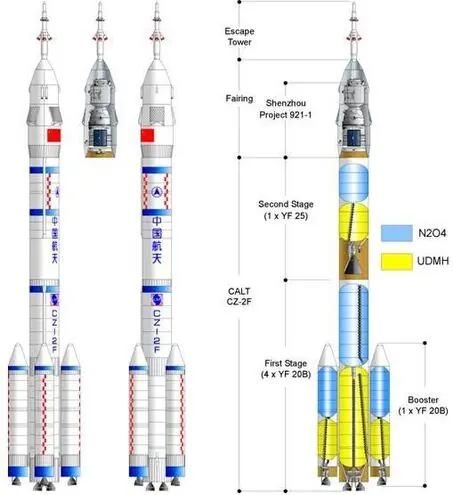
These engines store liquid fuel and oxidizer in separate tanks. A complex feed system pumps them into a combustion chamber for ignition. This allows for throttling, shutdown, and restart capability, offering high performance and control, which is essential for most primary launch vehicle stages. (e.g., Falcon 9, Long March 2F) Common propellant combinations: Kerosene/LOX (RP-1/LOX), Liquid Hydrogen/LOX (LH₂/LOX), Methane/LOX.
Liquid Monopropellant Engines
Monopropellant systems use a single fuel (ie:Hydrazine) that decomposes over a catalyst to produce thrust. They are mechanically simple and highly reliable, providing low but precise thrust. They are not used for ascent but are perfect for reaction control systems (RCS) in space.
Solid-Propellant Rocket Motors (SRMs)
Solid motors contain a pre-mixed solid propellant cast inside their combustion chamber. They are simple, reliable, and provide high thrust, making them ideal for booster stages. However, once ignited, they cannot be throttled or shut down, burning until all propellant is exhausted. Ideal for boosters (e.g., SLS, Vega), military missiles, and simple rockets.
Hybrid Rocket Engines
Hybrid engines combine a solid fuel with a liquid or gaseous oxidizer. This design offers a safer alternative, as the propellants are stable when separate. They can be throttled and stopped by regulating the oxidizer flow, providing a middle ground in performance and complexity between solids and liquids. (e.g., Virgin Galactic's SpaceShipTwo)
Liquid Bipropellant Rocket Engines
These engines store liquid fuel and oxidizer in separate tanks. A complex feed system pumps them into a combustion chamber for ignition. This allows for throttling, shutdown, and restart capability, offering high performance and control, which is essential for most primary launch vehicle stages. (e.g., Falcon 9, Long March 2F) Common propellant combinations: Kerosene/LOX (RP-1/LOX), Liquid Hydrogen/LOX (LH₂/LOX), Methane/LOX.
Liquid Monopropellant Engines
Monopropellant systems use a single fuel (ie:Hydrazine) that decomposes over a catalyst to produce thrust. They are mechanically simple and highly reliable, providing low but precise thrust. They are not used for ascent but are perfect for reaction control systems (RCS) in space.
Summary
|
Propulsion Type
Solid (SRM) Liquid Bipropellant Liquid Monopropellant Hybrid |
Propellant State
Solid Liquid + Liquid Liquid Solid + Liquid |
Throttling & Restart
No Yes Yes Yes |
Complexity
Low High Low Medium |
Typical Use Case
Boosters, Simple Launch Main/Upper Stages RCS Experimental |