|
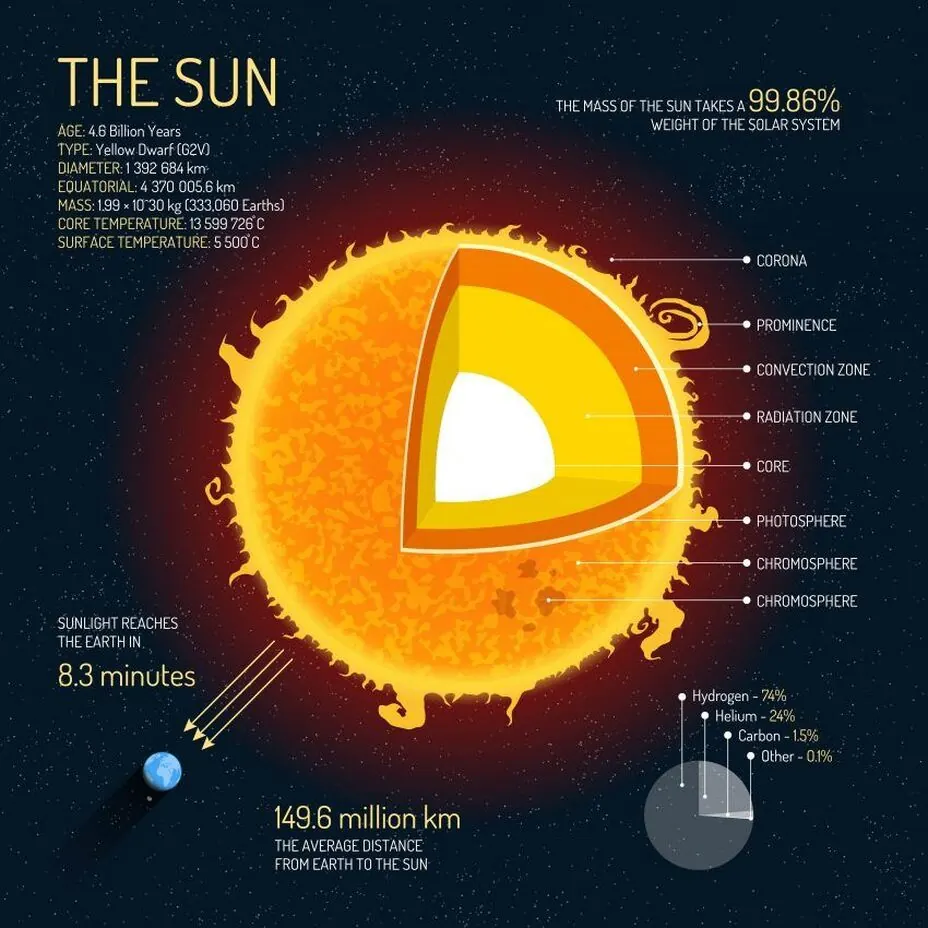
Our journey through the solar system begins at its heart: the Sun. This colossal sphere of incandescent plasma is not merely a distant light source but a dynamic celestial body that governs the environment of all its planet, asteroid, and comet. It contains 99.86% of the solar system's mass, and its gravitational pull and energetic output are the primary forces shaping our cosmic neighbourhood.
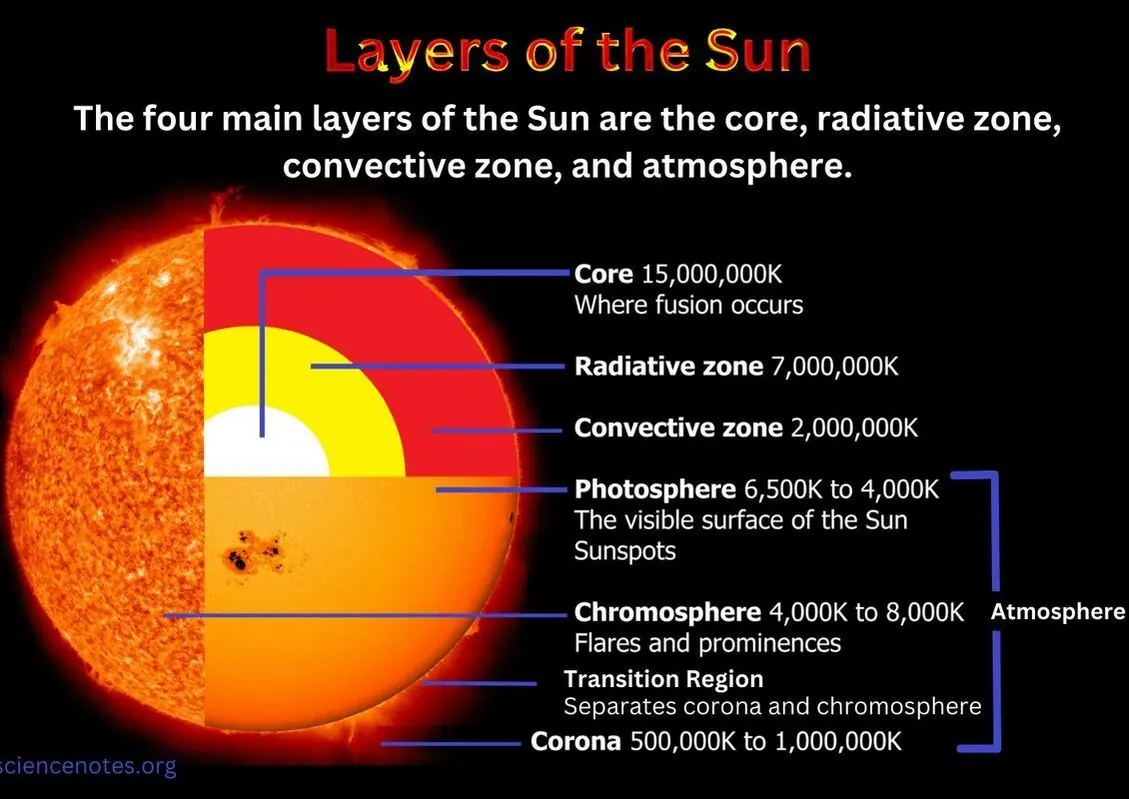
In this chapter, we will move beyond seeing the Sun as a simple yellowish star. We will explore its structure, its violently active atmosphere, and the constant stream of the solar wind that bathes the entire system. The Structure of the Sun: A Layered StarThe Sun, like an onion, is composed of distinct layers. We can divide it into two main regions: the solar interior, where energy is generated, and the solar atmosphere, which we can directly or indirectly observe.
|
 |
The Solar Interior
- The Core [~15 million °C]: This incredibly dense and hot region is where nuclear fusion occurs. Under immense pressure and temperature, hydrogen nuclei (protons) fuse together to form helium nuclei. This process releases a tremendous amount of energy in the form of gamma-ray photons. This is the source of all the Sun's energy.
- The Radiative Zone [~7 million °C to ~2 million °C]: Surrounding the core, energy from the core travels outward through this zone. The plasma is so dense that photons of energy are absorbed and re-emitted by atoms in a random walk. A single photon may take tens of thousands of years to travel through the radiative zone.
- The Convective Zone [~2 million °C to ~5,700 °C]: In the outer third of the Sun's interior, large bubbles of hot plasma become buoyant. They rise to the surface, cool down, and then sink back down to be reheated. This process, convection, is a much more efficient way of transferring energy to the surface. The bubbling pattern we see on the Sun's surface, called granulation, is a direct result of these convection currents.
 |
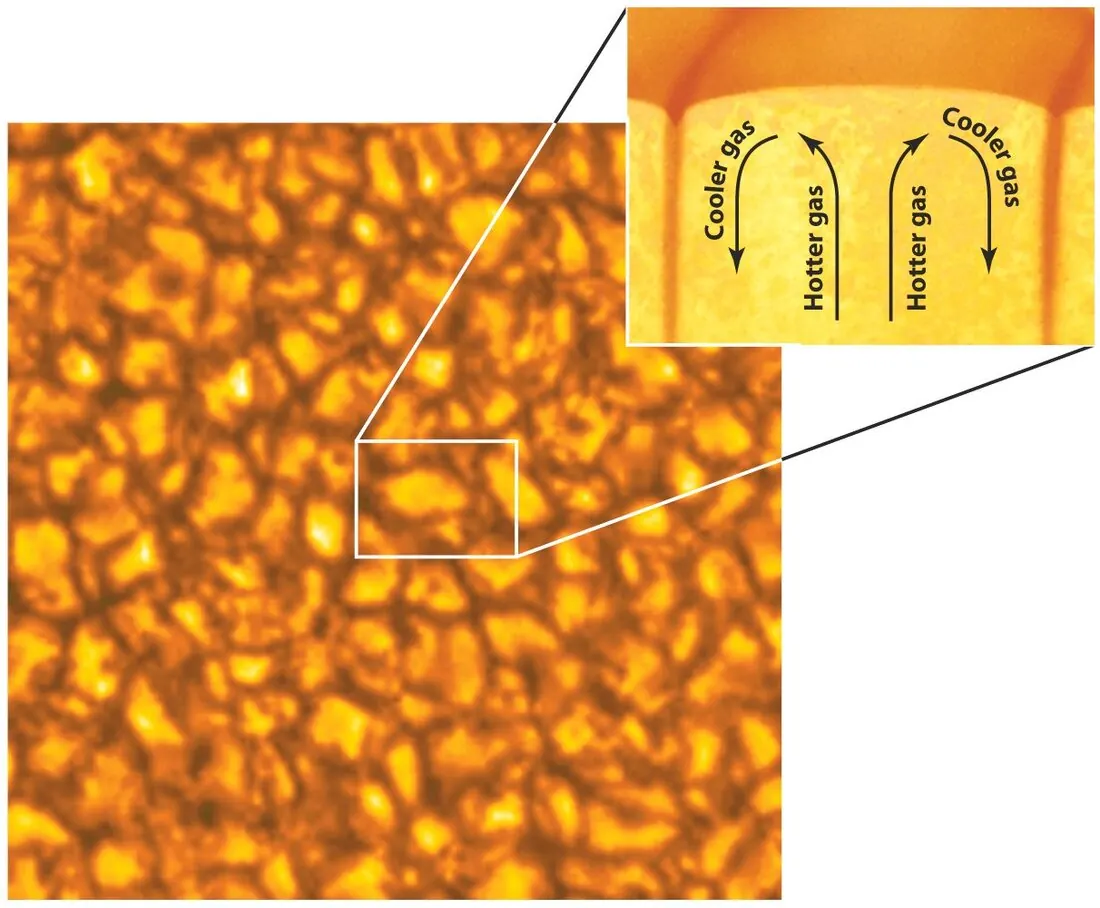 Granulation
|
The Solar Atmosphere
The Sun's atmosphere consists of three primary layers, which we can observe during a solar eclipse or with specialized telescopes.
- The Photosphere [~5,500°C]: Often referred to as the "surface" of the Sun, this is the layer from which visible light escapes into space. It is about 500 km thick and is where features like sunspots become visible.
- The Chromosphere [~4,500°C to ~20,000°C]: A reddish layer above the photosphere, visible for a few seconds during a total solar eclipse as a red rim (its name means "sphere of color"). Surprisingly, its temperature increases with altitude. Spicules, which are jet-like eruptions of gas, are a common feature here.
- The Corona [1-3 million °C]: The Sun's outer atmosphere, extending millions of kilometers into space. It is incredibly hot, a dramatic and counterintuitive increase from the cooler layers below. The reason for this super-heating is an area of active research, likely involving the Sun's magnetic field. The corona is the source of the solar wind and is visible as a pearly-white halo during a total solar eclipse.
Solar Activity: A Dynamic and Active Star
The Sun has an 11-year solar cycle during which its activity level rises and falls. This activity is driven by the Sun's magnetic field, which becomes tangled and twisted due to the Sun's differential rotation (the equator rotates faster than the poles).
- Sunspots: Sunspots are temporary, dark regions on the Sun's photosphere that appear dark due to their lower temperature (about 3,500°C). This cooling is caused by intense magnetic fields that inhibit heat flow from the interior. They always occur in pairs of opposite magnetic polarity and are the primary markers of the solar cycle: few to none exist at solar minimum, while many appear at solar maximum.
- Solar Flares: A solar flare is a sudden, powerful explosion in the Sun's corona, caused when twisted magnetic field lines near sunspots snap and reconnect. This event, the solar system's most powerful explosion, releases radiation across the electromagnetic spectrum and heats material to 10-20 million °C, accelerating particles to near-light speed.
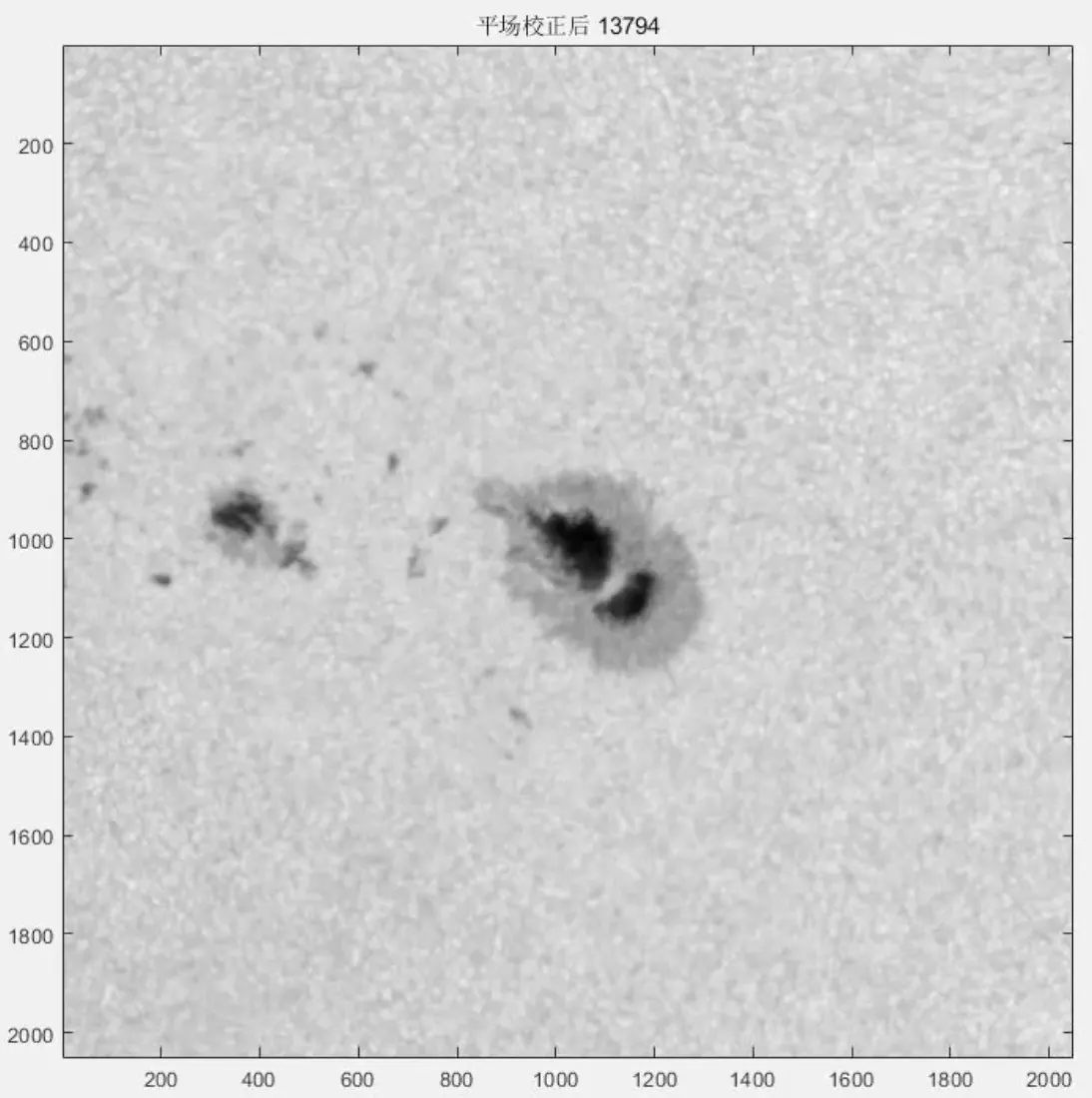 Sun spot example 1
Provided by National Astronomical Observatories, CAS
|
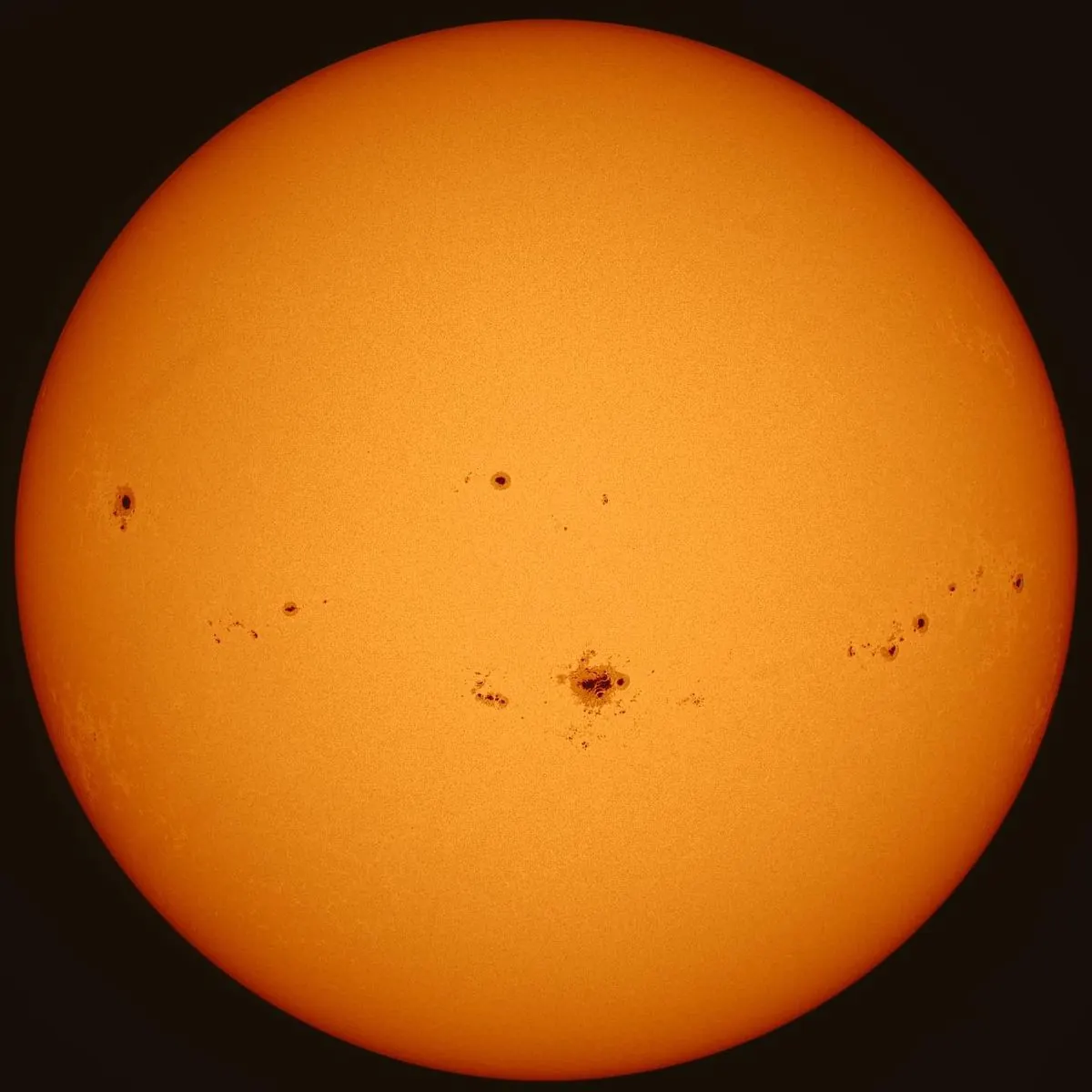 sun spot example 2
|
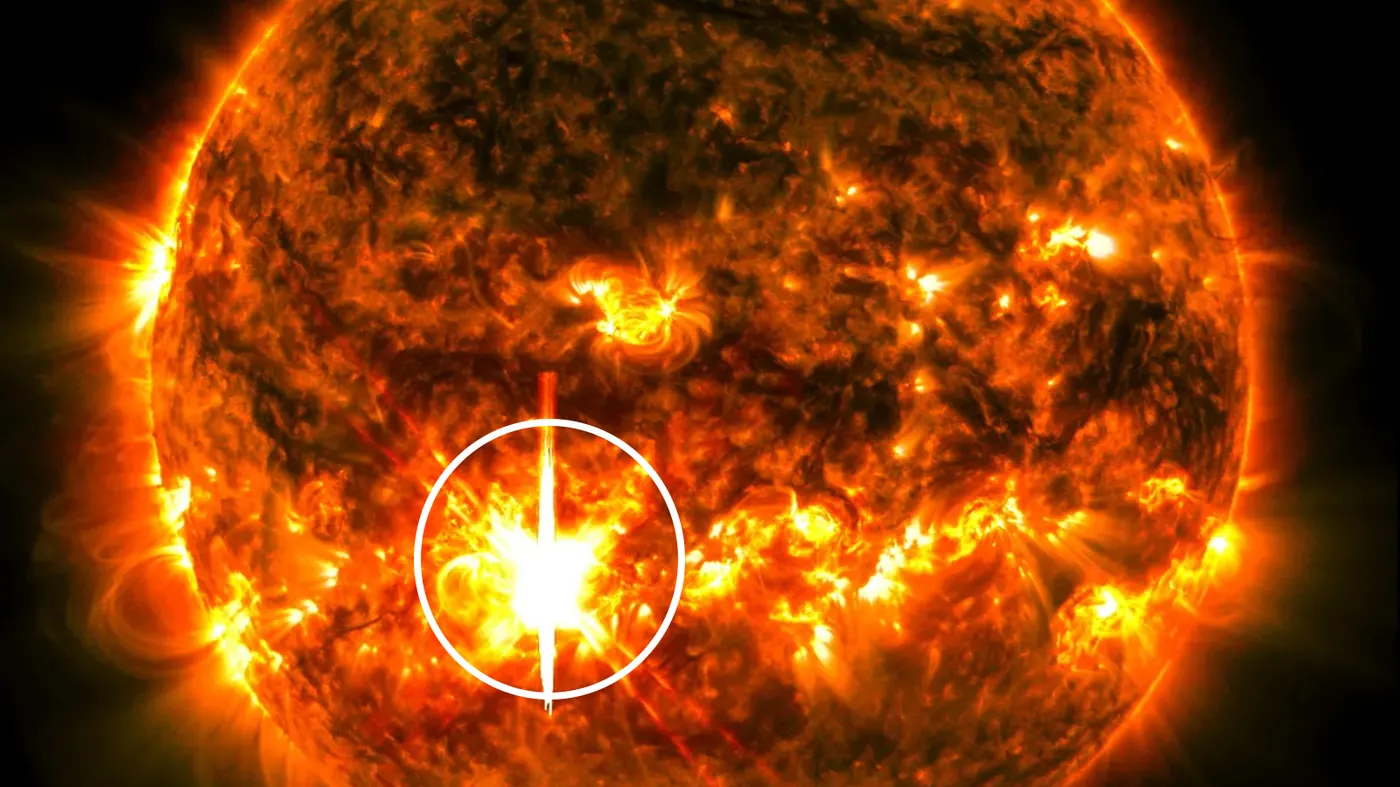 Solar flare example 1
|
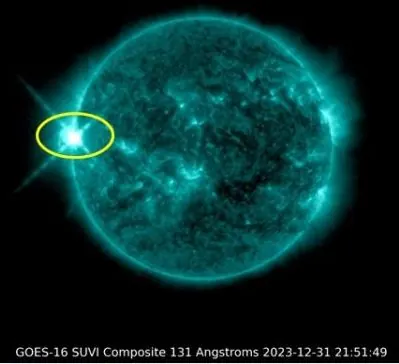 Solar flare example 2
|
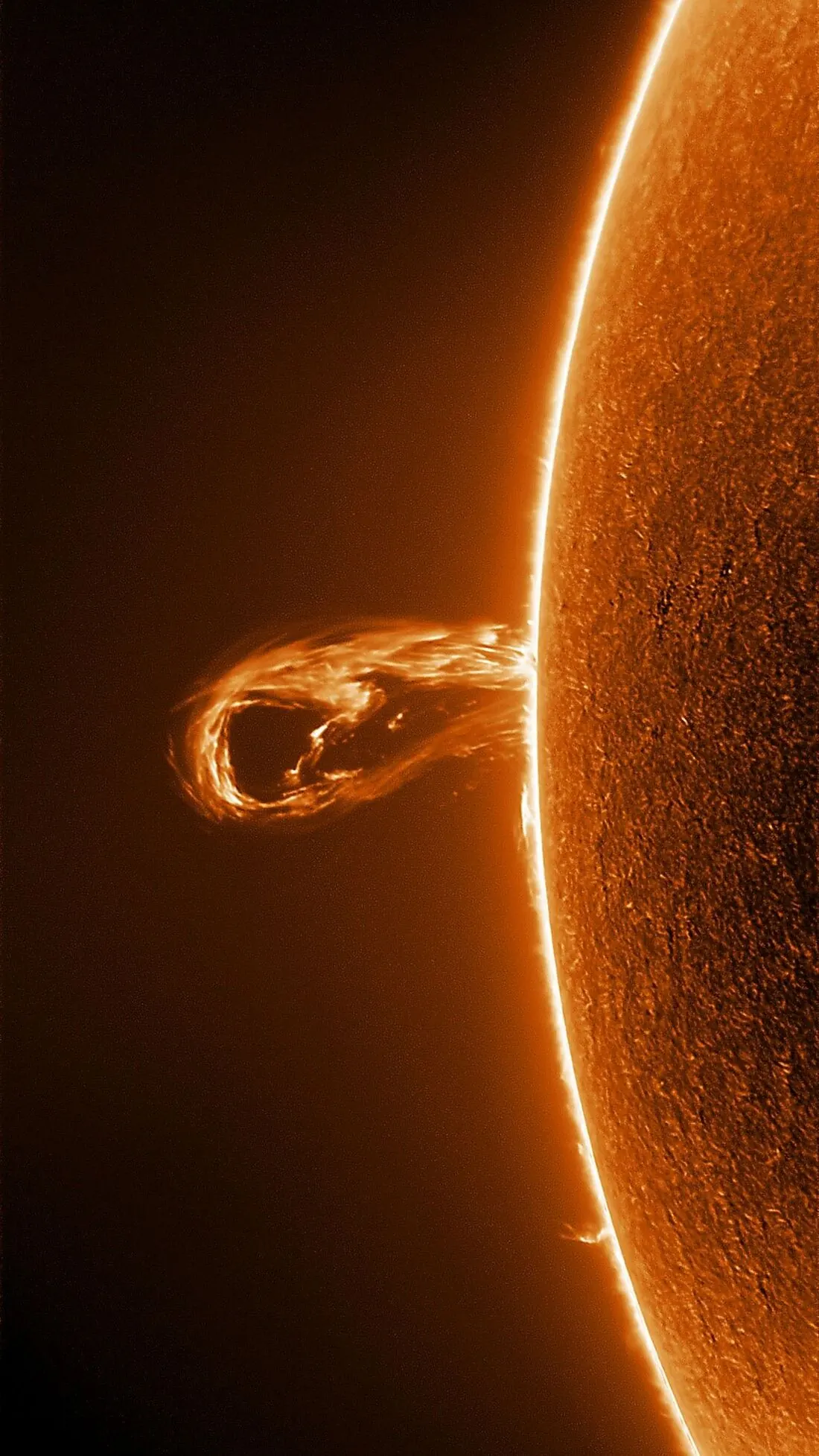
- Prominences: A prominence is a huge, bright, looping structure of cool, dense plasma (typically 5,000-50,000°C) extending from the photosphere into the hot corona. When seen against the bright solar disk, they appear as dark lines and are called filaments. They are anchored by the Sun's magnetic field and can remain stable for weeks. However, they can also become unstable and erupt, hurling massive amounts of solar material into space.
- Coronal Mass Ejections (CMEs): A CME is a massive billion-ton bubble of plasma and magnetic field ejected from the Sun's corona over the course of several hours. While often associated with flares, they are distinct events. CMEs are much larger and slower than flares, but they carry a significant portion of the Sun's mass and magnetic field into interplanetary space. When directed at Earth, they can cause severe space weather.
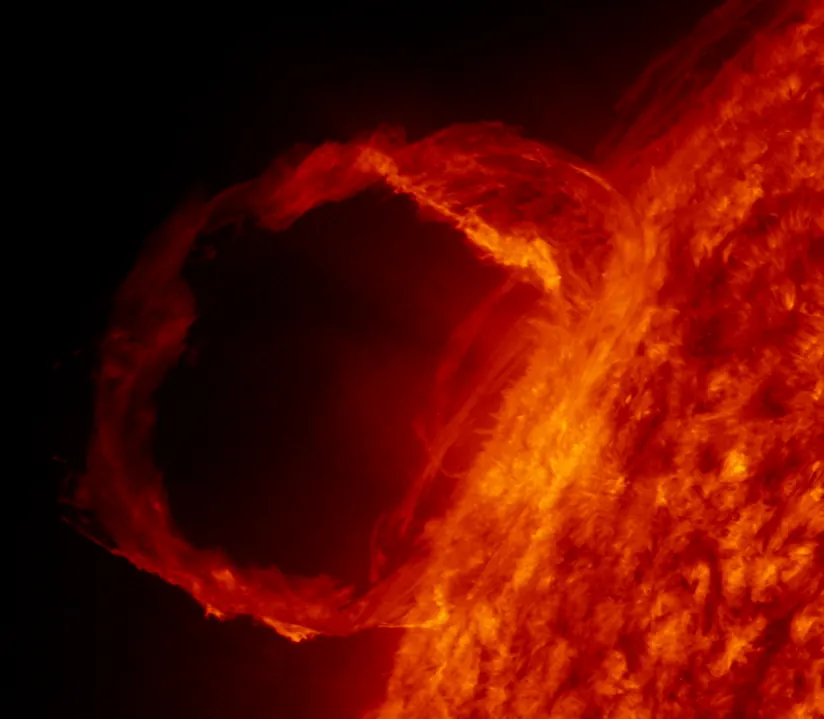 Solar prominences example 1
|
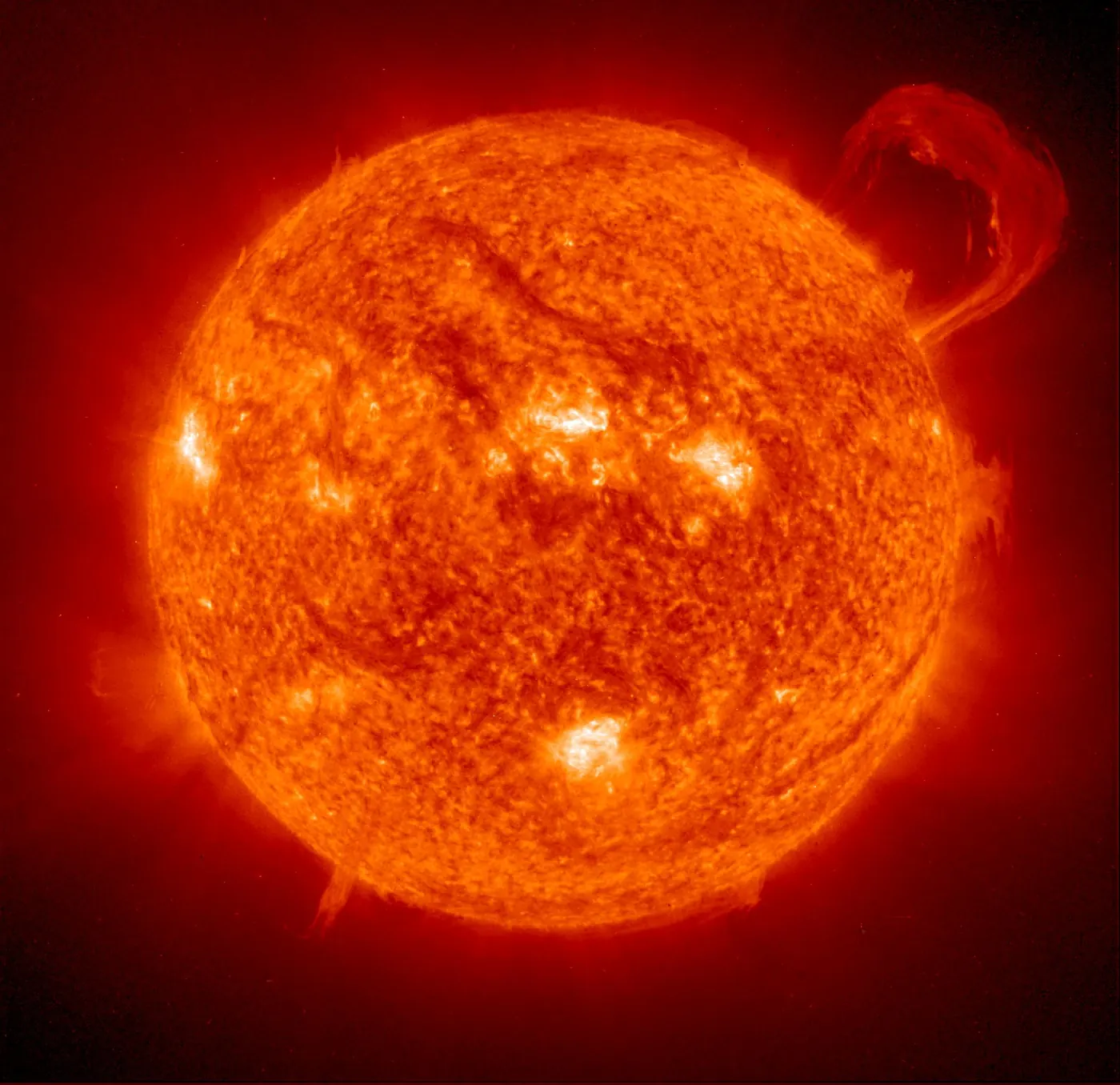 Solar prominences example 2
|
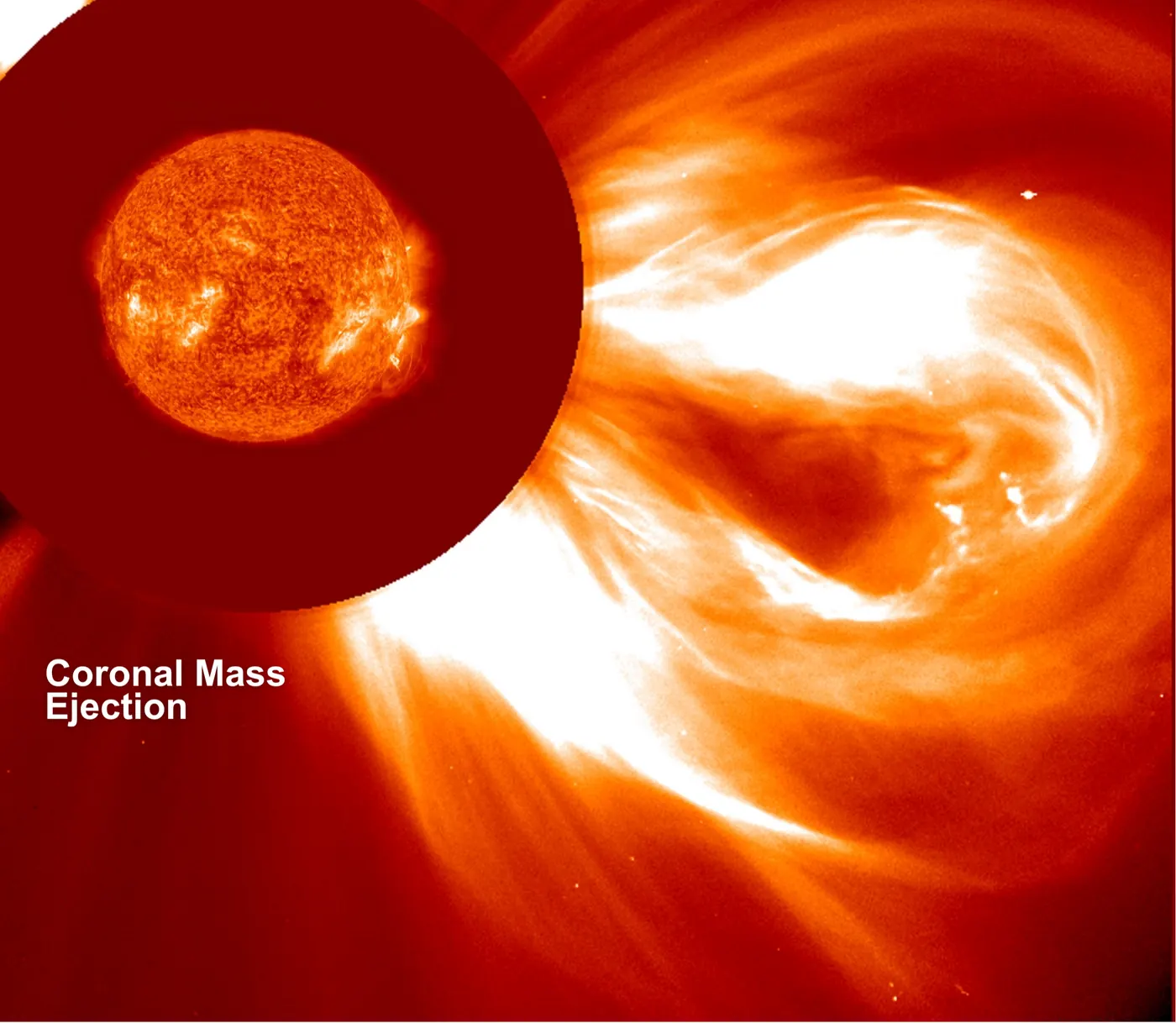 Coronal Mass Ejections example 1
|
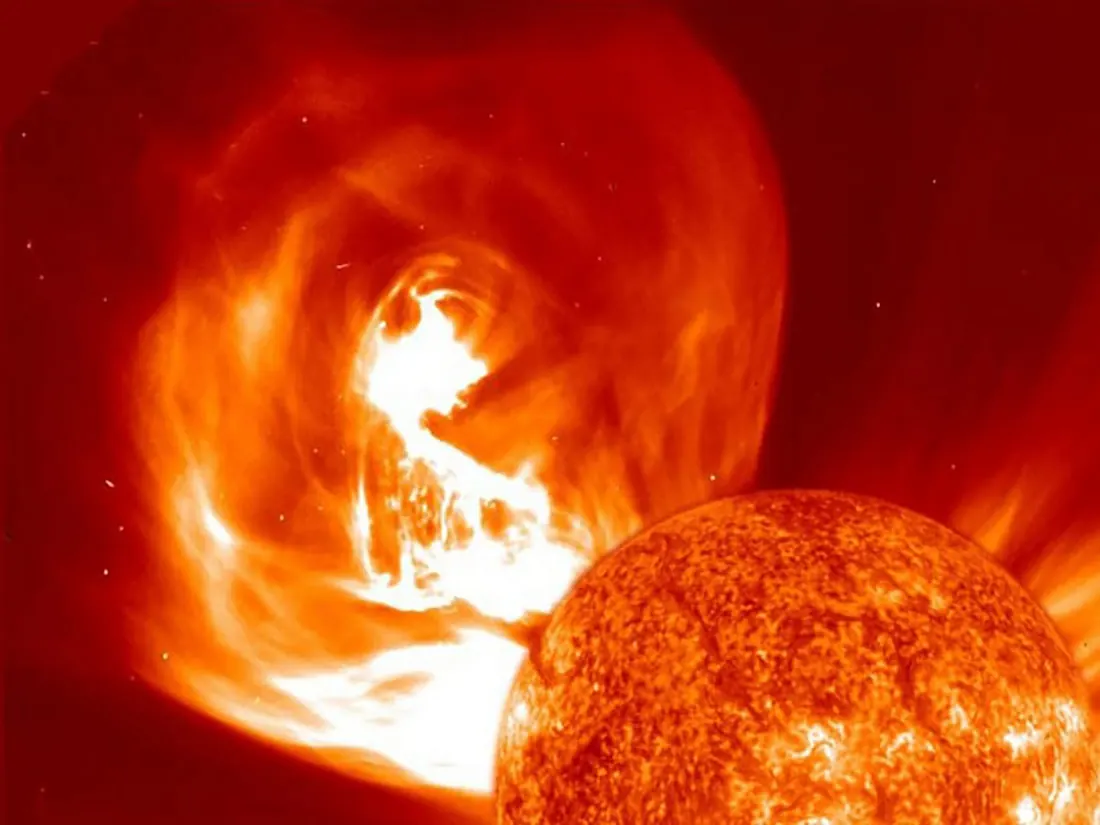 Coronal Mass Ejections example 2
|
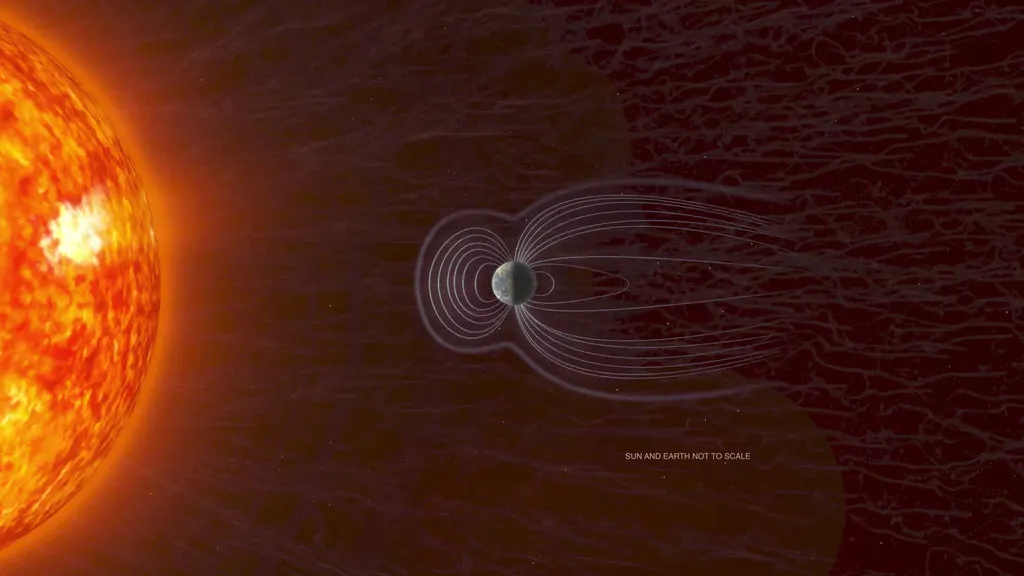
- Solar wind: it is a constant flow of charged particles primarily electrons and protons, travelling at speed exceeding one million miles per hour streaming outward from the Sun's corona. Because the corona is so hot, the Sun's gravity cannot hold onto all of its material, and it expands continuously into space. The solar wind carries with it the Sun's magnetic field, creating the interplanetary magnetic field.
 |
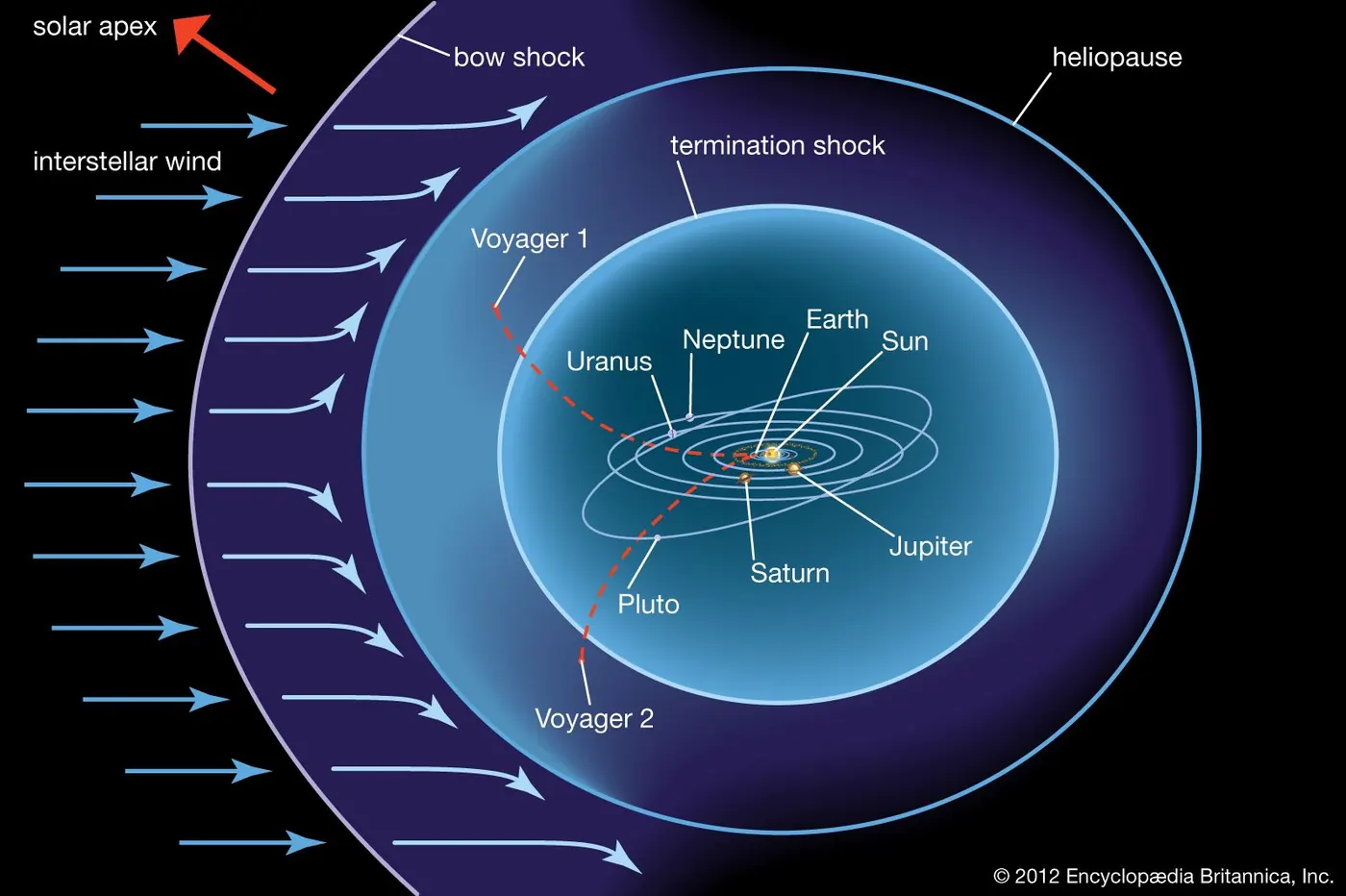 Heliosphere
|
The solar wind inflates a vast "bubble" in interstellar space called the heliosphere. This bubble extends far beyond the orbit of Pluto and protects the solar system from most of the galactic cosmic rays coming from interstellar space. The boundary where the solar wind slows down and terminates is called the heliopause, which is considered the edge of the solar system.
The Sun's Influence on the Earth
When charged particles from the solar wind (or a CME) are channeled by Earth's magnetic field toward the poles, they collide with atoms in the upper atmosphere, causing them to glow. This creates the spectacular aurora borealis (northern lights) and aurora australis (southern lights).

Aurora borealis
The strongest recorded solar storm was The Carrington Event in 1859. It caused telegraph systems to fail worldwide and made the auroras visible near the equator. A similar event today could cause widespread power outages, and mass destruction of unprotected electronics equippments. This is why spaceweather monitoring is so important.
In recent years, China's contributions to solar physics have become increasingly significant. The launch of dedicated solar observation satellites, such as Xihe (China's first solar exploration satellite) and the Advanced Space-based Solar Observatory (ASO-S), nicknamed "Kuafu-1," has provided valuable new data. These missions are designed to study solar flares, coronal mass ejections, and the Sun's magnetic field, enhancing our global capability to monitor space weather. The data they provide helps improving forecasts that protect satellites, power grids, and astronauts from solar storms.
In recent years, China's contributions to solar physics have become increasingly significant. The launch of dedicated solar observation satellites, such as Xihe (China's first solar exploration satellite) and the Advanced Space-based Solar Observatory (ASO-S), nicknamed "Kuafu-1," has provided valuable new data. These missions are designed to study solar flares, coronal mass ejections, and the Sun's magnetic field, enhancing our global capability to monitor space weather. The data they provide helps improving forecasts that protect satellites, power grids, and astronauts from solar storms.
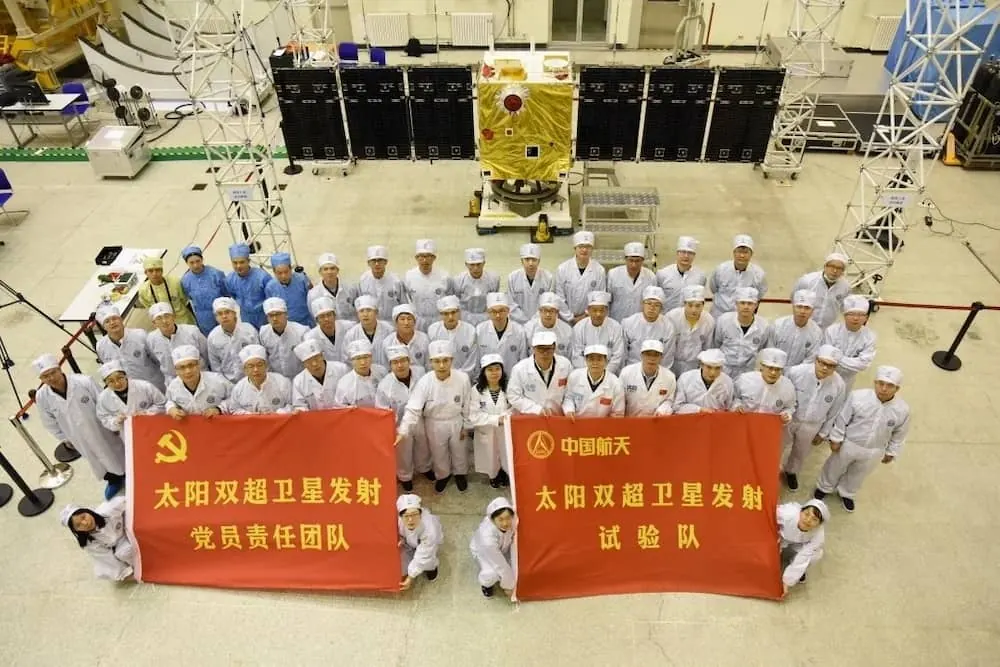 Xihe
|
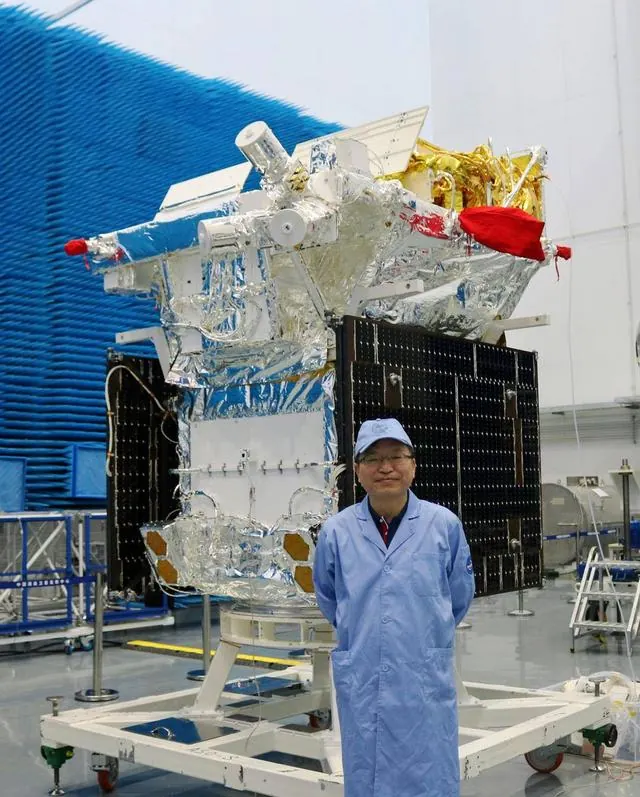 Kuafu-1
|