The Asteroid Belt and Near-Earth Objects
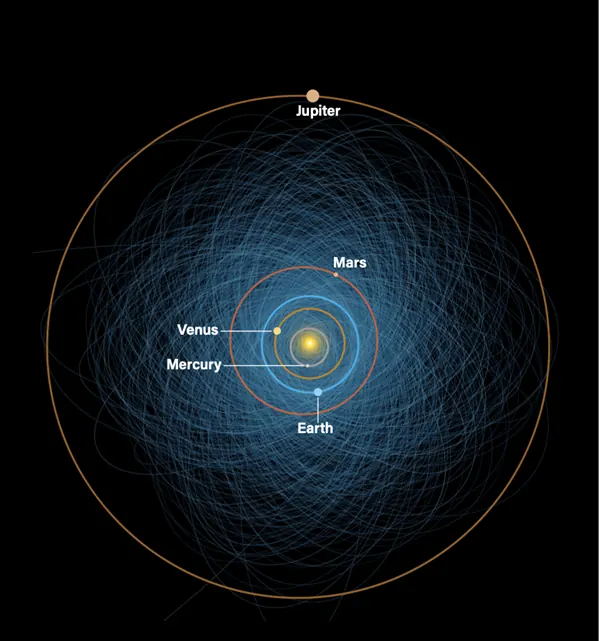
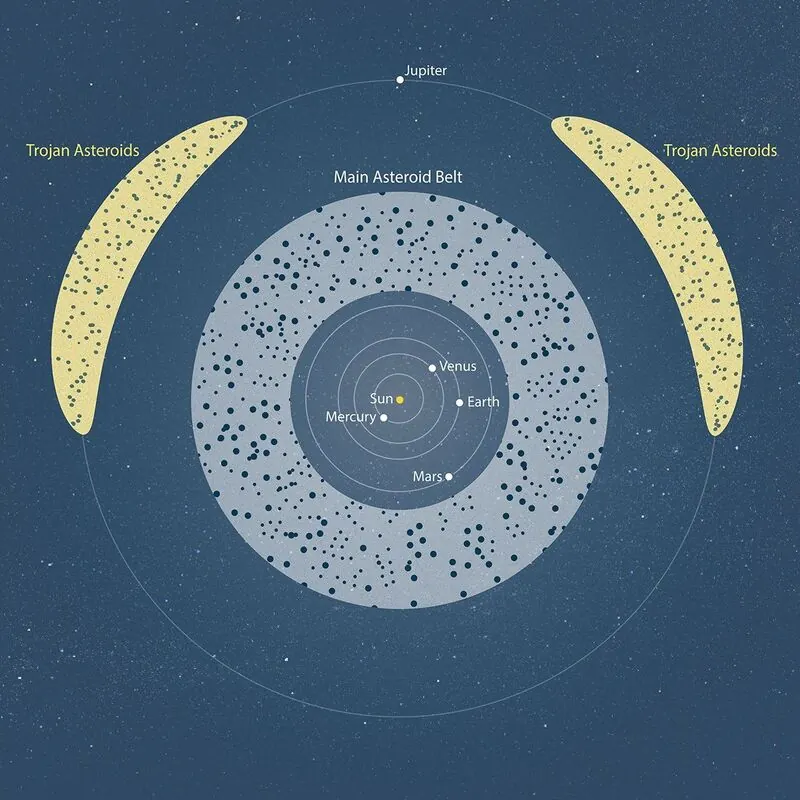
When we picture our solar system, we often imagine the Sun at the center, with the planets following neat, concentric orbits. Between the orbits of Mars and Jupiter, however, lies a region that defies this simple image: the Asteroid Belt. Far from the densely packed field of colliding rocks seen in movies, the Asteroid Belt is a vast and largely empty space, home to a fascinating collection of remnants from the solar system's earliest days.
The story of the Asteroid Belt begins over 4.6 billion years ago with the Nebular Hypothesis. As the solar system formed from a spinning disk of gas and dust, the gravitational pull of the young Jupiter stirred up the material between it and Mars, preventing Mars from ever becoming a full-sized planet. Countless planetesimals (the building blocks of planets) in this region continued to collide and break apart. Today's asteroids are the survivors of this process, the leftover debris from the solar system's construction.
The story of the Asteroid Belt begins over 4.6 billion years ago with the Nebular Hypothesis. As the solar system formed from a spinning disk of gas and dust, the gravitational pull of the young Jupiter stirred up the material between it and Mars, preventing Mars from ever becoming a full-sized planet. Countless planetesimals (the building blocks of planets) in this region continued to collide and break apart. Today's asteroids are the survivors of this process, the leftover debris from the solar system's construction.
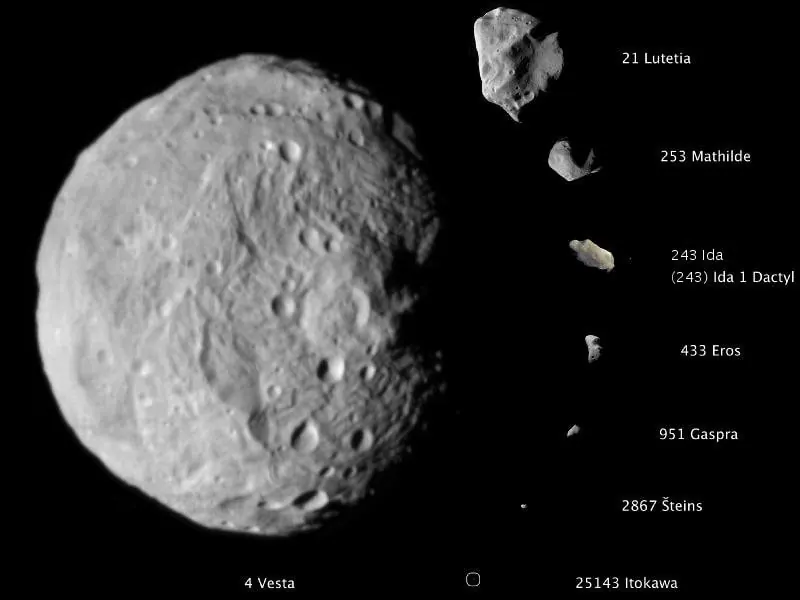
While over 1.3 million asteroids have been catalogued, the total mass of the belt is only about 4% of our Moon's mass. The population is dominated by small rocks, with more than a million objects over 1 km in diameter. The largest object is the dwarf planet Ceres, which is about 950 km across and contains a significant portion of the belt's total mass.
Asteroid Types
The asteroids are not uniform in their composition. They are largely categorized into three main types based on their makeup, which correlates with their distance from the Sun:
Temperatures were too high for volatile substances to condense close to the Sun, leading to rocky planets and asteroids, while cooler temperatures farther away allowed ices to form.
- C-type (Carbonaceous): Dark, carbon-rich, and very common in the outer belt.
- S-type (Silicaceous): Brighter, composed of silicate minerals and some metal, more common in the inner belt.
- M-type (Metallic): Metallic nickel-iron, thought to be fragments of larger asteroids' cores.
Temperatures were too high for volatile substances to condense close to the Sun, leading to rocky planets and asteroids, while cooler temperatures farther away allowed ices to form.
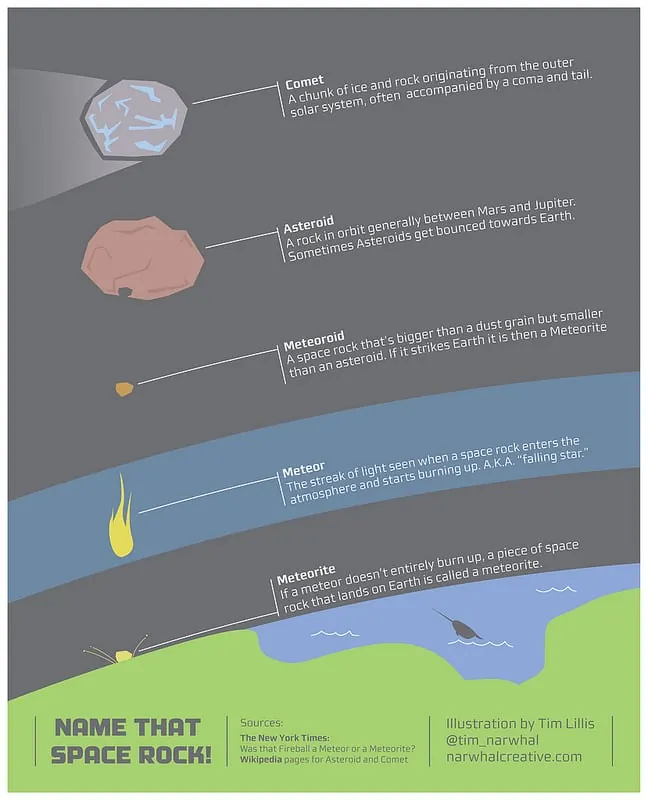
Not to be mistaken with meteor, meteoroid, and comets.
Asteroids on the Move: Near-Earth Objects
|
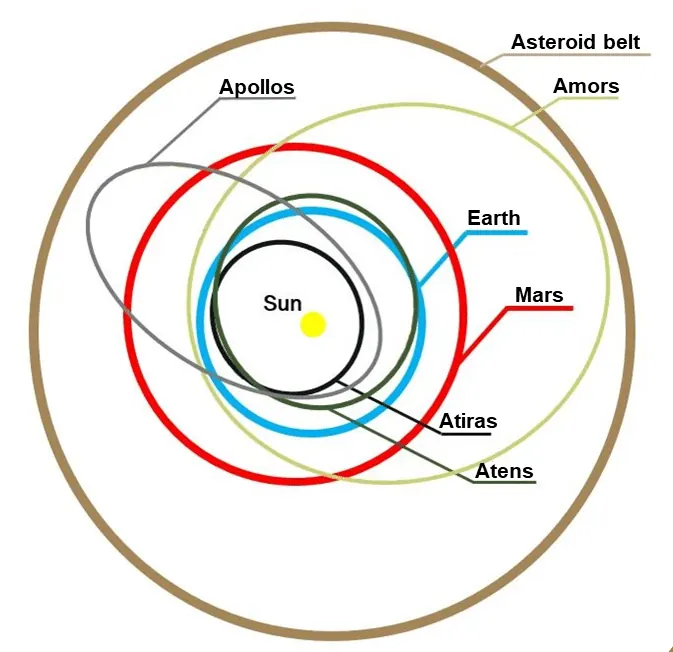
While most asteroids reside in the main belt, the gravitational influence of Jupiter, along with mutual collisions, can change their orbits. This can send them on new paths that bring them into the inner solar system.
These asteroids, along with comets that have been nudged from the colder outer reaches, are known as Near-Earth Objects (NEOs). NEOs are defined as any small solar system body whose orbit brings it within 1.3 Astronomical Units (AU) of the Sun.
|
 |
The Threat of Impacts and Planetary Defense
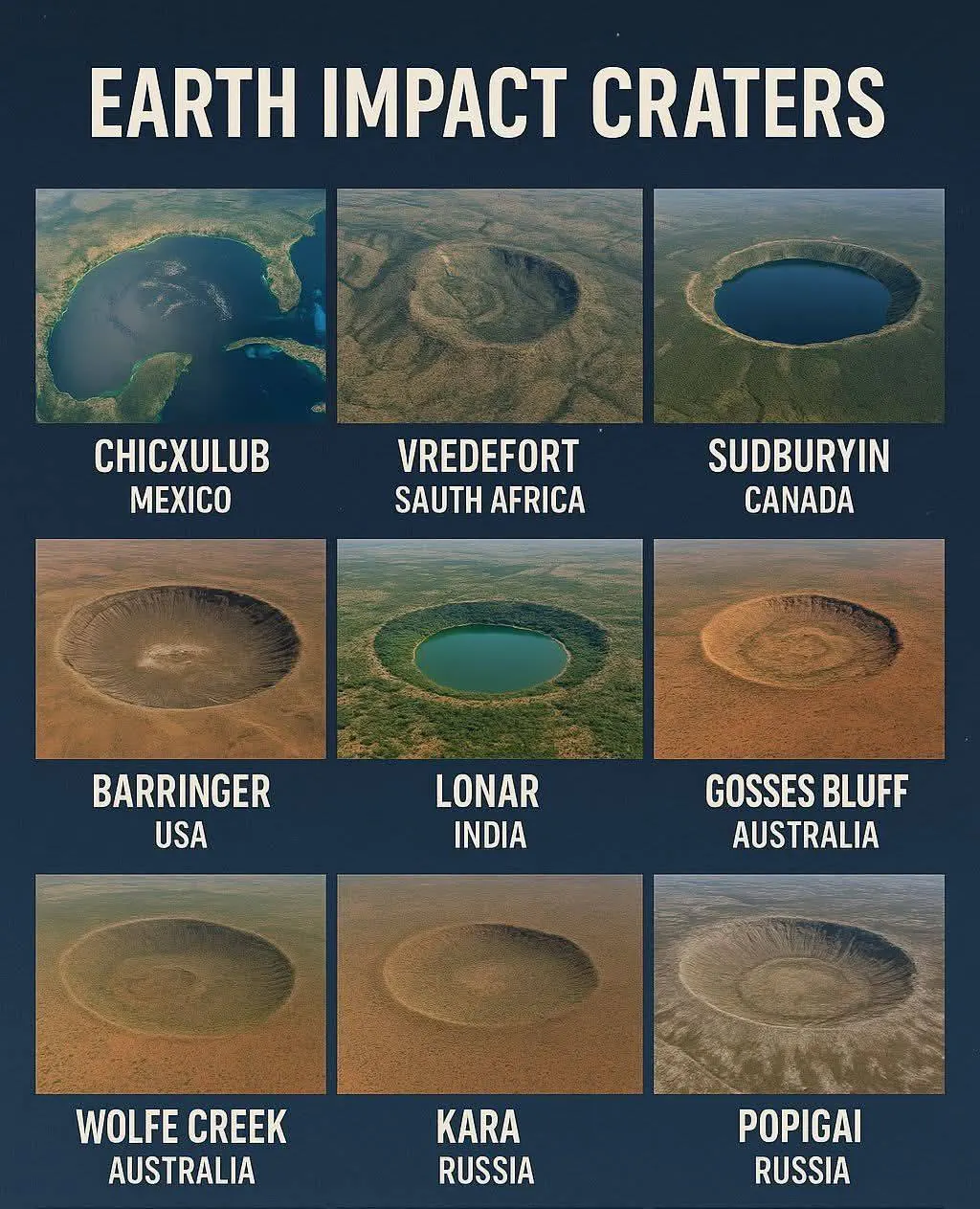
Earth, like all planets, has always been in a cosmic shooting gallery. The presence of impact craters on Earth, the Moon, and every other solid body in the solar system provides clear evidence that collisions have been a regular process throughout its history. While Earth's atmosphere protects us from most small asteroids, which burn up as meteors, a larger object could reach the surface or explode in the atmosphere with significant consequences.
The potential energy released by an impacting object depends on its size, speed, and composition. An impact from an object just one kilometer in diameter would release energy far exceeding that of our most powerful nuclear weapons, with global effects on climate and ecosystems. It is widely accepted that the impact of a large asteroid was a principal cause of the mass extinction that ended the age of the dinosaurs 66 million years ago.
The potential energy released by an impacting object depends on its size, speed, and composition. An impact from an object just one kilometer in diameter would release energy far exceeding that of our most powerful nuclear weapons, with global effects on climate and ecosystems. It is widely accepted that the impact of a large asteroid was a principal cause of the mass extinction that ended the age of the dinosaurs 66 million years ago.
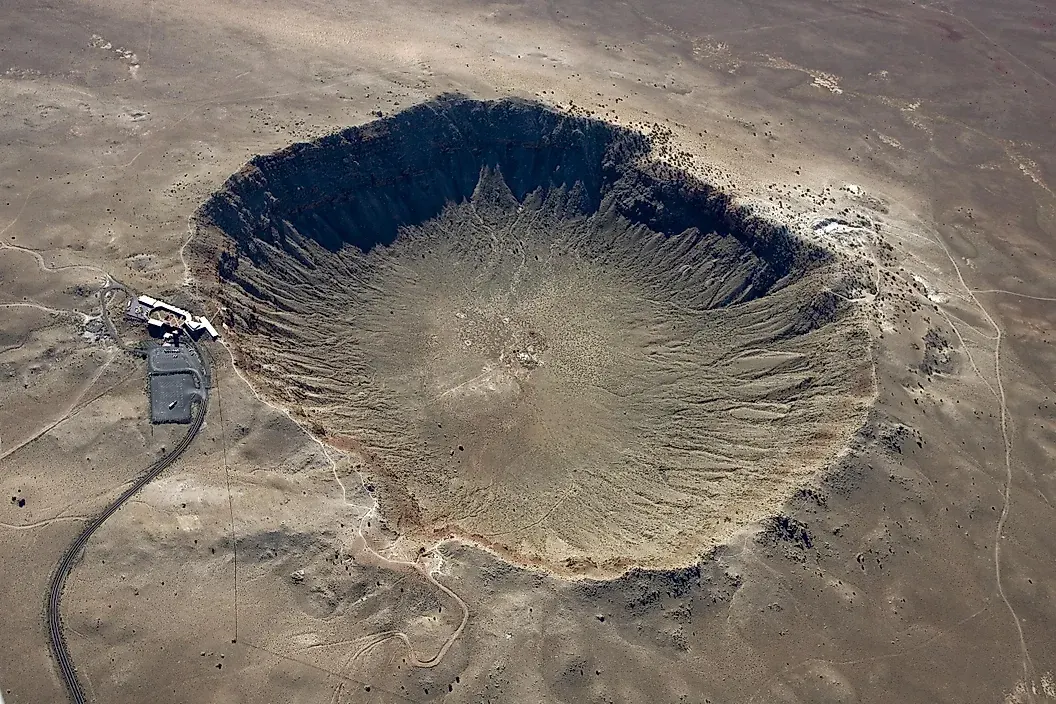
The Barriger Crater in Arizona
This understanding has led to the development of planetary defense, a field of science and engineering focused on detecting and mitigating potential impact threats. This multi-step process involves:
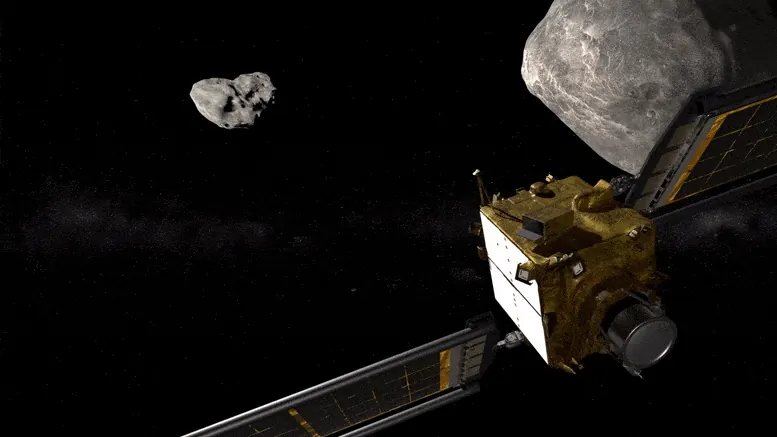
In 2022, NASA's DART mission successfully demonstrated this technology by altering the orbit of a small moonlet orbiting an asteroid.
- Finding and Tracking: The first step is to find them. International efforts, such as NASA's Planetary Defense Coordination Office, use ground-based telescopes to systematically scan the skies, cataloguing NEOs and precisely calculating their orbits far into the future. The vast majority of the largest, most potentially hazardous objects have already been identified and are not a threat for the foreseeable future.
- Characterizing: Once found, scientists use radar and spectroscopic observations to determine an asteroid's size, shape, composition, and rotation. This information is vital for planning any potential mitigation mission.
- Mitigation: If an asteroid were ever found to be on a collision course with Earth, several strategies have been proposed to deflect it. The most tested method is a kinetic impactor, which involves sending a spacecraft to collide with the asteroid at high speed, subtly changing its velocity and nudging it off course over time.
In 2022, NASA's DART mission successfully demonstrated this technology by altering the orbit of a small moonlet orbiting an asteroid.