Day and Night
The regular cycle of daylight and darkness we experience is caused by the rotation of the Earth. Earth spins on an imaginary line called its axis, which runs from the geographic North Pole to the South Pole. This axis is tilted at an angle of approximately 23.5 degrees from the line normal to Earth's orbital plane around the Sun.
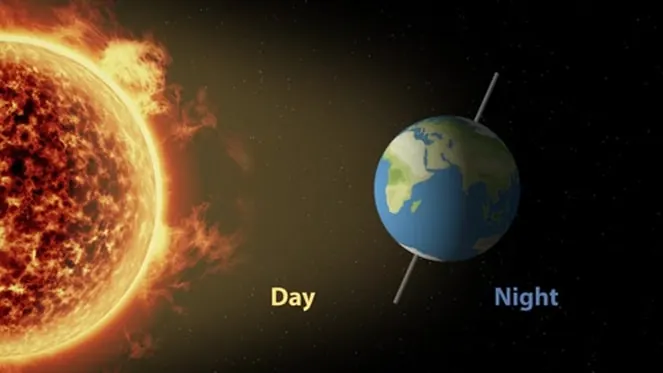
This rotation occurs in a west-to-east direction. As the Earth turns, different parts of its surface are exposed to the light of the Sun, creating day, while the opposite side faces away into the darkness of space, creating night. One complete rotation defines the length of a day, but astronomers use two different measurements based on different points of reference: the solar day and the sidereal day.
Sidereal Day
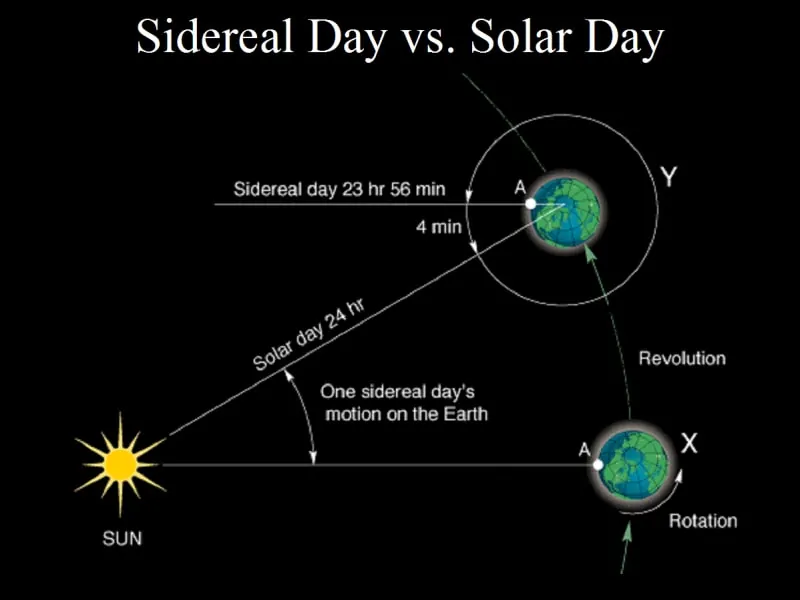
A sidereal day is the time it takes for Earth to complete one full 360-degree rotation on its axis. This period is about 23 hours, 56 minutes, and 4 seconds—approximately four minutes shorter than a solar day.
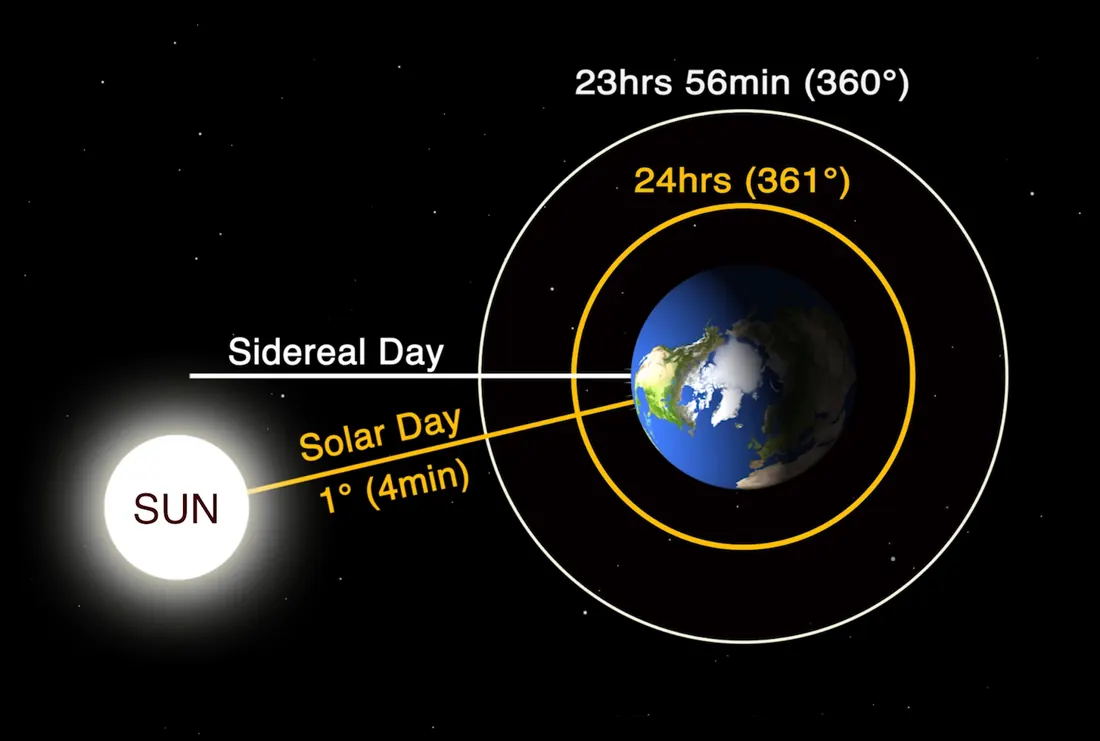
However, from one solar noon to the next solar noon (in the next day), Earth must rotate slightly further to "catch up" to the new position created by its orbital motion around the Sun.
Solar Day
A solar day is defined as the time it takes for the Sun to return to the same position at its highest point, known as local noon, on two consecutive days. This period is exactly 24 hours as measured by clocks.
However, during the time it takes Earth to complete one rotation relative to the Sun, it has also moved a short distance along its orbit around the Sun. To complete a solar day, Earth must therefore rotate a little more than 360 degrees. (about 1 degree more)
However, during the time it takes Earth to complete one rotation relative to the Sun, it has also moved a short distance along its orbit around the Sun. To complete a solar day, Earth must therefore rotate a little more than 360 degrees. (about 1 degree more)