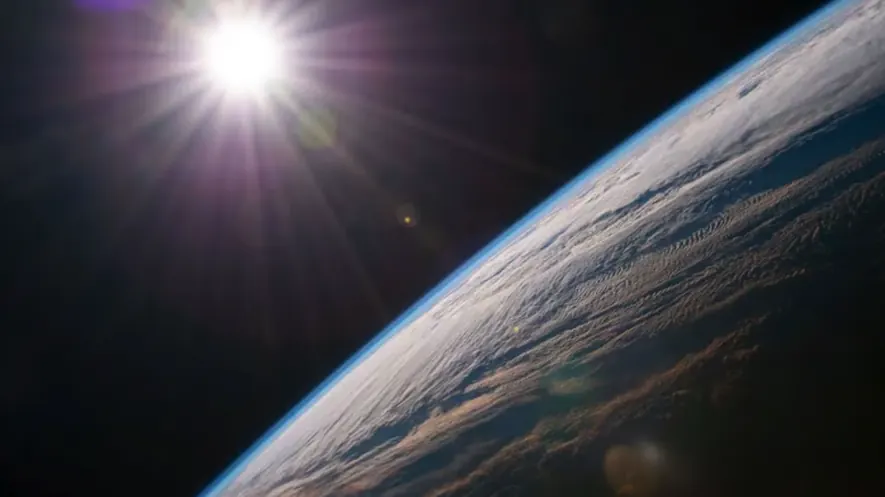
Part 1: The Goldilocks Zone
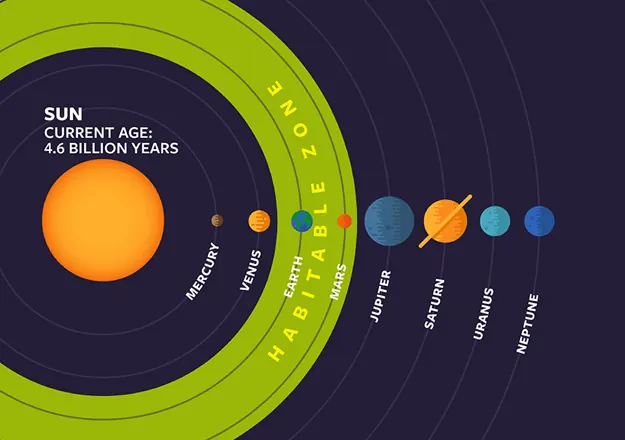
Earth is the only planet in our solar system on which life is known to exist. This is influenced by its position within a specific orbital region around the Sun known as the Circumstellar Habitable Zone, often referred to as the "Goldilocks Zone."
In this zone, the amount of solar energy received is within a range that allows water to exist in a liquid state on the planet's surface. If Earth orbited much closer to the Sun, the increased solar radiation would likely cause surface water to vaporize. If it orbited much farther away, lower temperatures would cause surface water to remain permanently frozen.
Earth's position within this zone provides a temperature range that enables the stable, long-term presence of liquid water, which is considered necessary for all known forms of life. Alongside other planetary features such as a protective atmosphere and magnetic field, this orbital position supports the conditions that make Earth habitable.
In this zone, the amount of solar energy received is within a range that allows water to exist in a liquid state on the planet's surface. If Earth orbited much closer to the Sun, the increased solar radiation would likely cause surface water to vaporize. If it orbited much farther away, lower temperatures would cause surface water to remain permanently frozen.
Earth's position within this zone provides a temperature range that enables the stable, long-term presence of liquid water, which is considered necessary for all known forms of life. Alongside other planetary features such as a protective atmosphere and magnetic field, this orbital position supports the conditions that make Earth habitable.
Comparing Venus, Earth, and Mars
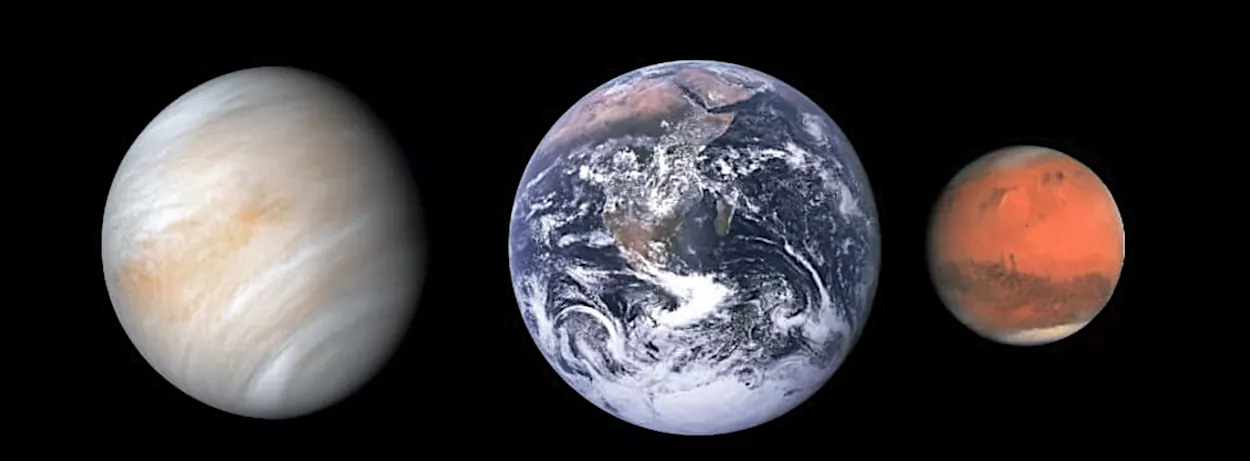
To understand the Goldilocks Zone, astronomers often compare Earth to its "sister" planets. While distance from the Sun is the starting point, a planet’s atmosphere acts like a lid on a bowl of porridge, determining how much heat is kept inside.
|
Planet Venus Earth Mars |
Distance from Sun 0.72 AU 1.00 AU 1.52 AU |
Surface Temperature 464°C (867°F) 15°C (59°F) -65°C (-85°F) |
Status Too Hot Just Right Too Cold |
Note: 1AU (Astronomical Unit) is the average distance from the Earth to the Sun, approximately 150 million kilometers.
Venus: The Runaway Greenhouse
Venus is actually a cautionary tale. Although it is only slightly closer to the Sun than Earth, its atmosphere is 90 times thicker and made almost entirely of Carbon Dioxide.
This creates a "Runaway Greenhouse Effect." The thick clouds trap so much solar heat that the surface is hot enough to melt lead and is far too hot for liquid water. Any oceans Venus might had billions would have been evaporated long ago, leaving the planet a scorched desert.
Venus is actually a cautionary tale. Although it is only slightly closer to the Sun than Earth, its atmosphere is 90 times thicker and made almost entirely of Carbon Dioxide.
This creates a "Runaway Greenhouse Effect." The thick clouds trap so much solar heat that the surface is hot enough to melt lead and is far too hot for liquid water. Any oceans Venus might had billions would have been evaporated long ago, leaving the planet a scorched desert.
Mars: The Deep Freeze
Mars sits near the outer edge of the Goldilocks Zone. In the distant past, Mars likely had a thicker atmosphere and flowing rivers. However, because Mars is much smaller than Earth (only about 10% of Earth's mass), its internal core cooled down quickly.
When the core cooled, Mars lost its protective magnetic field. Without that shield, the solar wind stripped away most of its atmosphere. Today, the air on Mars is so thin that it cannot trap heat. Any water on Mars is now locked away as ice at the poles or hidden underground.
Mars sits near the outer edge of the Goldilocks Zone. In the distant past, Mars likely had a thicker atmosphere and flowing rivers. However, because Mars is much smaller than Earth (only about 10% of Earth's mass), its internal core cooled down quickly.
When the core cooled, Mars lost its protective magnetic field. Without that shield, the solar wind stripped away most of its atmosphere. Today, the air on Mars is so thin that it cannot trap heat. Any water on Mars is now locked away as ice at the poles or hidden underground.
Earth: The "Just Right" Balance
Earth stays habitable because of a perfect "feedback loop." We are at the right distance to receive enough energy, and we have a balanced atmosphere that keeps us warm without boiling.
Most importantly, our active core keeps our magnetic field strong, ensuring our atmosphere (and our water) doesn't blow away into space. This combination of location, protection, and chemistry is what makes Earth the "Goldilocks" of the solar system.
Earth stays habitable because of a perfect "feedback loop." We are at the right distance to receive enough energy, and we have a balanced atmosphere that keeps us warm without boiling.
Most importantly, our active core keeps our magnetic field strong, ensuring our atmosphere (and our water) doesn't blow away into space. This combination of location, protection, and chemistry is what makes Earth the "Goldilocks" of the solar system.
Part 2: The Invisible Shield: Magnetic Field & Magnetosphere
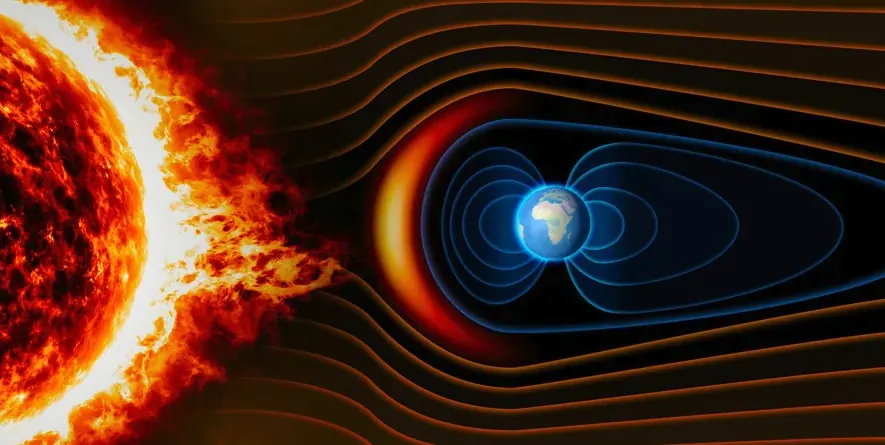
While the atmosphere protects us from radiation and rocks, Earth has another "invisible" protector: the Magnetic Field. Deep inside Earth, the swirling motion of liquid iron in the outer core creates a massive dynamo effect, generating a magnetic field that extends far into space.
The region of space dominated by this field is called the Magnetosphere. Its primary function is to act as a shield against the Solar Wind—a constant stream of charged particles (plasma) ejected by the Sun. Without the magnetosphere, these particles would strip away our atmosphere over millions of years, turning Earth into a barren desert like Mars.
The region of space dominated by this field is called the Magnetosphere. Its primary function is to act as a shield against the Solar Wind—a constant stream of charged particles (plasma) ejected by the Sun. Without the magnetosphere, these particles would strip away our atmosphere over millions of years, turning Earth into a barren desert like Mars.
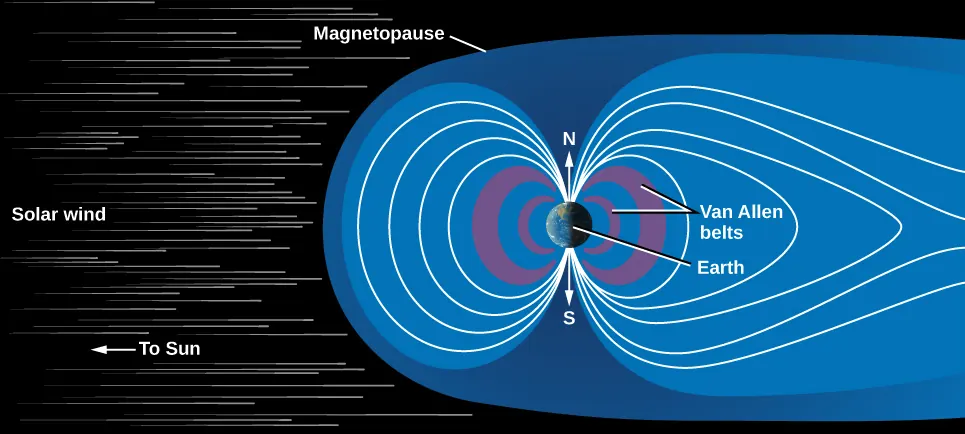
Van Allen Radiation Belts: Inside the magnetosphere are two "donut-shaped" regions that trap energetic charged particles. They act like a storage zone for radiation, keeping it away from the Earth's surface but making it a tricky area for satellites and astronauts to pass through.
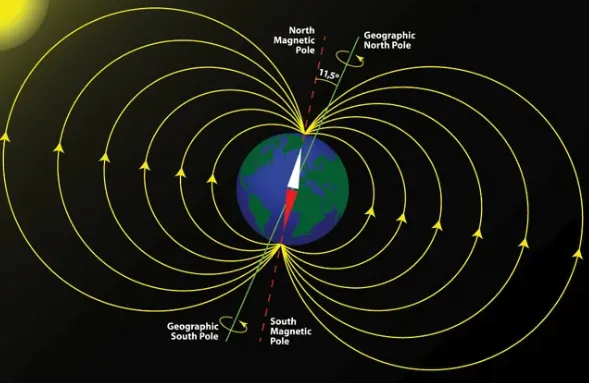
The Magnetic North and South Poles act as the entry and exit points for Earth's magnetic energy, creating "funnels" known as polar cusps where the protective shield of the magnetosphere is most exposed.
Because these field lines dive straight toward the surface at the poles, they allow small amounts of solar radiation to slip through and collide with our atmosphere, igniting the brilliant light shows we know as the Aurora.
Because these field lines dive straight toward the surface at the poles, they allow small amounts of solar radiation to slip through and collide with our atmosphere, igniting the brilliant light shows we know as the Aurora.
 |
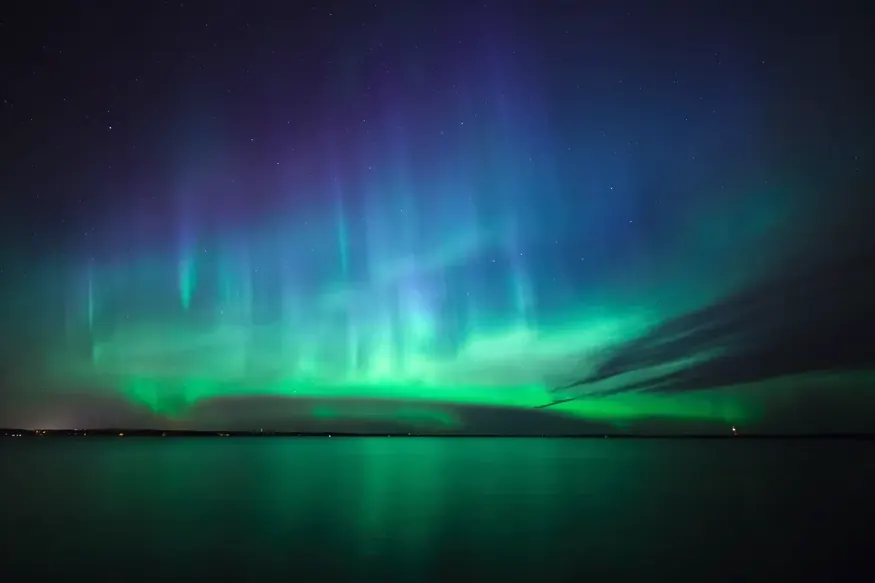 |
The Aurora Effect: Sometimes, solar particles get trapped by our magnetic field and funneled toward the North and South Poles. When these particles collide with gases in our atmosphere, they emit a vibrant glow in greens, purples, and reds.
We refer to these as the Aurora Borealis (Northern Lights) and the Aurora Australis (Southern Lights). They are a beautiful reminder that our planet's invisible shield is working.
We refer to these as the Aurora Borealis (Northern Lights) and the Aurora Australis (Southern Lights). They are a beautiful reminder that our planet's invisible shield is working.
Part 3: The Earth’s Atmosphere
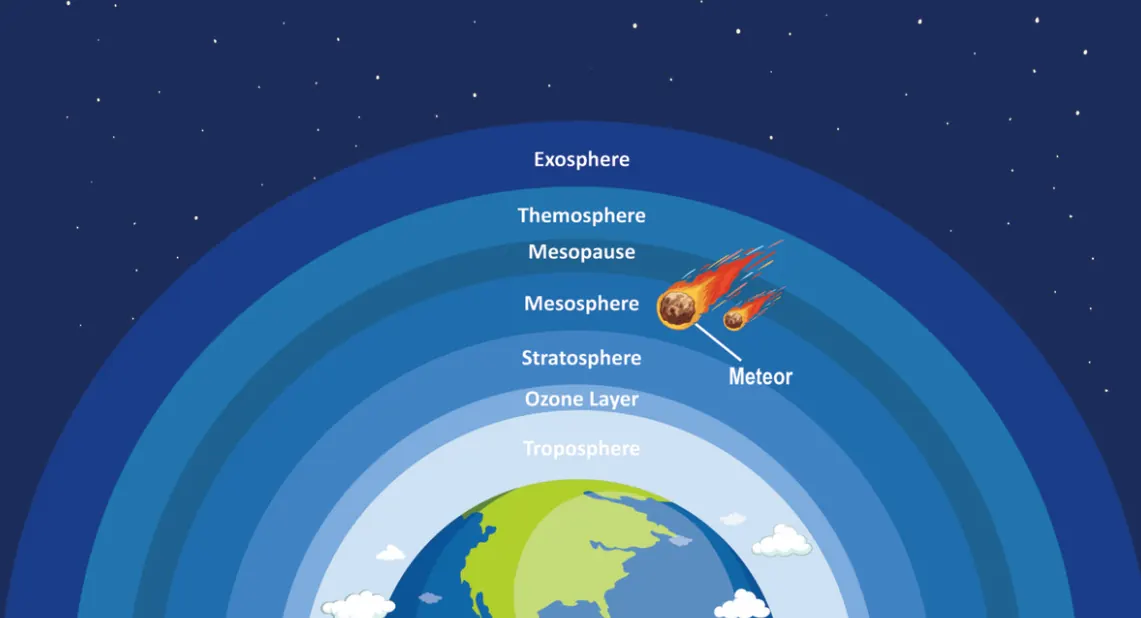
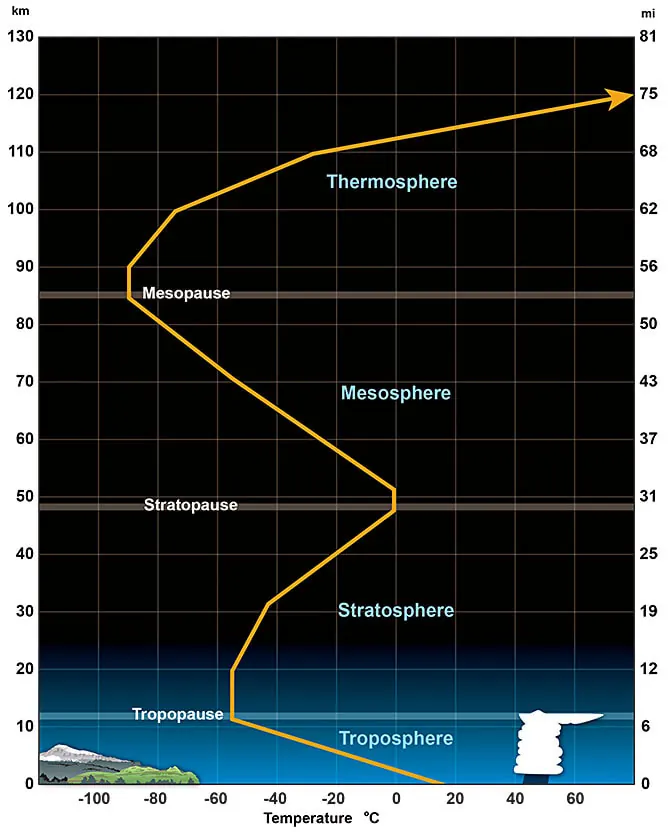
Our atmosphere is a mixture of gases that surrounds the planet, held in place by gravity. It doesn't just provide us with oxygen; it acts as a complex filtration system and a thermal blanket. Scientists divide the atmosphere into five distinct layers based on temperature and composition:
- The Troposphere (0–12 km): This is the layer we live in. It contains 75% of the atmosphere’s mass and almost all of its water vapor. This is where all our weather happens—from rain clouds to thunderstorms. As you moves up, it gets colder.
- The Stratosphere (12–50 km): Home to the Ozone Layer. Ozone absorbs and scatters solar ultraviolet (UV) radiation, protecting our skin and plants from damage by ultraviolet radiation from Space. The Ozone layer absorbs the energy from the UV rays and from this point onward, the air heats up and rises. There boundary between Troposphere and Stratosphere is very stable in terms of weather, because cold troposphere air has no tendency to rise, thus creating a ceiling containing our weather close to ground. But in case there is volcano smoke penetrating through the ceiling, it stays in the Stratosphere and circulate the Earth.
- The Mesosphere (50–85 km): The "Middle Layer." This is the coldest part of the atmosphere. It serves as our first line of defense against space debris; most meteors burn up here due to friction, creating meteor showers.
The Mesopause is the thin boundary layer that separates the Mesosphere from the Thermosphere above it. If you were traveling upward from Earth, this is the exact point where the air stops getting colder and starts getting much, much hotter.
- The Thermosphere (85–600 km): In this layer, temperatures actually rise again because it absorbs high-energy X-rays from the Sun. The air particles can get up to thousands of degrees, but it wouldn't feel hot because the density of air is very low. The International Space Station (ISS) orbits here, which is not a perfect vacuum, that's why it needs to perform orbital boost to maintain altitude.
- The Exosphere (600–10,000 km): The outermost edge of our atmosphere. The air here is extremely thin, and it eventually fades out into the vacuum of space.
Earth is far more than just a rocky planet; it is a perfectly balanced life-support system.
By maintaining the right temperature, preserving liquid water, and recycling vital nutrients through a protective atmosphere, Earth has created an environment where life can not only exist but thrive. While our solar system is vast, the "just right" conditions found here remind us of the fragility and uniqueness of our home.
Whether we are studying the inner planets or hunting for distant Earth-like worlds, the lessons of our own planet's habitability remain the most important guide for our future in space.
By maintaining the right temperature, preserving liquid water, and recycling vital nutrients through a protective atmosphere, Earth has created an environment where life can not only exist but thrive. While our solar system is vast, the "just right" conditions found here remind us of the fragility and uniqueness of our home.
Whether we are studying the inner planets or hunting for distant Earth-like worlds, the lessons of our own planet's habitability remain the most important guide for our future in space.