Engineering for Discovery
It is hard to imagine that machines built by humans have flown beyond Neptune, taken portraits of newborn stars, and drilled into the rocks of another planet. But we did it, as a species.
This chapter follows a few of those missions that changed what we know: Voyager racing past the giant planets, Hubble and the James Webb Space Telescope turning the whole sky into a laboratory, and a sequence of Mars landers and rovers that turned “the Red Planet” from a distant dot into a place with valleys, lakes, and chemistry we can measure.
By looking at what each spacecraft was designed to do—its orbit or trajectory, its main instruments, and the data they collected—you will see how engineering choices directly shape the discoveries scientists can make.
This chapter follows a few of those missions that changed what we know: Voyager racing past the giant planets, Hubble and the James Webb Space Telescope turning the whole sky into a laboratory, and a sequence of Mars landers and rovers that turned “the Red Planet” from a distant dot into a place with valleys, lakes, and chemistry we can measure.
By looking at what each spacecraft was designed to do—its orbit or trajectory, its main instruments, and the data they collected—you will see how engineering choices directly shape the discoveries scientists can make.
Space Probes to the Outer Planets: Voyager 1 and 2
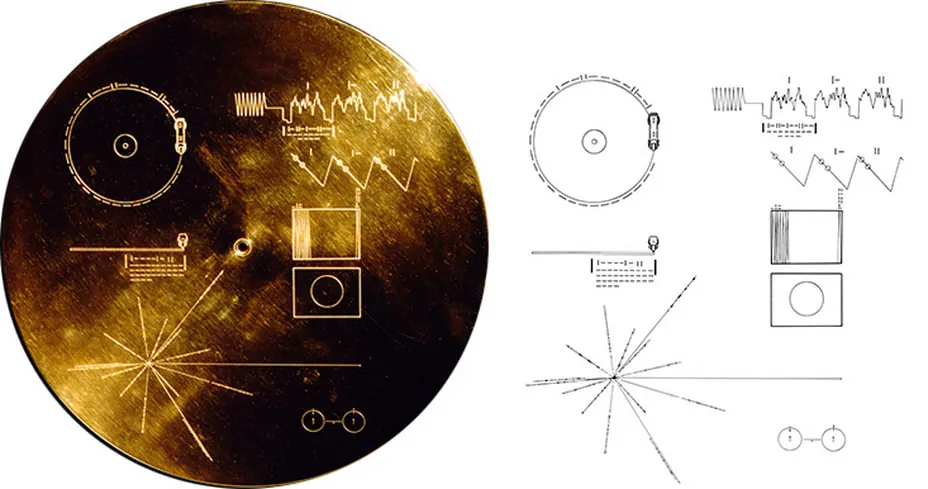
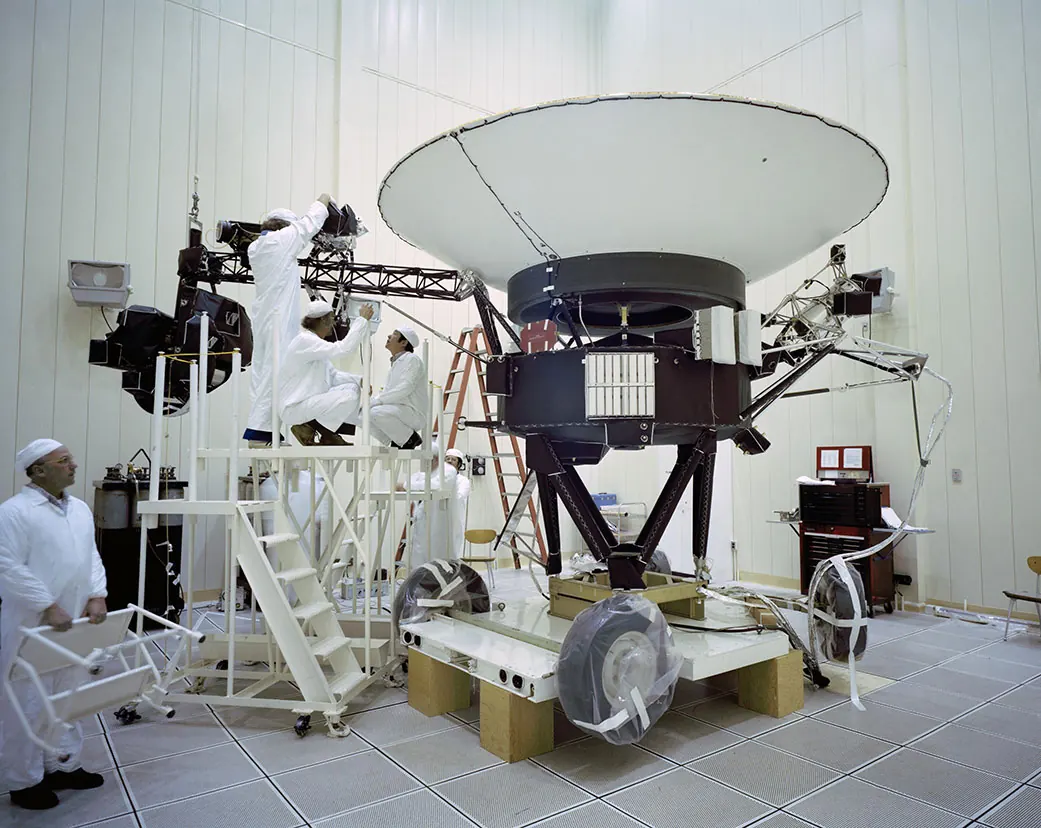
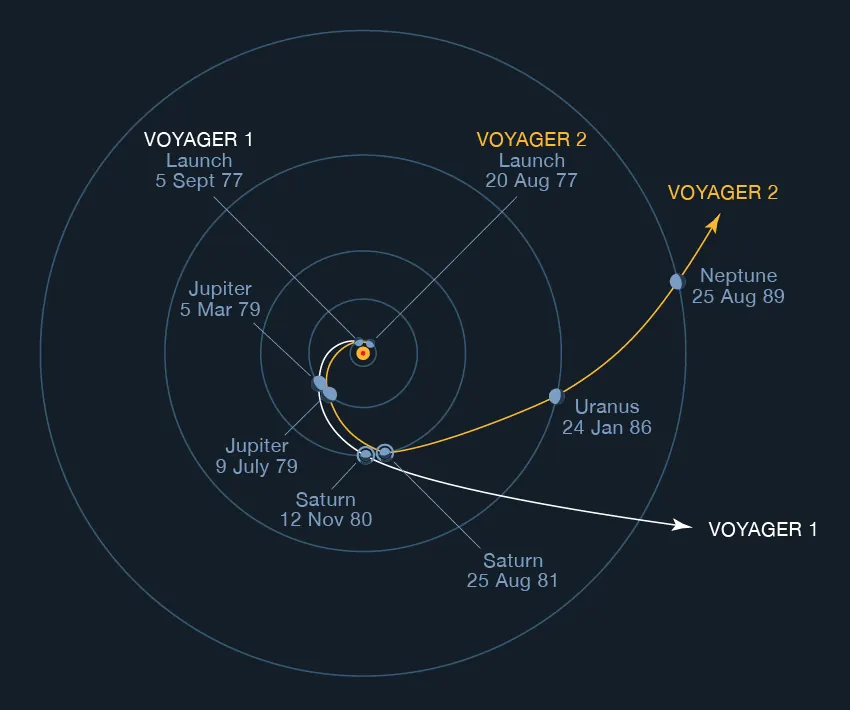
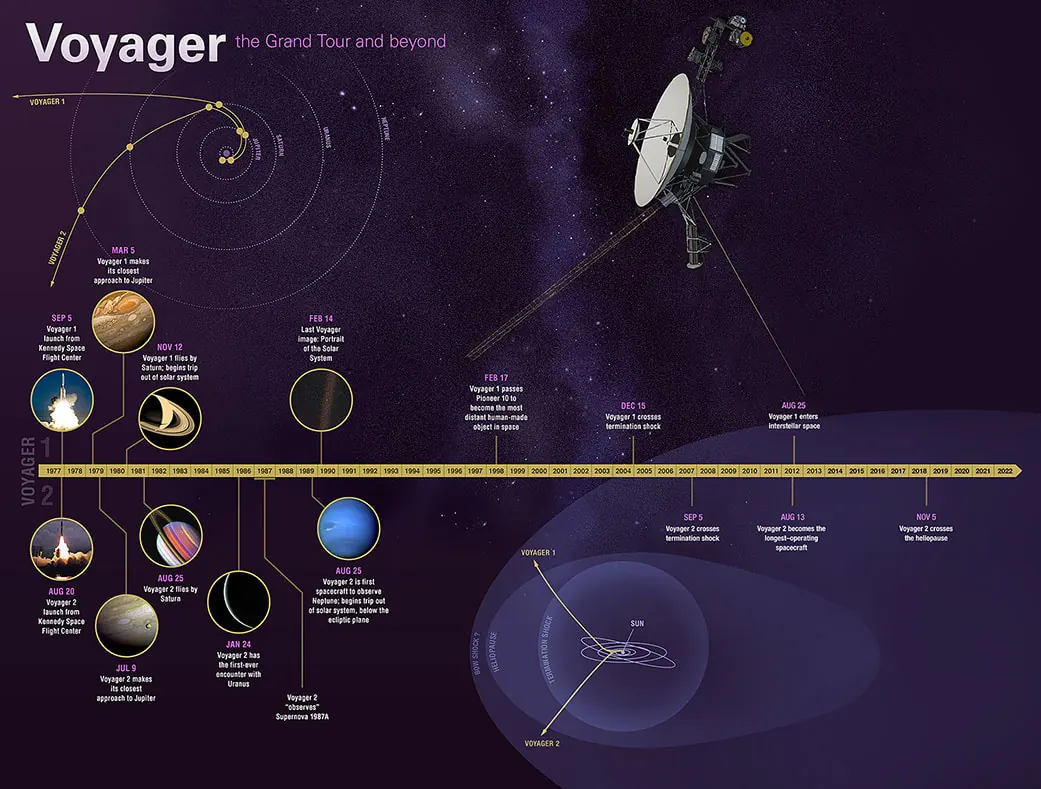
Voyager 1 and Voyager 2 are robotic spacecraft called space probes, which means they travel far from Earth without people on board and send data back by radio. They launched in 1977 to fly past the giant planets and study their atmospheres, rings, and moons using cameras and instruments that measured magnetic fields, charged particles, and radio waves. Voyager 1 flew past Jupiter and Saturn and is now in interstellar space, while Voyager 2 is the only spacecraft to have visited Uranus and Neptune, giving scientists close-up views of these distant worlds and showing that many outer-planet moons have active surfaces with features like volcanoes and icy geysers.
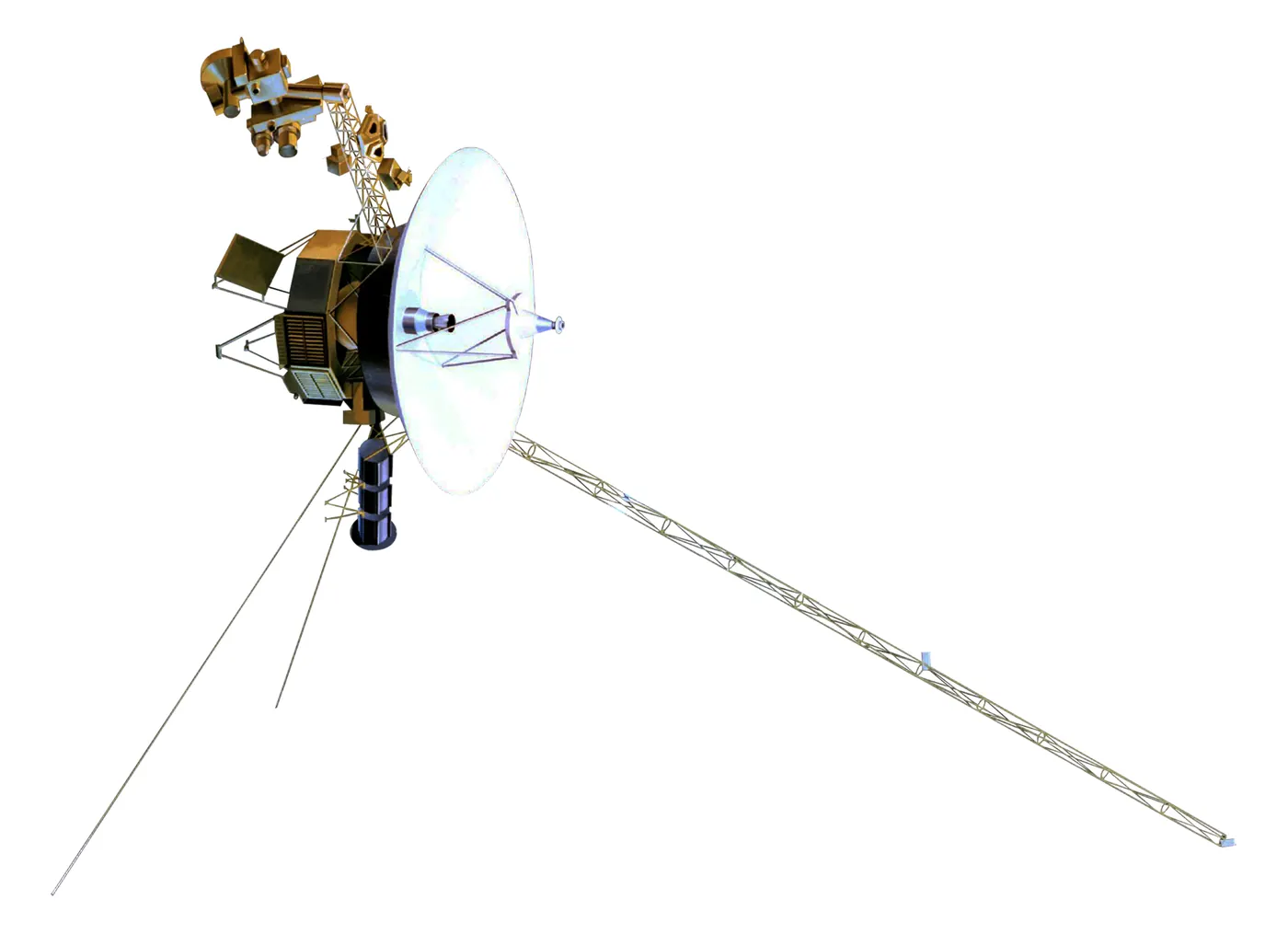
These spacecraft were designed as "flyby" probes, meaning they were built to travel past planets and moons at high speeds rather than landing or entering orbit. Because they had to operate far from the Sun where sunlight is weak, they were equipped with radioisotope thermoelectric generators for power instead of solar panels.
Main Instruments
These spacecraft were designed as "flyby" probes, meaning they were built to travel past planets and moons at high speeds rather than landing or entering orbit. Because they had to operate far from the Sun where sunlight is weak, they were equipped with radioisotope thermoelectric generators for power instead of solar panels.
Main Instruments
- Imaging Science System: High-resolution cameras used to take the first close-up photos of the outer gas giants.
- Magnetometer: A tool used to measure the magnetic fields around planets.
  |
 |
Major Discoveries
The Voyager mission revealed that the outer solar system is geologically active. For example, Voyager 1 discovered active volcanoes on Jupiter’s moon, Io, which was the first time volcanoes were seen on a world other than Earth. Voyager 2 provided the first close-up images of Uranus and Neptune, discovering that Neptune has a massive storm system known as the Great Dark Spot.
The Voyager mission revealed that the outer solar system is geologically active. For example, Voyager 1 discovered active volcanoes on Jupiter’s moon, Io, which was the first time volcanoes were seen on a world other than Earth. Voyager 2 provided the first close-up images of Uranus and Neptune, discovering that Neptune has a massive storm system known as the Great Dark Spot.
Space Telescopes Above Earth: Hubble
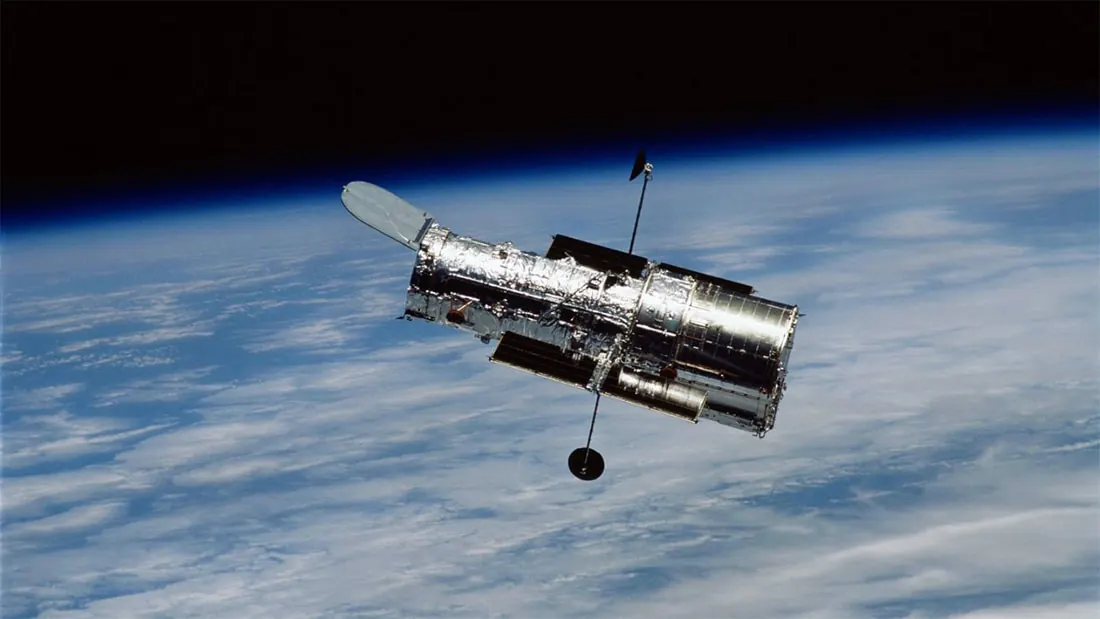
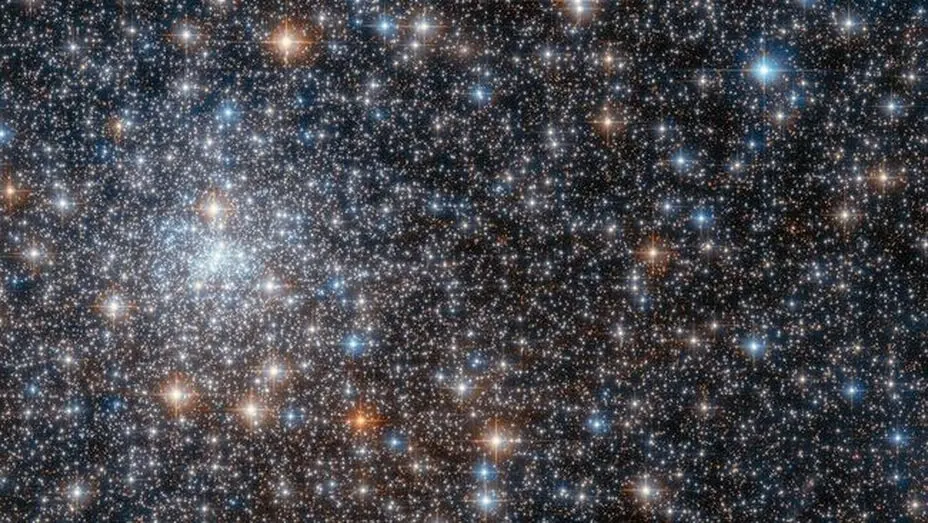
The Hubble Space Telescope is a space telescope that orbits Earth and takes detailed pictures of stars, nebulae, and galaxies without looking through Earth’s air. Hubble carries instruments such as cameras and spectrographs that record light in visible and ultraviolet wavelengths, allowing it to measure how bright and how far away objects are and what they are made of. By staring for many days at small, “empty” patches of sky in projects like the Hubble Deep Field and Ultra Deep Field, it revealed thousands of very faint and distant galaxies, helping scientists study how galaxies formed and changed over billions of years and measure how fast the universe is expanding.
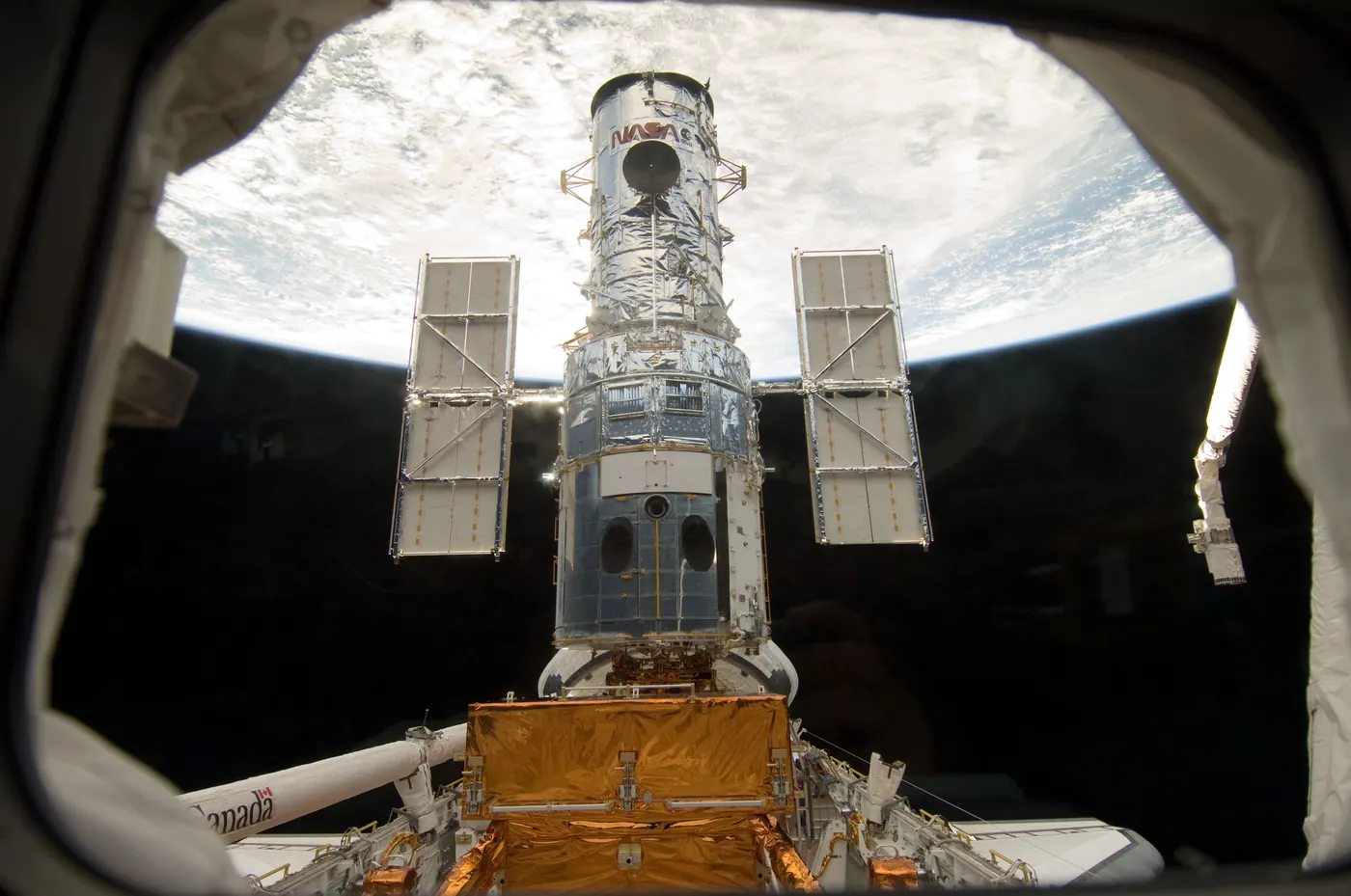
It orbits approximately 547 kilometers above Earth. By placing the telescope above the atmosphere, engineers ensured that its view would not be blurred by Earth's air and weather. It was designed to be modular, allowing astronauts to visit and install new parts or fix old ones.
Main Instruments
Major Discoveries Hubble determined the age of the universe more accurately, placing it at about 13.8 billion years. It also captured the "Pillars of Creation," showing a region in space where new stars are forming from clouds of gas and dust.
Main Instruments
- Wide Field Camera 3 (WFC3): An instrument that captures images in visible, ultraviolet, and near-infrared light.
- Cosmic Origins Spectrograph: A tool that breaks light into colors to study the chemistry of stars and galaxies.
Major Discoveries Hubble determined the age of the universe more accurately, placing it at about 13.8 billion years. It also captured the "Pillars of Creation," showing a region in space where new stars are forming from clouds of gas and dust.
Seeing in Infrared: The James Webb Space Telescope
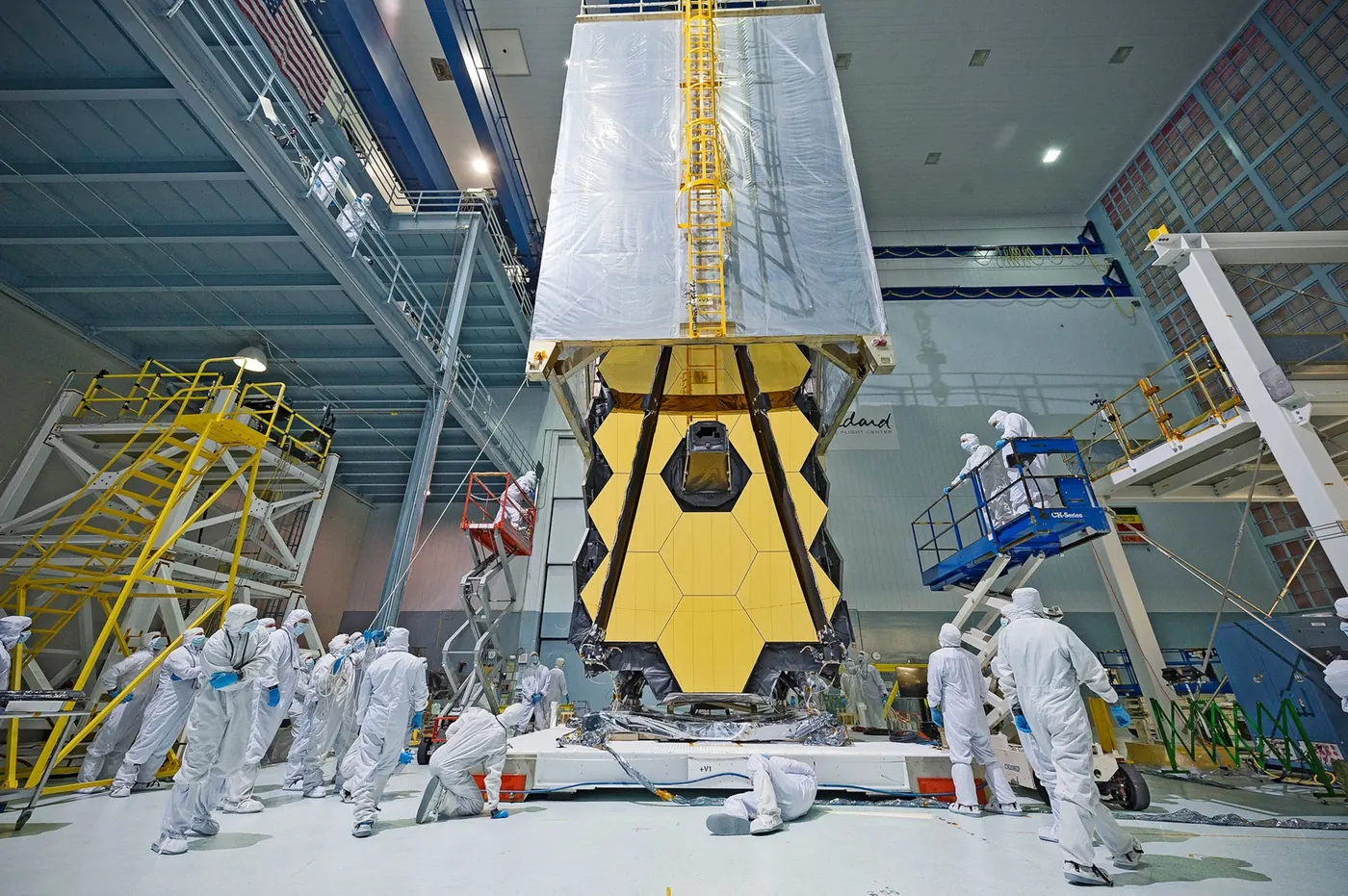
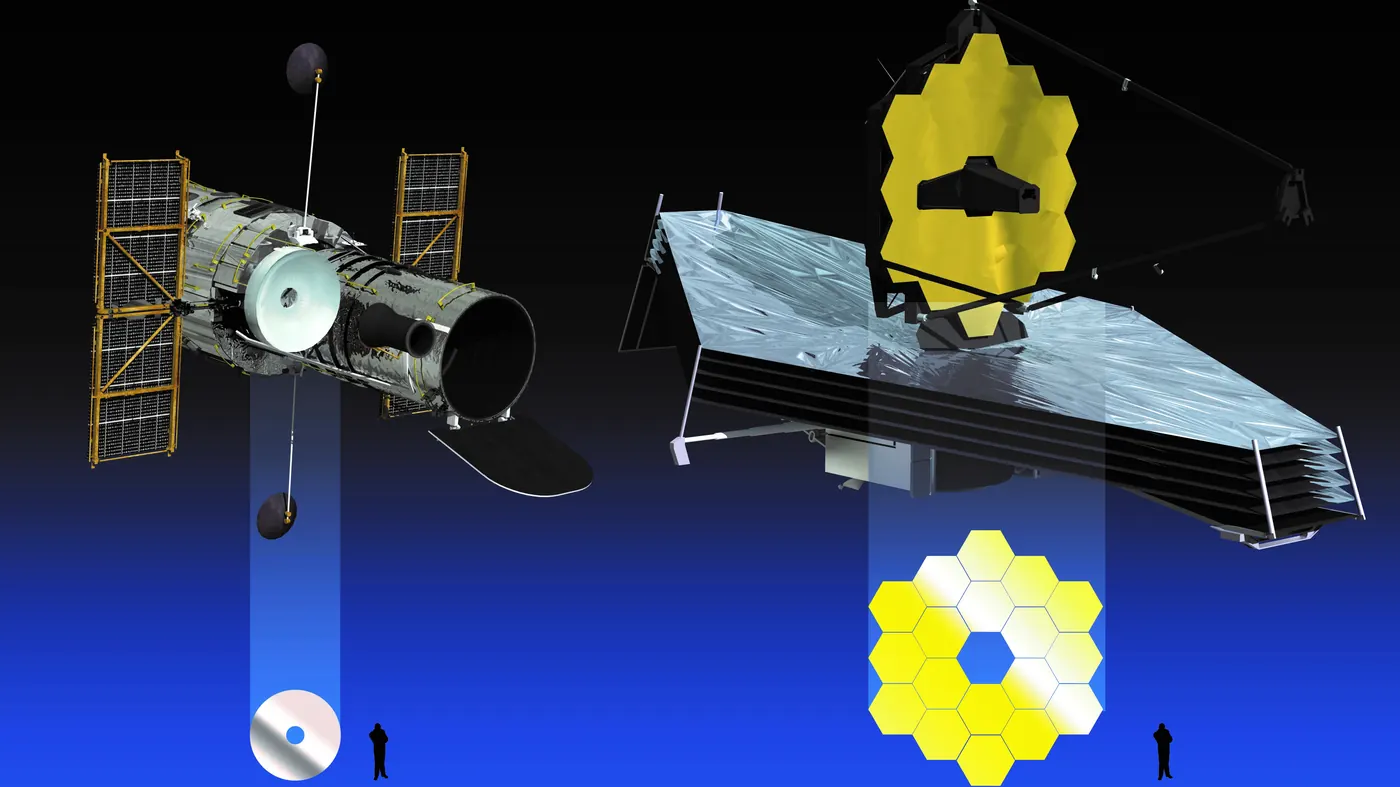
The James Webb Space Telescope (JWST) is a large infrared observatory launched in 2021. Unlike Hubble, it orbits the Sun at a location 1.5 million kilometers away from Earth called the L2 point, where it can stay very cold and shade itself from sunlight. Its design features a massive, gold-coated 6.5-meter mirror and a tennis-court-sized sunshield. Because it detects heat (infrared light), it must be kept extremely cold to work correctly.
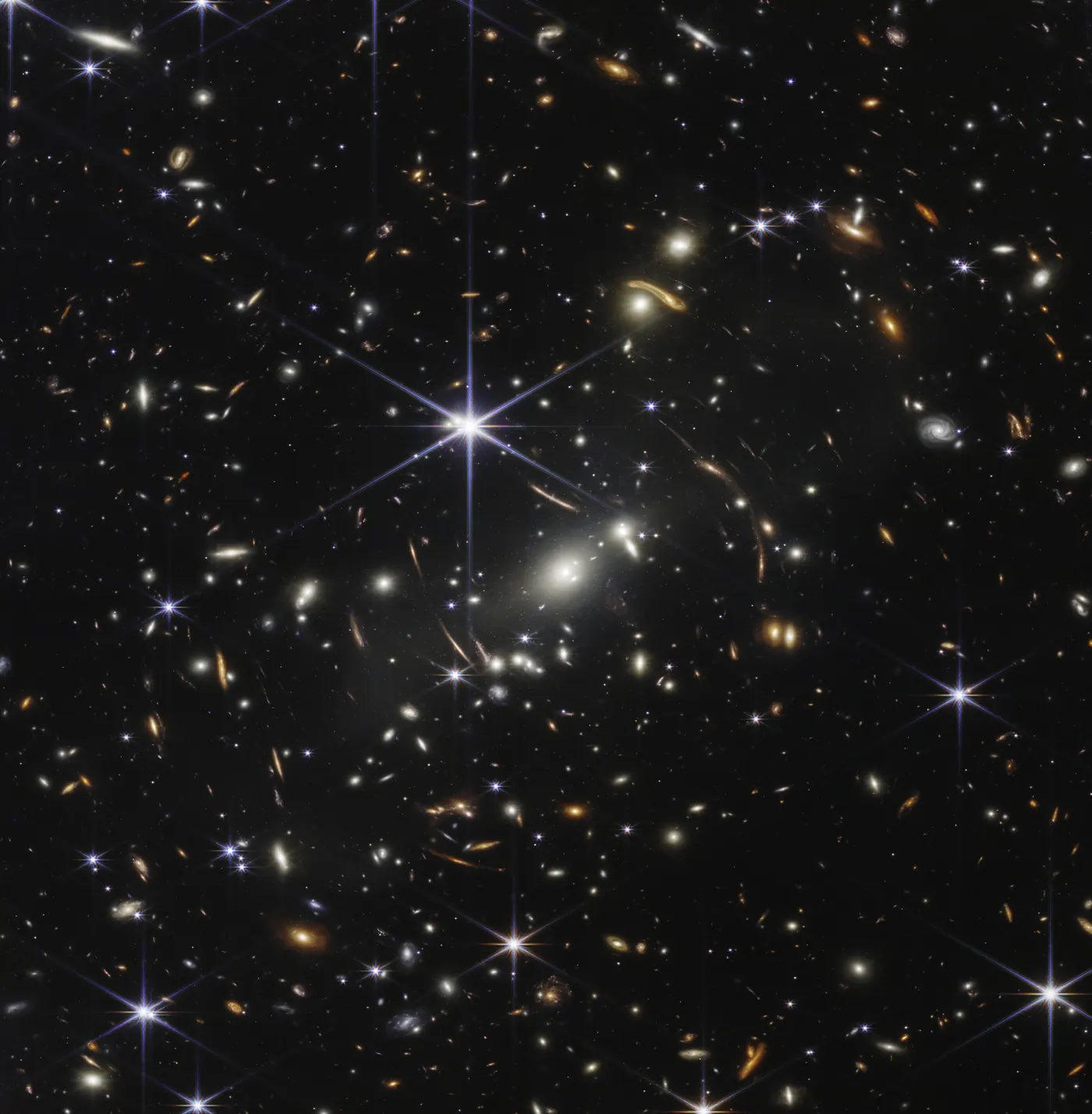
Its main instruments—such as NIRCam, NIRSpec, and MIRI—collect infrared light to study very distant galaxies, young stars still forming inside dust clouds, and the atmospheres of exoplanets that orbit other stars. Webb can detect objects that are much fainter than Hubble can see and looks back to a time when the universe was very young, allowing scientists to investigate some of the first galaxies and to identify exoplanets in debris disks around stars using techniques like coronagraphy.
Its main instruments—such as NIRCam, NIRSpec, and MIRI—collect infrared light to study very distant galaxies, young stars still forming inside dust clouds, and the atmospheres of exoplanets that orbit other stars. Webb can detect objects that are much fainter than Hubble can see and looks back to a time when the universe was very young, allowing scientists to investigate some of the first galaxies and to identify exoplanets in debris disks around stars using techniques like coronagraphy.
Main Instruments
Major Discoveries
JWST has observed the oldest and most distant galaxies ever seen, some forming just a few hundred million years after the universe began. It has also detected water vapor and chemical signatures in the atmospheres of planets orbiting other stars (exoplanets).
- NIRCam (Near-Infrared Camera): A camera that can see through thick clouds of space dust to find the very first stars.
- MIRI (Mid-Infrared Instrument): An instrument that looks for the heat signatures of distant planets.
Major Discoveries
JWST has observed the oldest and most distant galaxies ever seen, some forming just a few hundred million years after the universe began. It has also detected water vapor and chemical signatures in the atmospheres of planets orbiting other stars (exoplanets).
Webb's First Deep Field
Mars Exploration: From Pathfinder to China’s Zhurong
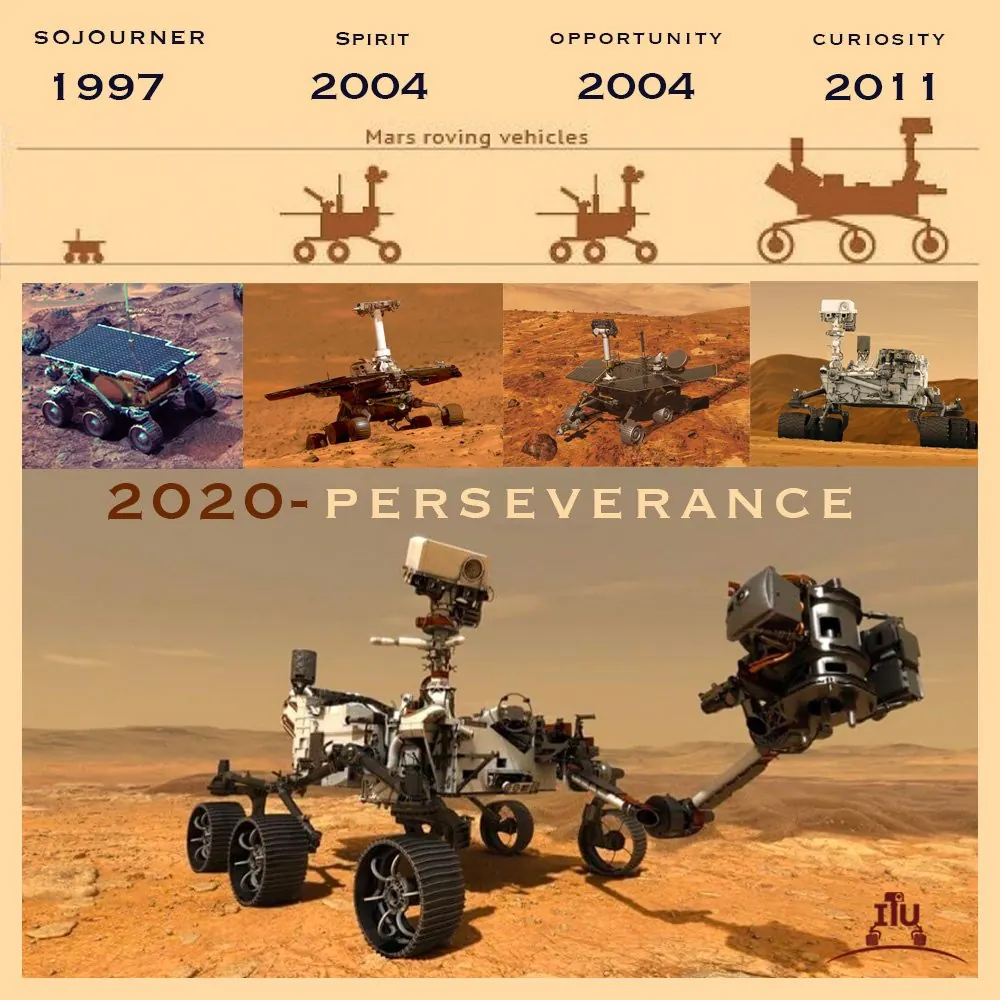
NASA and the China National Space Administration (CNSA) have both sent robotic rovers to study the surface of Mars. These missions began with small machines and grew into large mobile laboratories that can stay on the planet for many years.
- Mars Pathfinder (Sojourner): This was a small, 10-kilogram rover that landed in 1997. It was designed to prove that a mobile robot could move on Mars.
- Spirit and Opportunity: These twin rovers landed in 2004. They acted as "robotic geologists," using cameras and robotic arms to look at rocks.
- Curiosity and Perseverance: These are the largest NASA rovers. Curiosity (2012) uses a laser to study rock chemistry, while Perseverance (2021) collects rock samples to be brought back to Earth.
- Tianwen-1 (Zhurong): China’s first Mars rover, named Zhurong, landed in 2021 in a flat area called Utopia Planitia. It used solar panels shaped like butterfly wings to collect power from the Sun.
 |
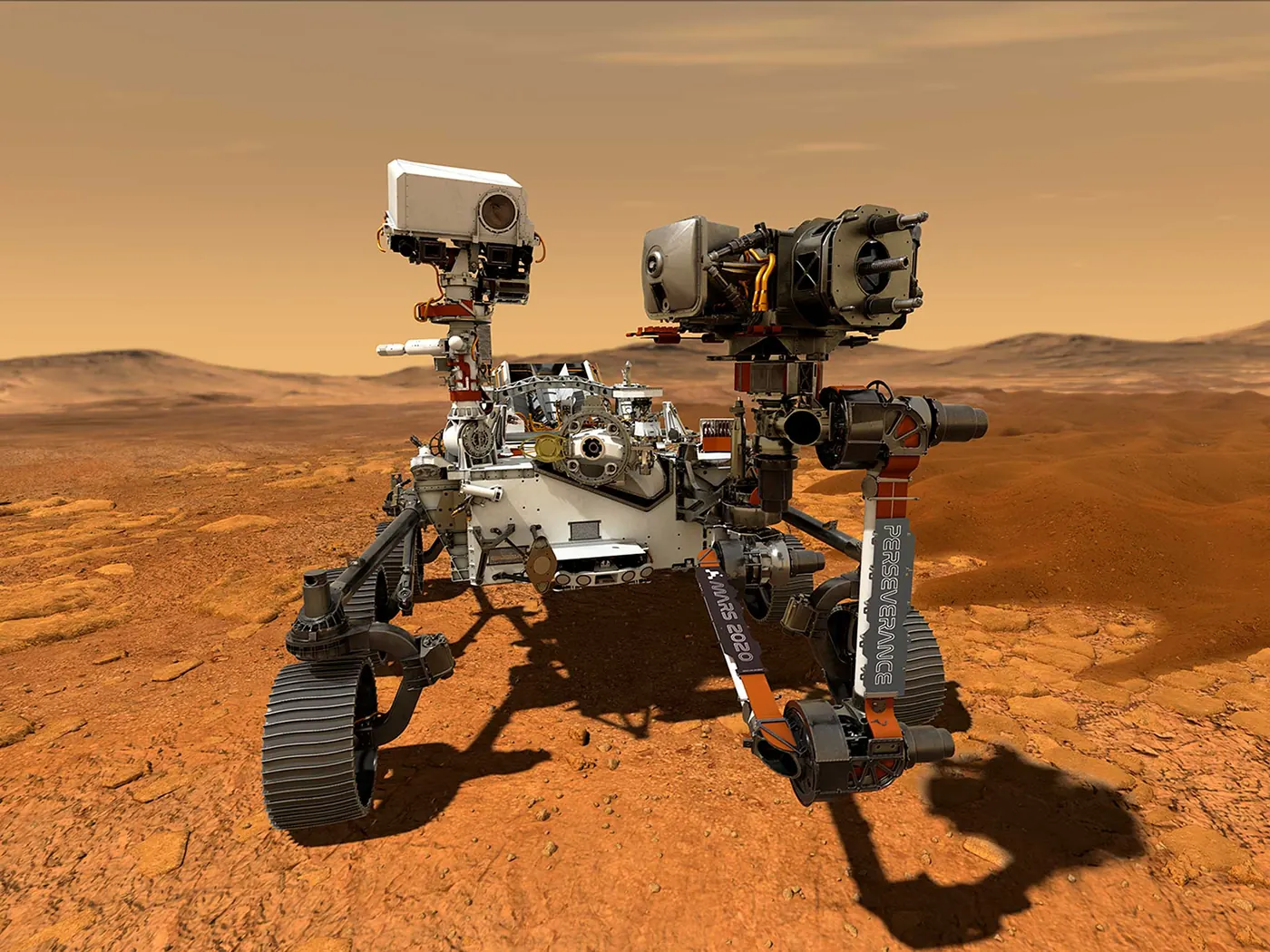 Perseverance
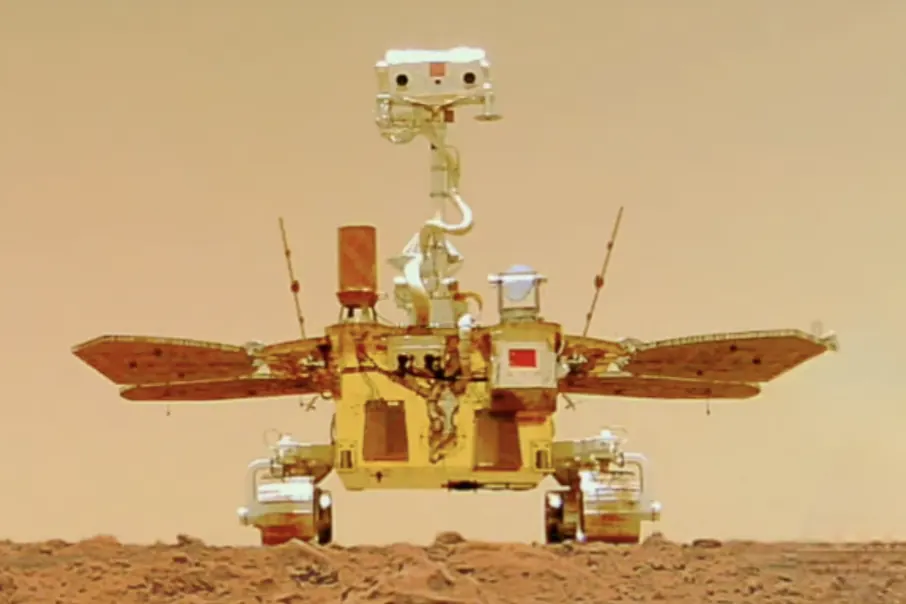 Zhurong
|
Main Instruments
Major Discoveries
Mars exploration has shown that the planet was once a very different place. The Opportunity rover found small, round rocks called "blueberries" that only form in water. More recently, data from the Zhurong rover's radar and cameras showed evidence of ancient "beaches" and sedimentary layers. These findings, along with recent studies from early 2026, suggest that a large ocean might have covered the northern part of Mars for much longer than previously thought—possibly until 750 million years ago.
- Mastcam-Z (NASA): High-definition zoom cameras on the Perseverance rover that allow engineers to see the landscape in 3D and color.
- Mars Surface Composition Detector or MarSCoDe (CNSA): A tool on Zhurong that uses a laser to vaporize small pieces of rock. It then looks at the light produced to identify what elements (like iron or magnesium) the rock is made of.
- Mars Rover Penetrating Radar (CNSA): This instrument on Zhurong sends radio waves down into the ground. By measuring how the waves bounce back, engineers can map layers of soil and ice hidden beneath the surface.
- SHERLOC (NASA): A laser on Perseverance that looks for organic molecules, which are the building blocks of life.
Major Discoveries
Mars exploration has shown that the planet was once a very different place. The Opportunity rover found small, round rocks called "blueberries" that only form in water. More recently, data from the Zhurong rover's radar and cameras showed evidence of ancient "beaches" and sedimentary layers. These findings, along with recent studies from early 2026, suggest that a large ocean might have covered the northern part of Mars for much longer than previously thought—possibly until 750 million years ago.
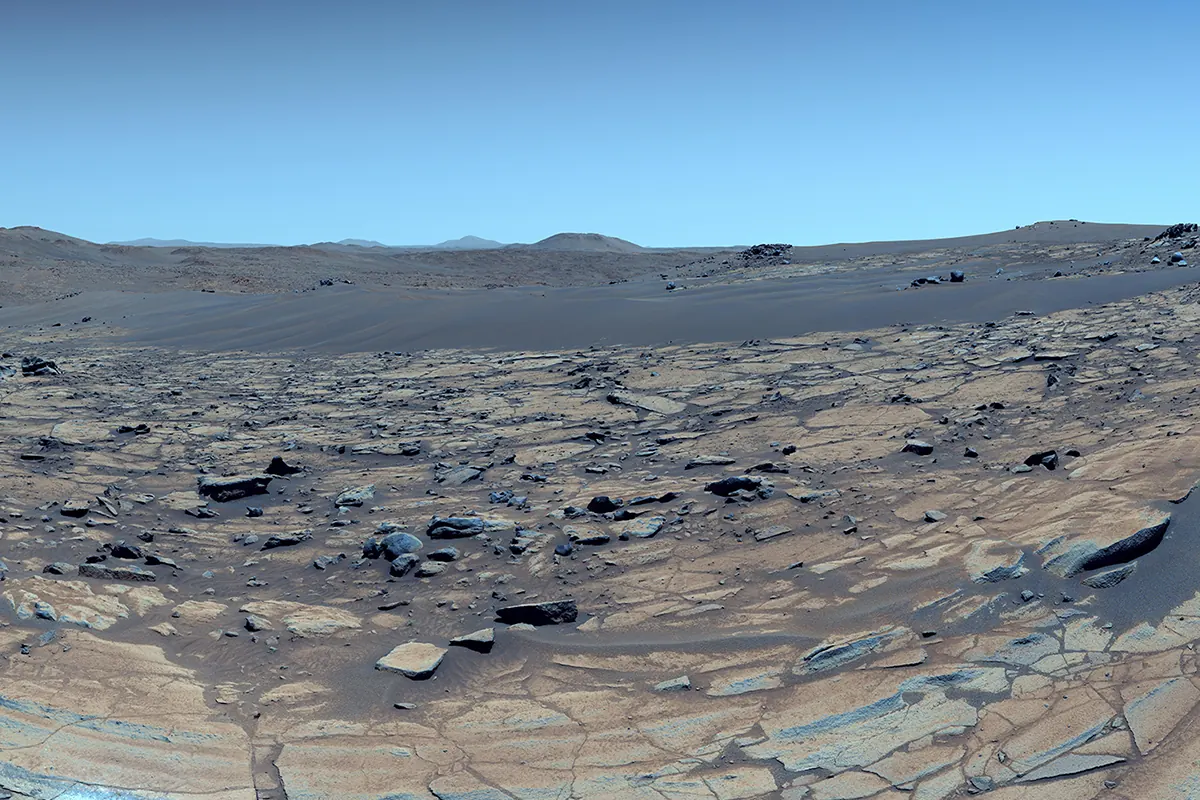
Panoramas captured by Perseverance
From Design to Discovery
The missions explored in this chapter show that space exploration is a result of careful engineering. Every part of a spacecraft—from the gold mirrors of the James Webb Space Telescope to the ground-penetrating radar on the Zhurong rover—is designed to solve a specific problem. As technology improves, engineers develop new instruments that allow us to see further into the past and deeper into the soil of other worlds. The success of these missions does not just provide beautiful images; it provides the data necessary to understand the history of our solar system and the possibility of life beyond Earth.