The Misconception of "Up"
|
Before we dive into the mathematics of orbital velocity, let's start with a simple question: When a rocket launches, does it go straight up, or does it go sideways?
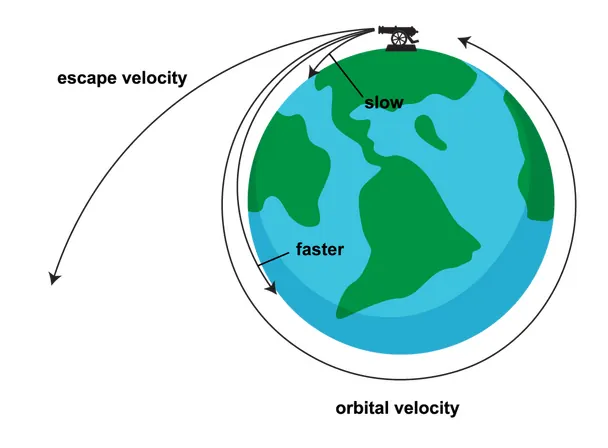
If you pictured a rocket soaring vertically into the sky, you're not wrong—but you're not entirely right either. A rocket does initially launch vertically to efficiently escape the thickest part of the Earth's atmosphere and minimize drag. However, if it continued straight up, it would simply fall right back to Earth once its engines cut off. To achieve orbit, a rocket must perform a "gravity turn," gradually pitching over and accelerating horizontally. The ultimate goal is not to simply reach a high altitude, but to achieve such a high horizontal speed that the spacecraft continuously "falls around" the curve of the Earth. This concept of falling while moving forward so fast that you miss the ground is the very essence of orbit. In this chapter, we will uncover the precise tangential speed required to perform this celestial balancing act at any given altitude. 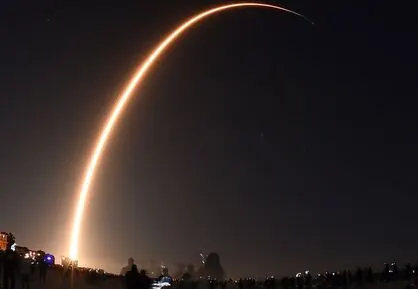 |
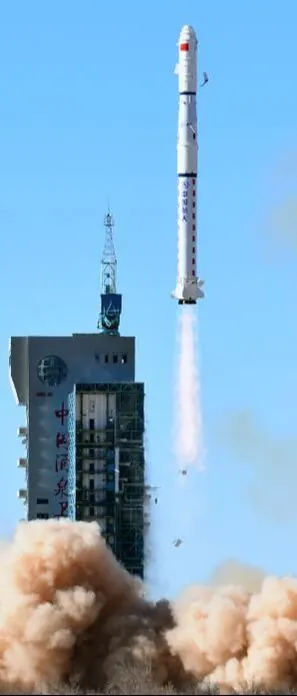 |
Rockets need to achieve enough horizontal speed to sustain orbit.
The satellite falls at the same rate the ground is curving away from it.
Centripetal Force vs. Gravity
|
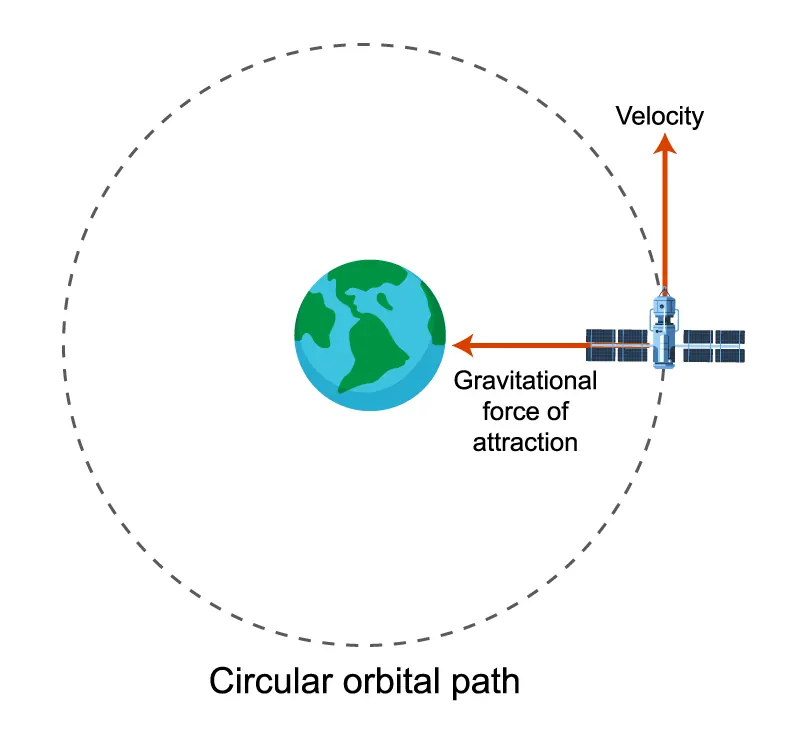
An object in a stable circular orbit is in a constant state of freefall. The only force acting upon it is gravity, which pulls it directly towards the center of the planet. So, why doesn't it just crash down? Because it has a perpendicular, or tangential, velocity.
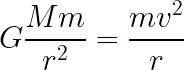
This tangential velocity creates an inertia that wants to carry the object off in a straight line, as per Newton's first law. Gravity, acting as a centripetal force, constantly pulls the object away from that straight-line path and bends its trajectory into a circle. For a stable orbit, these two effects must be in perfect equilibrium. Let's formalize this balance. For a satellite of mass m, orbiting a central body of mass M, at a distance r from the center of the planet, travelling at some tangential velocity v, where G is the Universal Gravitational Constant, we have: |
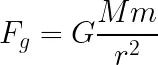
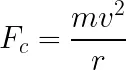 Since the gravitational attractive force is responsible for pulling the satellite toward the centre of the orbit, it acts as the centripetal force. (F_g = F_c)
 |
 |
 |
Deriving the Orbital Velocity Equation
|
We can now solve for the orbital velocity. Notice that the mass of the satellite m cancels out from both sides. This is a profound insight: the orbital velocity depends only on the mass of the central body and the orbital radius, not on the mass of the satellite. A tiny CubeSat and the massive International Space Station require the same speed to orbit at the same altitude.
|
Multiplying both sides by r:
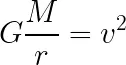 Taking the square root, we arrive at the Equation for Circular Orbital Velocity:
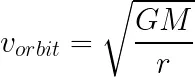 |
The more massive the planet, the more speed the satellite needs to sustain orbit.
The further the satellite, the less speed it needs to sustain orbit.