A mysterious attractive force
Look up. The Moon, a silent wanderer in the night sky, is falling. It is in a perpetual state of freefall towards Earth, caught in an endless loop by the invisible tether of gravity. This same force pulls rain from the sky and anchors you to the planet. From the orbit of a satellite to the path of a thrown ball, gravity is the unseen architect of motion in the universe. This chapter explores the fundamental force that sculpts the cosmos itself.
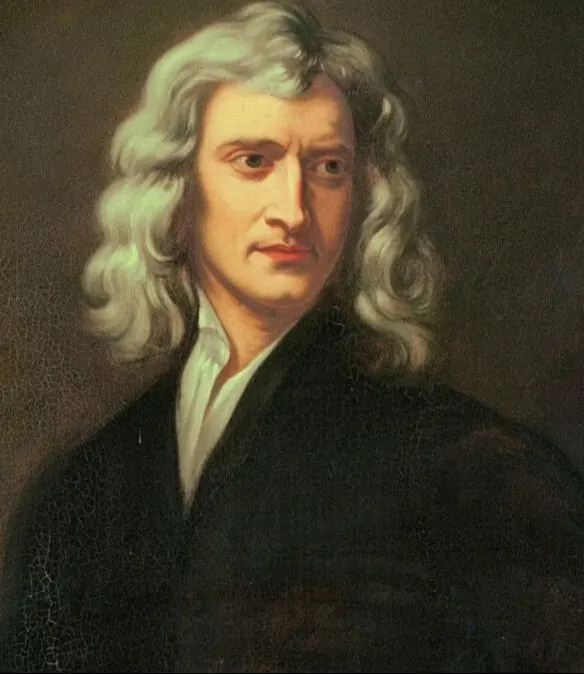
Newton's Law of Universal GravitationIn 1687, in his seminal work Philosophiæ Naturalis Principia Mathematica, Newton presented his law of universal gravitation. It can be stated as:
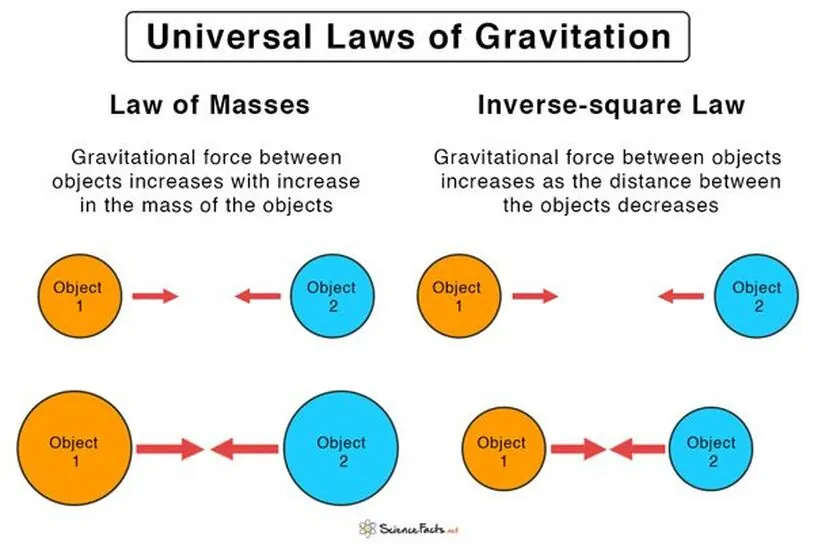
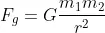
Every particle of matter in the universe attracts every other particle with a force that is directly proportional to the product of their masses and inversely proportional to the square of the distance between their centres. |
 |
The simplified version on the left is a standard one we learn in high school, while the more explicit vector form is usually used rigious scientific journals.
 |
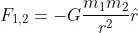 |
In the vector form, the direction is explicitly shown:
- F₁₂ is the gravitational force vector on mass m₁ due to mass m₂.
- G is the universal gravitational constant, determined experimentally. Its value is 6.67430 × 10⁻¹¹ m³ kg⁻¹ s⁻².
- m₁ and m₂ are the masses of the two particles.
- r is the distance between the centres of the two masses.
- r̂ is the unit vector pointing from mass m₁ to mass m₂.
- The negative sign indicates that the force is always attractive, acting in the opposite direction of the unit vector r̂.
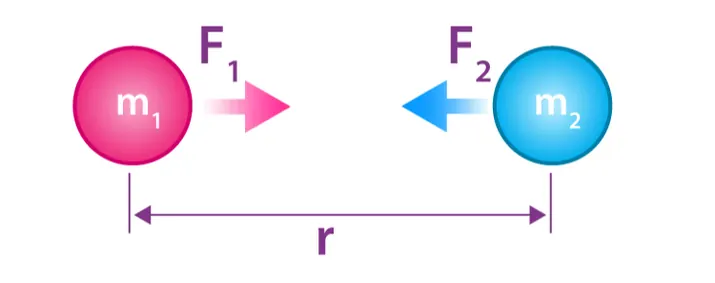
Key Properties:
- Action-Reaction Pair: The force on m₁ due to m₂ (F₁₂) is equal in magnitude and opposite in direction to the force on m₂ due to m₁ (F₂₁). Newton's Third Law is satisfied.
- Central Force: The force vector always acts along the line joining the centres of the two masses.
- Inverse-Square Law: The strength of the force diminishes with the square of the distance. Doubling the distance reduces the force to a quarter of its original value.
The greater the two masses, the greater the gravitational force
The greater the distance b/w masses, the smaller the gravitational force.