Not a Circle? Why Planets and Comets Travel in Ovals!
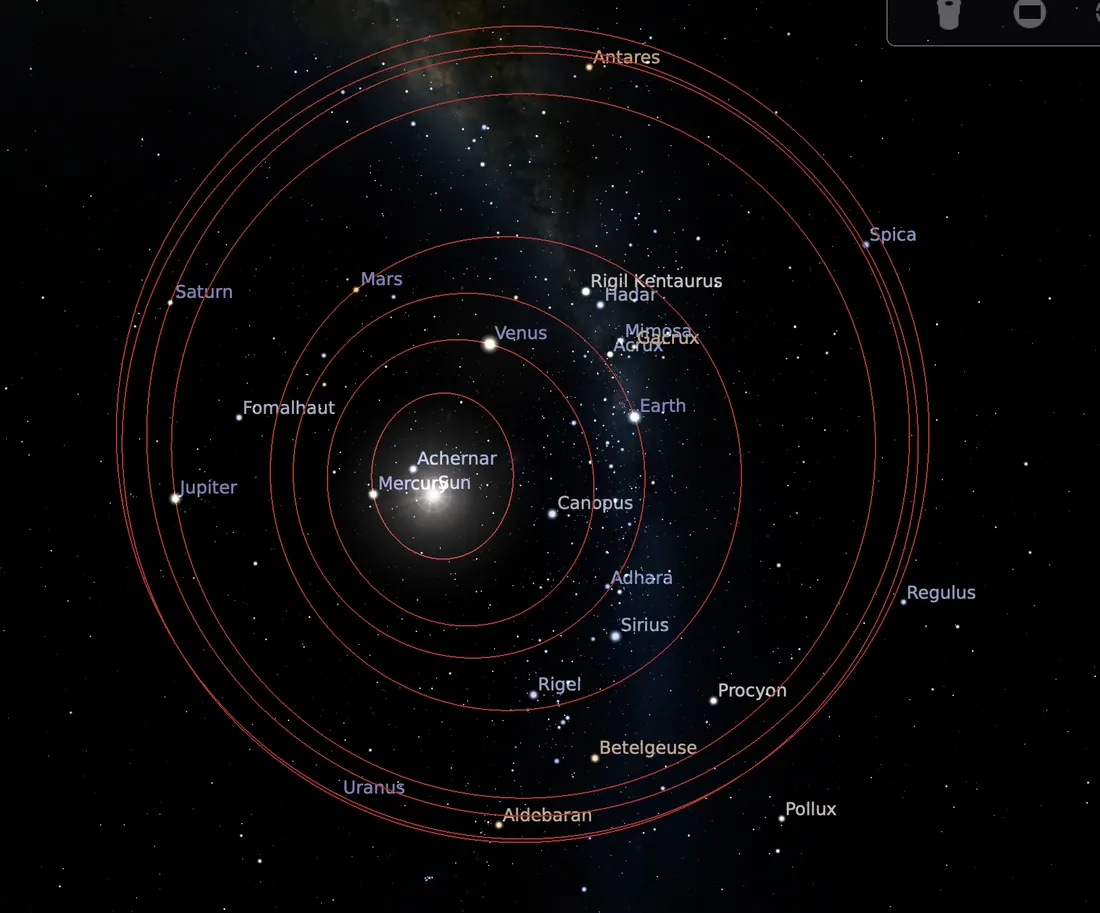
Look up at the night sky, and the planets and stars seem to move in perfect circles. For centuries, that’s what astronomers believed. But the truth, discovered by Johannes Kepler in the 17th century, is far more interesting! Celestial bodies don't travel in perfect circles; they orbit in ellipses—stretched circles or ovals. Understanding the geometry of this simple shape is the key to unlocking the laws of planetary motion. In this chapter, we'll learn the language of elliptical orbits and discover how a single number, called eccentricity, tells us just how "un-circular" an orbit really is.
The Geometry of an Ellipse
An ellipse is a closed curve that looks like a flattened circle. It has two special fixed points inside it, each called a focus (plural: foci). For any point on the ellipse, the sum of the distances to the two foci is always the same.
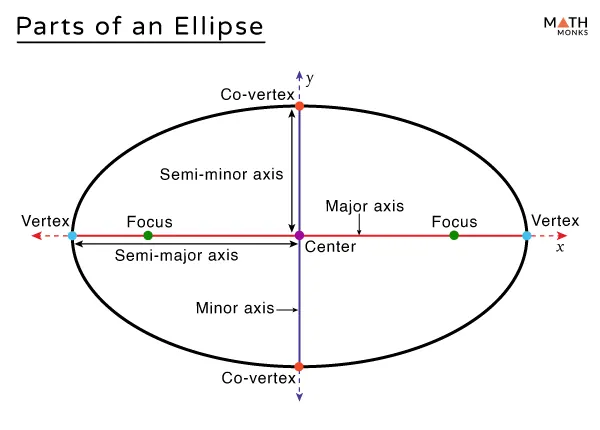
- Major Axis: The longest diameter of an ellipse. It is the line segment that passes through both foci, the center, and touches the ellipse at its two widest points.
- Semi-Major Axis (a): Half of the major axis. It runs from the center to one end of the ellipse along the major axis.
- Minor Axis: The shortest diameter of an ellipse. It is perpendicular to the major axis at the center and touches the ellipse at its two narrowest points.
- Semi-Minor Axis (b): Half of the minor axis. It runs from the center to one side of the ellipse along the minor axis.
- Foci (Singular: Focus): Two fixed points located inside the ellipse along the major axis. For any point on the ellipse, the sum of the distances to the two foci is constant.
- Center: The midpoint of both the major axis and minor axis. It is the exact center of the ellipse and is located exactly halfway between the two foci.
In our solar system:
- The Sun is always located at one focus of a planet's elliptical orbit. The other focus is empty.
- The semi-major axis is often described as the planet's "average distance" from the Sun.
Eccentricity - The "Stretch" Factor
|
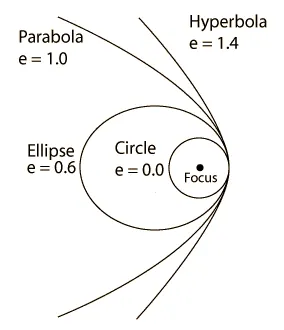
Eccentricity (e) is a number that describes how much an ellipse deviates from being a perfect circle. It is a ratio, so it has no units. Its value is always between 0 and 1 for an elliptical orbit (0 ≤ e < 1).
|
 |
Examples:
Venus: 0.007 - The most circular planetary orbit. It's nearly a perfect circle.
Earth: 0.017 - Very close to circular. Our distance from the Sun varies by only about 3%.
Mars: 0.093 - A more noticeable ellipse than Earth's.
Jupiter 0.049 - A fairly circular orbit for such a giant planet.
Pluto: 0.244 - A highly elliptical orbit. Its distance from the Sun changes dramatically.
Halley's Comet: 0.967 - An extremely elongated orbit! It spends most of its time far away, "swooping" in quickly around the Sun.
Earth: 0.017 - Very close to circular. Our distance from the Sun varies by only about 3%.
Mars: 0.093 - A more noticeable ellipse than Earth's.
Jupiter 0.049 - A fairly circular orbit for such a giant planet.
Pluto: 0.244 - A highly elliptical orbit. Its distance from the Sun changes dramatically.
Halley's Comet: 0.967 - An extremely elongated orbit! It spends most of its time far away, "swooping" in quickly around the Sun.
Summary
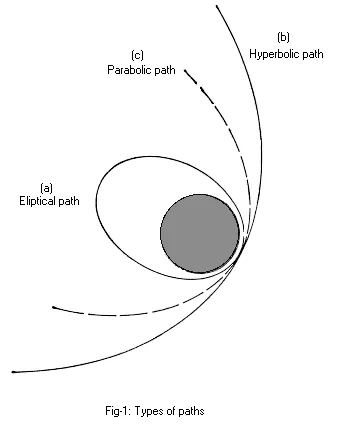
- Planets and other bodies orbit in ellipses, with the Sun at one focus.
- The semi-major axis is half of the longest diameter of the ellipse. It determines the size and period of the orbit.
- Eccentricity (e) measures how stretched an orbit is, on a scale from 0 to 1 (where 0 is a perfect circle).
- Orbits in our solar system range from near-circular (e.g., Venus, e=0.007) to highly elliptical (e.g., comets, e close to 1).