What is the Speed of Light?
|
The speed of light in a vacuum, denoted by the constant c, is 299,792,458 meters per second. For most cosmological calculations, we round this to 300,000 kilometers per second (or about 186,000 miles per second).
To grasp this incredible speed:
|
 The foundational idea is credited to Georges Lemaître, a Belgian physicist and priest, who in 1927 first proposed that the universe began from a primordial “cosmic egg” and has been expanding ever since.
|
A Fundamental Constant, Not Just a Speed
The speed of light, c, is much more than just how fast light travels. It is a fundamental pillar of modern physics:
Key Concept: The speed of light (c) is not just the speed of photons; it is a fundamental constant that defines the causal structure of the universe, setting the absolute limit for how fast any interaction can occur.
- The Universe's Speed Limit: According to Einstein's theory of Special Relativity, c is the maximum speed at which all matter, energy, and information in the universe can travel. Nothing with mass can ever reach, let alone exceed, the speed of light.
- A Constant for All Observers: Unlike speeds we experience daily, the speed of light is the same for every observer, regardless of their own motion. This counterintuitive fact leads to fascinating consequences like time dilation and length contraction.
- The Fabric of Spacetime: The speed of light is woven into the very equations that describe the universe, most famously in E = mc², which reveals the relationship between energy (E), mass (m), and the speed of light (c).
Key Concept: The speed of light (c) is not just the speed of photons; it is a fundamental constant that defines the causal structure of the universe, setting the absolute limit for how fast any interaction can occur.
The Ultimate Yardstick - The Light-Year
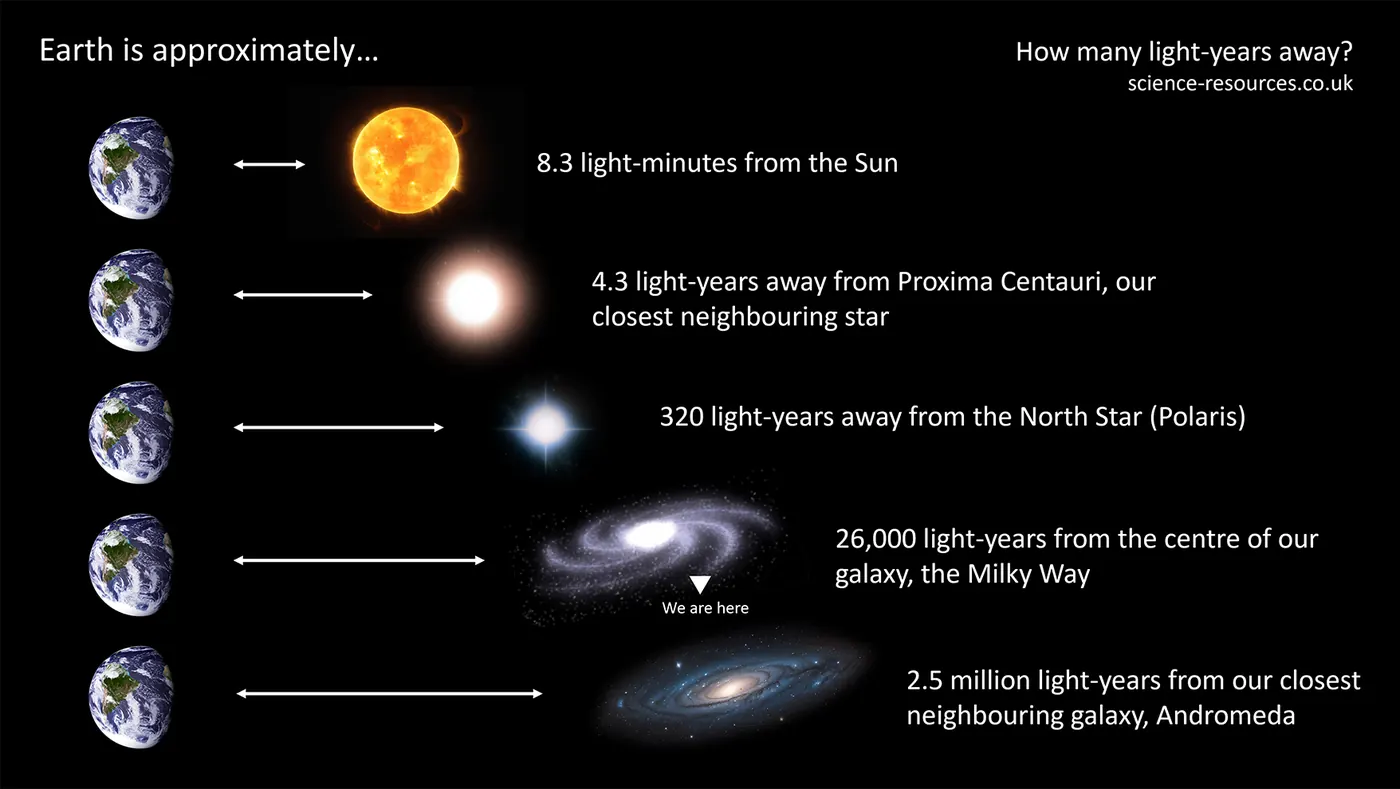
A light-year is the distance that light travels in one Earth year. A light-year is a unit of distance, not time. It combines the concept of the universe's maximum speed (c) with a unit of time (a year) to create a cosmic-scale ruler.
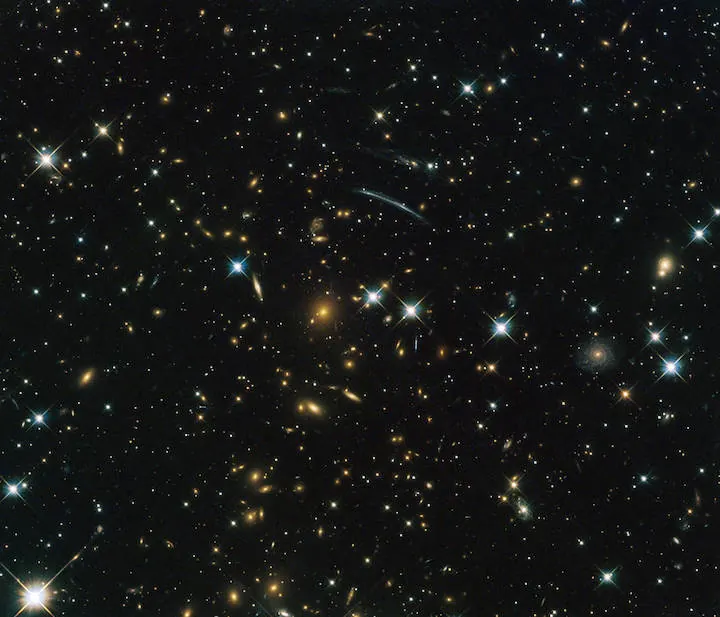
The use of light-years gives astronomers a powerful tool: look-back time. Because light takes time to travel any distance, the farther out we look into the universe, the further back in time we see.
This means a telescope is not just a tool for viewing space, but also a time machine. By observing distant objects, astronomers can directly study the history and evolution of the universe.
- The Sun: We see it as it was 8 minutes ago.
- The Andromeda Galaxy: Our nearest major galactic neighbor is about 2.5 million light-years away. When we observe it, we are seeing light that was emitted 2.5 million years ago, when early humans were first walking the Earth.
- The Hubble Deep Field: Some of the faintest galaxies captured in this famous image are over 13 billion light-years away. We are witnessing them as they appeared just a few hundred million years after the Big Bang, in their infant state.
This means a telescope is not just a tool for viewing space, but also a time machine. By observing distant objects, astronomers can directly study the history and evolution of the universe.